THE ADVENTURE COLLECTIVE® · Independent discovery and booking for outdoor travel

Watch scarlet uniforms and military bands trade duties in front of Buckingham Palace on a focused walking tour that pairs front-row ceremony views with concise historical context. Learn where to stand, what to expect, and how to plan for weather and crowds.
Watch scarlet uniforms and military bands trade duties in front of Buckingham Palace on a focused walking tour that pairs front-row ceremony views with concise historical context. Learn where to stand, what to expect, and how to plan for weather and crowds.
A crisp London morning focuses into a single ritual: brass and boots on The Mall, scarlet tunics cutting clean lines against palace stone, and a military band that fills the space between Horse Guards Parade and Buckingham Palace. Standing near the Queen Victoria Memorial, you feel the cadence of drums and the shift of disciplined formation as one detachment hands over duty to the next.
Verified experiences and guided adventures in the surrounding area.
A crisp London morning focuses into a single ritual: brass and boots on The Mall, scarlet tunics cutting clean lines against palace stone, and a military band that fills the space between Horse Guards Parade and Buckingham Palace. Standing near the Queen Victoria Memorial, you feel the cadence of drums and the shift of disciplined formation as one detachment hands over duty to the next.
The Changing of the Guard is a living chapter of Britain’s ceremonial history, rooted in the Household Division traditions of the 17th and 18th centuries and made public as the royal household centralized at Buckingham Palace in the 19th century. The route threads past St James’s Palace, Clarence House, and the carefully managed lawns of St James’s Park — a reminder that even urban green spaces here have been shaped by centuries of civic planning and royal need.
On a guided walking tour you’ll pair front-row views of the ceremony with concise historical context: why the guards wear bearskins, the role of the Household Cavalry, and how the ceremonial band fits into military pageantry. Expect two hours that include walking between vantage points, short interpretive stops, and photo opportunities.
Practical guidance: arrive at least 30–45 minutes before the scheduled exchange for best vantage points; public transport and security checks are the norm; carry a compact rain jacket and wear supportive shoes for standing and short urban walking. Keep voices low during the ceremony and respect cordoned areas — the experience depends on order as much as spectacle.
Times vary by season and special events; the full ceremony often begins mid-morning — check the official schedule for the exact day you plan to visit.
Yes — it’s largely flat urban walking with plenty of stopping points, but expect standing in crowds; bring seating for very young children or guests who need it.
Arriving early is the best strategy for a front-row position near the Queen Victoria Memorial or along The Mall; some spots along Birdcage Walk and Horse Guards Parade give different angles.
Yes, photography is permitted, but avoid using large tripods in crowded areas and respect security cordons; flash is usually unnecessary and can distract performers.
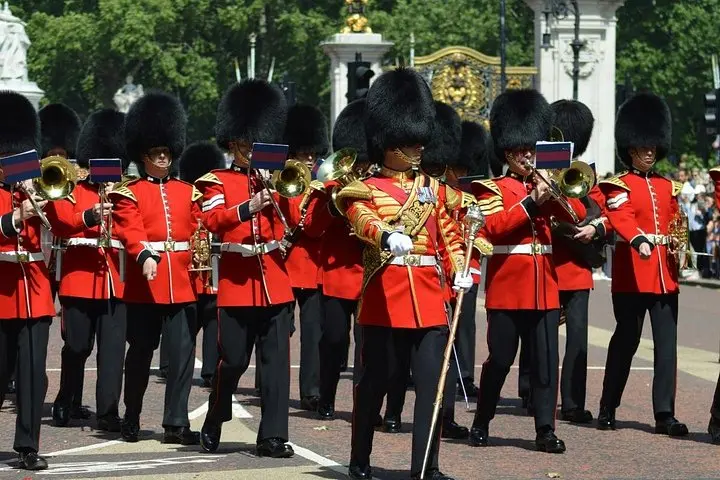
A crisp London morning focuses into a single ritual: brass and boots on The Mall, scarlet tunics cutting clean lines against palace stone, and a military band that fills the space between Horse Guards Parade and Buckingham Palace. Standing near the Queen Victoria Memorial, you feel the cadence of drums and the shift of disciplined formation as one detachment hands over duty to the next.
A crisp London morning focuses into a single ritual: brass and boots on The Mall, scarlet tunics cutting clean lines against palace stone, and a military band that fills the space between Horse Guards Parade and Buckingham Palace. Standing near the Queen Victoria Memorial, you feel the cadence of drums and the shift of disciplined formation as one detachment hands over duty to the next.
The Changing of the Guard is a living chapter of Britain’s ceremonial history, rooted in the Household Division traditions of the 17th and 18th centuries and made public as the royal household centralized at Buckingham Palace in the 19th century. The route threads past St James’s Palace, Clarence House, and the carefully managed lawns of St James’s Park — a reminder that even urban green spaces here have been shaped by centuries of civic planning and royal need.
On a guided walking tour you’ll pair front-row views of the ceremony with concise historical context: why the guards wear bearskins, the role of the Household Cavalry, and how the ceremonial band fits into military pageantry. Expect two hours that include walking between vantage points, short interpretive stops, and photo opportunities.
Practical guidance: arrive at least 30–45 minutes before the scheduled exchange for best vantage points; public transport and security checks are the norm; carry a compact rain jacket and wear supportive shoes for standing and short urban walking. Keep voices low during the ceremony and respect cordoned areas — the experience depends on order as much as spectacle.