THE ADVENTURE COLLECTIVE® · Independent discovery and booking for outdoor travel

Five days of 4WD approaches, 6 km jungle treks, cave tubing and overnight hammock camping in Gunung Buda’s limestone massif. Expect muddy trails, karst caves, local food cooked in bamboo, and stories of the Tabun people.
Five days of 4WD approaches, 6 km jungle treks, cave tubing and overnight hammock camping in Gunung Buda’s limestone massif. Expect muddy trails, karst caves, local food cooked in bamboo, and stories of the Tabun people.
A low-angled sun slices through dipterocarp canopy as your 4WD grinds toward Kuala Mendalam — jungle smells sharpen, and the limestone cliffs of Gunung Buda begin to loom like a pale wall. By evening a river will be daring you to float its clear arms in a rubber tube; by night, a guide will spin stories of Tabun migrations while bamboo steam hisses with Pansoh chicken.
Verified experiences and guided adventures in the surrounding area.
Operated by Borneo Touch Ecotour · Limbang, Sarawak
A low-angled sun slices through dipterocarp canopy as your 4WD grinds toward Kuala Mendalam — jungle smells sharpen, and the limestone cliffs of Gunung Buda begin to loom like a pale wall. By evening a river will be daring you to float its clear arms in a rubber tube; by night, a guide will spin stories of Tabun migrations while bamboo steam hisses with Pansoh chicken.
Gunung Buda sits on the Melinau Limestone, the same karst family as nearby Mulu; its caves and underground channels were sculpted by millennia of acidic water. The valley around Mendalam supports local Tabun and Malay communities and the Limbang area has a frontier history as a border town between Sarawak and Brunei — you’ll see this layered past in roadside memorials and the modest Limbang Museum.
Expect flat but muddy trekking (about 6 km on day two), multi-hour cave passages, river tubing, and a mix of hammock camping and simple homestay rooms. Wildlife is present but shy; hornbills and macaques frequent forest edges. Guides emphasize low-impact travel — stick to trails, pack out trash, and avoid bright white lights inside caves to protect bats and formations.
Practical edge: bring sturdy quick-dry boots, a reliable headlamp, a lightweight drybag for electronics, and insect protection. Plan for humid heat by day and cooler, damp nights at camp. Moderate fitness and comfort with confined cave spaces are required; if you get claustrophobic, discuss alternatives with your guide. The route rewards patience: river crossings, cavern silence, and the peculiar calm of standing beneath a limestone cliff at dusk.
Treks include a 6 km approach with some muddy sections and multi-hour cave passages; moderate fitness and comfort in confined spaces are recommended.
No formal experience is required but you should be comfortable with low ceilings, wet passages, and using a headlamp for extended periods.
Guides supply hammocks and basic caving equipment; meals are included as listed—bring personal sleeping layers if you sleep in hammocks.
Local operators can often accommodate common dietary needs if notified at booking; use the special requirements field to state allergies or restrictions.
Borneo Touch Ecotour operates guided outdoor trips and adventures with an emphasis on safety, stewardship, and memorable experiences.
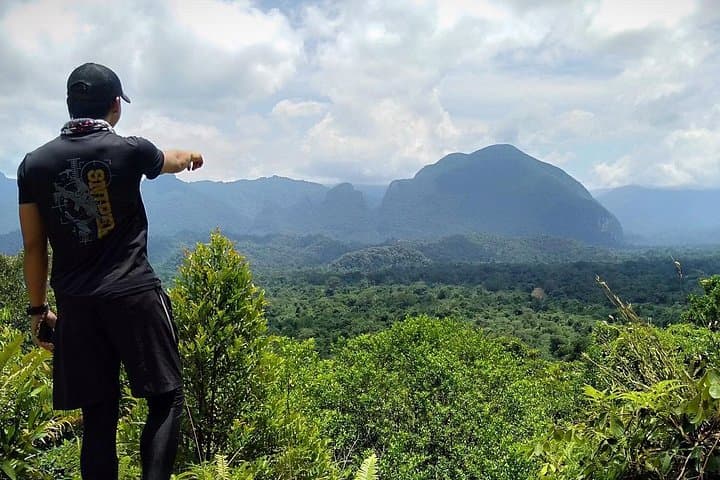


A low-angled sun slices through dipterocarp canopy as your 4WD grinds toward Kuala Mendalam — jungle smells sharpen, and the limestone cliffs of Gunung Buda begin to loom like a pale wall. By evening a river will be daring you to float its clear arms in a rubber tube; by night, a guide will spin stories of Tabun migrations while bamboo steam hisses with Pansoh chicken.
A low-angled sun slices through dipterocarp canopy as your 4WD grinds toward Kuala Mendalam — jungle smells sharpen, and the limestone cliffs of Gunung Buda begin to loom like a pale wall. By evening a river will be daring you to float its clear arms in a rubber tube; by night, a guide will spin stories of Tabun migrations while bamboo steam hisses with Pansoh chicken.
Gunung Buda sits on the Melinau Limestone, the same karst family as nearby Mulu; its caves and underground channels were sculpted by millennia of acidic water. The valley around Mendalam supports local Tabun and Malay communities and the Limbang area has a frontier history as a border town between Sarawak and Brunei — you’ll see this layered past in roadside memorials and the modest Limbang Museum.
Expect flat but muddy trekking (about 6 km on day two), multi-hour cave passages, river tubing, and a mix of hammock camping and simple homestay rooms. Wildlife is present but shy; hornbills and macaques frequent forest edges. Guides emphasize low-impact travel — stick to trails, pack out trash, and avoid bright white lights inside caves to protect bats and formations.
Practical edge: bring sturdy quick-dry boots, a reliable headlamp, a lightweight drybag for electronics, and insect protection. Plan for humid heat by day and cooler, damp nights at camp. Moderate fitness and comfort with confined cave spaces are required; if you get claustrophobic, discuss alternatives with your guide. The route rewards patience: river crossings, cavern silence, and the peculiar calm of standing beneath a limestone cliff at dusk.