THE ADVENTURE COLLECTIVE® · Independent discovery and booking for outdoor travel

A private, full-day hike from Seoul into Bukhansan National Park that reaches Baegundae peak and visits Doseonsa Temple. Expect 4–6 hours of mixed granite trails, mountain streams, and sweeping city views—plus hotel pickup and a Korean lunch box.
A private, full-day hike from Seoul into Bukhansan National Park that reaches Baegundae peak and visits Doseonsa Temple. Expect 4–6 hours of mixed granite trails, mountain streams, and sweeping city views—plus hotel pickup and a Korean lunch box.
Morning in Seoul begins with coffee and a narrow street, then a short drive north where the city loosens its grip and granite starts to show. The van hums up winding roads and, within an hour, the skyline behind you flattens as Bukhansan’s blocky peaks push up through a mist of pine. On this private day trek the city becomes a soundtrack behind you; ahead are ridgelines, a clear mountain stream that dares you to slow, and the weathered roofs of Doseonsa Temple tucked against stone.
Verified experiences and guided adventures in the surrounding area.
Operated by Outdoors Korea · Seoul, Seoul
Morning in Seoul begins with coffee and a narrow street, then a short drive north where the city loosens its grip and granite starts to show. The van hums up winding roads and, within an hour, the skyline behind you flattens as Bukhansan’s blocky peaks push up through a mist of pine. On this private day trek the city becomes a soundtrack behind you; ahead are ridgelines, a clear mountain stream that dares you to slow, and the weathered roofs of Doseonsa Temple tucked against stone.
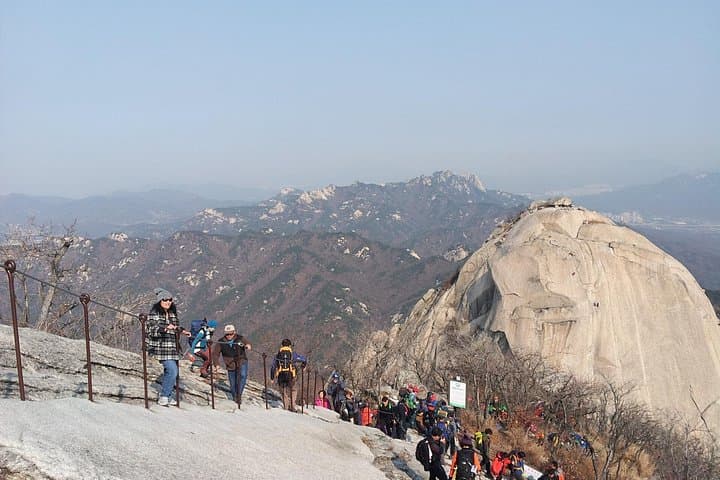
Bukhansan was made Korea’s 15th national park in 1983, an urban anomaly: a protected granite massif pressed against a megacity. Geologically, the park is a rugged outcrop of Cretaceous granite, smoothed by millennia into steep slabs, cracks and domes—Baegundae, the highest point, sits near 836 m and offers a skyline view that reads Seoul like a map. Culturally, these trails are as much local as they are scenic; weekend climbers, elderly hikers with walking sticks and families keep the mountains tied to everyday Korean life. You’ll pass sections of the old Bukhansanseong fortress wall, reminders of Joseon-era efforts to guard the capital.
The route is practical and purposeful: expect 4–6 hours on trail depending on pace. The ascent to Baegundae is steep in places—rock steps, short scrambles and exposed ridges—balanced by quiet stretches along streams and the shaded approach to Doseonsa, a centuries-old Buddhist site where incense still threads the air. Your guide is a mountain expert and driving guide, so the logistics—hotel pickup in Seoul, bottled water and a Korean lunch box—are handled; you get to focus on footing and the views.
For planning: start early to avoid crowds and midday heat, wear sturdy boots with good grip for granite slabs, and bring layers—the mountain can be 5–10°C cooler than downtown Seoul. Trekking poles help on descents; carry at least 1.5 liters of water even though bottled water is included. If weather threatens, expect wet, slippery rock and re-route options with your guide.
This private option suits hikers who want flexibility—shorten or extend the day—and a local perspective on both the natural and cultural corners of one of Asia’s most accessible national parks. Pack light, move deliberately and let the granite lead the way: the summit rewards persistence with a view that makes Seoul feel both impossibly near and quietly small.
You should have good cardiovascular fitness and be comfortable with continuous uphill hiking for several hours; beginners can do it at a slower pace but should expect a longer day.
Yes—hotel pickup and drop-off anywhere in Seoul are included; pick-up details are confirmed after booking.
A Korean lunch box is provided—typically rice, side dishes and a protein—suitable for refueling on the trail.
There are restroom facilities near trailheads and at the temple area, but expect none on exposed ridgelines—plan accordingly.
Children over 10 years old are allowed but must be accompanied by an adult; assess endurance and footing ability before booking.
The operator does not automatically cancel for weather; if conditions become unsafe guides will adjust the route or reschedule to protect guests.
Outdoors Korea operates guided outdoor trips and adventures with an emphasis on safety, stewardship, and memorable experiences.


Morning in Seoul begins with coffee and a narrow street, then a short drive north where the city loosens its grip and granite starts to show. The van hums up winding roads and, within an hour, the skyline behind you flattens as Bukhansan’s blocky peaks push up through a mist of pine. On this private day trek the city becomes a soundtrack behind you; ahead are ridgelines, a clear mountain stream that dares you to slow, and the weathered roofs of Doseonsa Temple tucked against stone.
Morning in Seoul begins with coffee and a narrow street, then a short drive north where the city loosens its grip and granite starts to show. The van hums up winding roads and, within an hour, the skyline behind you flattens as Bukhansan’s blocky peaks push up through a mist of pine. On this private day trek the city becomes a soundtrack behind you; ahead are ridgelines, a clear mountain stream that dares you to slow, and the weathered roofs of Doseonsa Temple tucked against stone.
Bukhansan was made Korea’s 15th national park in 1983, an urban anomaly: a protected granite massif pressed against a megacity. Geologically, the park is a rugged outcrop of Cretaceous granite, smoothed by millennia into steep slabs, cracks and domes—Baegundae, the highest point, sits near 836 m and offers a skyline view that reads Seoul like a map. Culturally, these trails are as much local as they are scenic; weekend climbers, elderly hikers with walking sticks and families keep the mountains tied to everyday Korean life. You’ll pass sections of the old Bukhansanseong fortress wall, reminders of Joseon-era efforts to guard the capital.
The route is practical and purposeful: expect 4–6 hours on trail depending on pace. The ascent to Baegundae is steep in places—rock steps, short scrambles and exposed ridges—balanced by quiet stretches along streams and the shaded approach to Doseonsa, a centuries-old Buddhist site where incense still threads the air. Your guide is a mountain expert and driving guide, so the logistics—hotel pickup in Seoul, bottled water and a Korean lunch box—are handled; you get to focus on footing and the views.
For planning: start early to avoid crowds and midday heat, wear sturdy boots with good grip for granite slabs, and bring layers—the mountain can be 5–10°C cooler than downtown Seoul. Trekking poles help on descents; carry at least 1.5 liters of water even though bottled water is included. If weather threatens, expect wet, slippery rock and re-route options with your guide.
This private option suits hikers who want flexibility—shorten or extend the day—and a local perspective on both the natural and cultural corners of one of Asia’s most accessible national parks. Pack light, move deliberately and let the granite lead the way: the summit rewards persistence with a view that makes Seoul feel both impossibly near and quietly small.