THE ADVENTURE COLLECTIVE® · Independent discovery and booking for outdoor travel

Spend a full day from Seville exploring Cádiz’s ancient peninsula and Jerez’s sherry bodegas. Expect sandy beaches, narrow medieval lanes, and an optional wine tasting that brings Andalusian history into focus.
Spend a full day from Seville exploring Cádiz’s ancient peninsula and Jerez’s sherry bodegas. Expect sandy beaches, narrow medieval lanes, and an optional wine tasting that brings Andalusian history into focus.
A morning coach leaves Seville before the heat takes hold; olive groves smear past the windows and the Atlantic light broadens as you approach the Bay of Cádiz. By mid-morning you stand on golden sand that seems to dare you to slow down—waves pushing close to the old city walls while gulls quarter the horizon.
Verified experiences and guided adventures in the surrounding area.
Operated by Naturanda Turismo Ambiental · Cádiz, Andalusia
A morning coach leaves Seville before the heat takes hold; olive groves smear past the windows and the Atlantic light broadens as you approach the Bay of Cádiz. By mid-morning you stand on golden sand that seems to dare you to slow down—waves pushing close to the old city walls while gulls quarter the horizon.
Cádiz is older than most European capitals, founded by Phoenicians around 1100 BCE. Its peninsula geology—sand and limestone—has shaped a compact old town of narrow lanes, watchtowers and plazas. Across the bay, Jerez de la Frontera carries an Arabic imprint in its street plan and the slow pulse of bodegas where solera-aged sherry gathers color by gravity and time.
Culture here is tactile: wind-tossed beaches, the clipped clatter of horse hooves at a Jerez equestrian yard, and the sharp, toasted scent of oak casks. Local guides thread short walking tours through Cádiz’s cathedral quarter and a family-run winery in Jerez, offering context to monuments and the practicalities of Andalusian life.
Plan for a long day—expect 9–10 hours with periods of on-foot exploration and optional tastings. Bring sun protection and comfortable shoes for cobbles; cathedral entry and some historic sites are usually paid separately. The route is wheelchair-accessible in parts, though narrow streets and steps in older buildings mean some sites are best viewed from outside if mobility is limited.
Timing matters: mornings favor beach light and fewer crowds; late afternoon offers warmer tones on the cathedral dome. This is a day for sensory contrasts—salt and oak, ancient stone and modern plazas—delivered in a steady, accessible itinerary.
The excursion runs approximately 9–10 hours, including coach travel and time at both Cádiz and Jerez.
General parkings and coach travel are included, but cathedral entries and some private museum or equestrian experiences are usually not included.
Pickup and drop-off are offered at three set points in Seville; confirm your pickup location during booking.
The tour and transportation are wheelchair accessible in parts, but historic sites may have steps; contact the operator for site-by-site accessibility details.
Naturanda Turismo Ambiental operates guided outdoor trips and adventures with an emphasis on safety, stewardship, and memorable experiences.
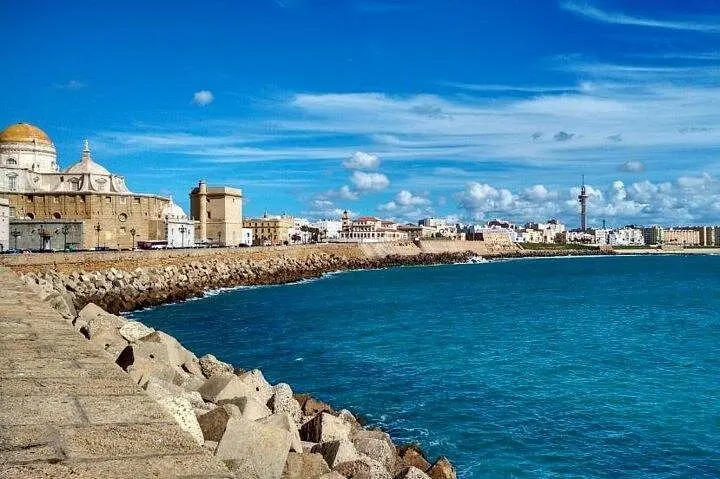



A morning coach leaves Seville before the heat takes hold; olive groves smear past the windows and the Atlantic light broadens as you approach the Bay of Cádiz. By mid-morning you stand on golden sand that seems to dare you to slow down—waves pushing close to the old city walls while gulls quarter the horizon.
A morning coach leaves Seville before the heat takes hold; olive groves smear past the windows and the Atlantic light broadens as you approach the Bay of Cádiz. By mid-morning you stand on golden sand that seems to dare you to slow down—waves pushing close to the old city walls while gulls quarter the horizon.
Cádiz is older than most European capitals, founded by Phoenicians around 1100 BCE. Its peninsula geology—sand and limestone—has shaped a compact old town of narrow lanes, watchtowers and plazas. Across the bay, Jerez de la Frontera carries an Arabic imprint in its street plan and the slow pulse of bodegas where solera-aged sherry gathers color by gravity and time.
Culture here is tactile: wind-tossed beaches, the clipped clatter of horse hooves at a Jerez equestrian yard, and the sharp, toasted scent of oak casks. Local guides thread short walking tours through Cádiz’s cathedral quarter and a family-run winery in Jerez, offering context to monuments and the practicalities of Andalusian life.
Plan for a long day—expect 9–10 hours with periods of on-foot exploration and optional tastings. Bring sun protection and comfortable shoes for cobbles; cathedral entry and some historic sites are usually paid separately. The route is wheelchair-accessible in parts, though narrow streets and steps in older buildings mean some sites are best viewed from outside if mobility is limited.
Timing matters: mornings favor beach light and fewer crowds; late afternoon offers warmer tones on the cathedral dome. This is a day for sensory contrasts—salt and oak, ancient stone and modern plazas—delivered in a steady, accessible itinerary.