THE ADVENTURE COLLECTIVE® · Independent discovery and booking for outdoor travel

Once one of the world’s most notorious cliff paths, Caminito del Rey is now a secure, 7.7 km traverse through the Gaitanes Gorge. This day trip from the Costa del Sol mixes dramatic viewpoints, hydroelectric history and practical logistics for a full-day adventure.
Once one of the world’s most notorious cliff paths, Caminito del Rey is now a secure, 7.7 km traverse through the Gaitanes Gorge. This day trip from the Costa del Sol mixes dramatic viewpoints, hydroelectric history and practical logistics for a full-day adventure.
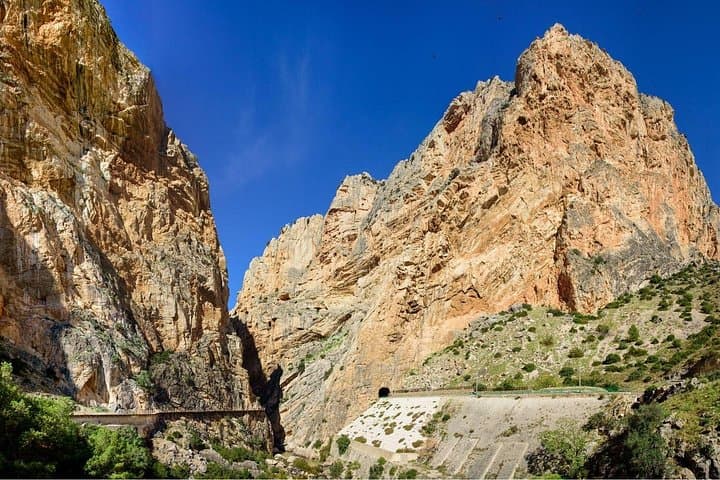
You step off the coach at the small cluster of buildings by El Chorro and the cliffside seems to inhale sharply — the gorge narrows, rock faces fold like pages, and the old walkway clings where feet once feared to go. For decades Caminito del Rey carried a reputation for danger; today the path is reconceived, steel and concrete bolstering carved limestone so visitors can walk where workers and mules once threaded a precarious route.
Verified experiences and guided adventures in the surrounding area.
Operated by Visitanddo.com · El Chorro (Ardales), Andalusia
You step off the coach at the small cluster of buildings by El Chorro and the cliffside seems to inhale sharply — the gorge narrows, rock faces fold like pages, and the old walkway clings where feet once feared to go. For decades Caminito del Rey carried a reputation for danger; today the path is reconceived, steel and concrete bolstering carved limestone so visitors can walk where workers and mules once threaded a precarious route.
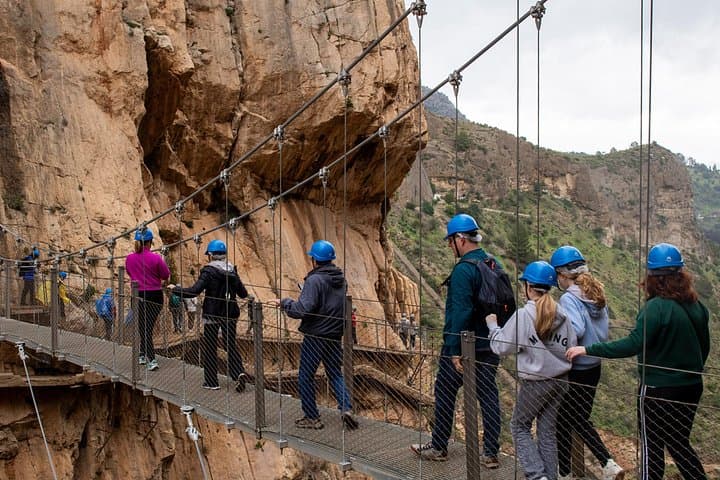
The route itself is 7.7 km end-to-end, a linear traverse through the Gaitanes Gorge that takes you over suspension bridges, through a long tunnel, and out onto a glass viewing platform suspended above the drop. Geologically, the canyon records Mediterranean history: tabular limestone, deep tectonic joints and water-sculpted tafoni show how rivers and time sliced through the Serranía de Ronda.
Culturally the walk sits between white Andalusian villages and century-old hydroelectric infrastructure. The path was originally built between 1901 and 1905 to move materials between dams and a power station; the “king” in the name refers to Alfonso XIII, who crossed here in 1921. Modern restoration preserved the route’s industrial bones while making it safe for the thousands who come each year.
Local life in Ardales and El Chorro still orients around olive groves, reservoirs and trains. Stop at the Kiosko by the entrance for coffee and a view of the Chorro reservoir, and notice shepherding dogs and kestrels scanning the rock faces — the landscape remains working, not merely theatrical.
Practical guidance: the full day trip from the Costa del Sol runs about 7–9 hours including pick-up and return; the walkway segment is timed at roughly 2–3 hours (the operator lists 240 minutes on-site to allow for stops). There are fixed pick-up points across Benalmádena, Torremolinos, Fuengirola and Marbella — confirm your exact meeting time by phone the evening before. The trail is linear; transportation shuttles you between trailheads, so you won't retrace your steps.
Safety notes: no umbrellas or walking sticks are permitted, and children under 7 are not allowed. Wear sturdy shoes with grip, bring 1–2 liters of water, sun protection and a light wind layer — the gorge can be cool in shade and windy on exposed platforms. If you have spine, heart or pregnancy concerns, opt out: the operator explicitly restricts certain medical conditions.
Timing matters: morning light opens the canyon, while late afternoon softens the limestone and brings vultures into the thermals. Keep your camera ready; the best viewpoints are the King’s Bridge, the glass balcony at Gran Gaitán and the stretch over the suspension bridge in Gaitanes Gorge.
The Caminito del Rey feels engineered for awe — a narrow path, a long view and a river that keeps daring you to look down. Walk it respectfully and it will repay you with geology, history and a compact, thrilling slice of Andalusia.
The official walkway is 7.7 km end-to-end; the on-site visit is typically 2–3 hours, while the full day trip from Costa del Sol takes 7–9 hours including transport.
Children under 7 are not permitted; the operator enforces a minimum age for safety reasons.
No — the path includes long stretches, stairs and exposed walkways; it’s not wheelchair accessible and is not recommended for those with serious mobility limitations.
Walking sticks and umbrellas are prohibited on the walkway; tripods may also be restricted — check with the guide before bringing bulky camera gear.
This day trip includes the Caminito del Rey admission ticket; independent visitors should reserve timed tickets in advance, as slots sell out.
Tours may be canceled for safety in high winds or heavy rain; the operator allows refunds if canceled at least 24 hours before departure.
Visitanddo.com operates guided outdoor trips and adventures with an emphasis on safety, stewardship, and memorable experiences.

You step off the coach at the small cluster of buildings by El Chorro and the cliffside seems to inhale sharply — the gorge narrows, rock faces fold like pages, and the old walkway clings where feet once feared to go. For decades Caminito del Rey carried a reputation for danger; today the path is reconceived, steel and concrete bolstering carved limestone so visitors can walk where workers and mules once threaded a precarious route.
You step off the coach at the small cluster of buildings by El Chorro and the cliffside seems to inhale sharply — the gorge narrows, rock faces fold like pages, and the old walkway clings where feet once feared to go. For decades Caminito del Rey carried a reputation for danger; today the path is reconceived, steel and concrete bolstering carved limestone so visitors can walk where workers and mules once threaded a precarious route.
The route itself is 7.7 km end-to-end, a linear traverse through the Gaitanes Gorge that takes you over suspension bridges, through a long tunnel, and out onto a glass viewing platform suspended above the drop. Geologically, the canyon records Mediterranean history: tabular limestone, deep tectonic joints and water-sculpted tafoni show how rivers and time sliced through the Serranía de Ronda.
Culturally the walk sits between white Andalusian villages and century-old hydroelectric infrastructure. The path was originally built between 1901 and 1905 to move materials between dams and a power station; the “king” in the name refers to Alfonso XIII, who crossed here in 1921. Modern restoration preserved the route’s industrial bones while making it safe for the thousands who come each year.
Local life in Ardales and El Chorro still orients around olive groves, reservoirs and trains. Stop at the Kiosko by the entrance for coffee and a view of the Chorro reservoir, and notice shepherding dogs and kestrels scanning the rock faces — the landscape remains working, not merely theatrical.
Practical guidance: the full day trip from the Costa del Sol runs about 7–9 hours including pick-up and return; the walkway segment is timed at roughly 2–3 hours (the operator lists 240 minutes on-site to allow for stops). There are fixed pick-up points across Benalmádena, Torremolinos, Fuengirola and Marbella — confirm your exact meeting time by phone the evening before. The trail is linear; transportation shuttles you between trailheads, so you won't retrace your steps.
Safety notes: no umbrellas or walking sticks are permitted, and children under 7 are not allowed. Wear sturdy shoes with grip, bring 1–2 liters of water, sun protection and a light wind layer — the gorge can be cool in shade and windy on exposed platforms. If you have spine, heart or pregnancy concerns, opt out: the operator explicitly restricts certain medical conditions.
Timing matters: morning light opens the canyon, while late afternoon softens the limestone and brings vultures into the thermals. Keep your camera ready; the best viewpoints are the King’s Bridge, the glass balcony at Gran Gaitán and the stretch over the suspension bridge in Gaitanes Gorge.
The Caminito del Rey feels engineered for awe — a narrow path, a long view and a river that keeps daring you to look down. Walk it respectfully and it will repay you with geology, history and a compact, thrilling slice of Andalusia.