THE ADVENTURE COLLECTIVE® · Independent discovery and booking for outdoor travel

Trace a 3 km walkway clinging 100 meters above a roaring gorge—Caminito del Rey is an engineered marvel and a sensory cliff-side walk. This private-transport day trip from Málaga makes access effortless while letting you take the route at your own pace.
Trace a 3 km walkway clinging 100 meters above a roaring gorge—Caminito del Rey is an engineered marvel and a sensory cliff-side walk. This private-transport day trip from Málaga makes access effortless while letting you take the route at your own pace.
You step onto a narrow strip of concrete and wood and the gorge takes over: a river far below threads jade and slate, wind threads through limestone walls, and the path—barely a meter wide—presses you against a cliff. The Caminito del Rey doesn’t whisper; it makes a statement. Built for dam workers in the early 20th century and famously crossed by King Alfonso XIII, this engineered promenade now threads three kilometers of sheer rock, suspended up to 100 meters above the river in places.
Verified experiences and guided adventures in the surrounding area.
Operated by Yannat.com · El Chorro, Andalusia
You step onto a narrow strip of concrete and wood and the gorge takes over: a river far below threads jade and slate, wind threads through limestone walls, and the path—barely a meter wide—presses you against a cliff. The Caminito del Rey doesn’t whisper; it makes a statement. Built for dam workers in the early 20th century and famously crossed by King Alfonso XIII, this engineered promenade now threads three kilometers of sheer rock, suspended up to 100 meters above the river in places.
Geology here is blunt and dramatic: the Desfiladero de los Gaitanes carved over millions of years into banded limestone and dolomite. Glacial-runoff and the furious pulse of mountain streams gouged these walls into vertical ribs and narrow chutes, which workers later spanned with walkways and bridges. The result is both industrial archaeology and raw natural theatre—iron anchors and bolts meet feathered ledges where griffon vultures wheel.
Culturally, the trail sits between white Andalusian villages and the reservoir lakes that powered Málaga’s early hydroelectric ambitions. Local guides will point out small farm terraces and olive groves clinging to plateaus above the gorge—human persistence as much a part of the landscape as the rock.
Practicalities matter. The official walkway is one-way and roughly 3 km long; most people complete it in 2½–3 hours at a relaxed pace. The surface is generally flat and well-maintained—boardwalk, concrete, and metal bridges—but the exposure is constant: guard rails are reliable, but if you’re uncomfortable with heights the sensation is real. The tour from Málaga adds private round-trip transport and scheduled pickup, turning a one-hour drive into a full-day adventure (expect roughly 7 hours door-to-door including breaks).
Timing changes the experience. Morning light softens the cliffs and keeps summer heat at bay; late afternoon drapes the gorge in warmth and fewer crowds. Bring at least 1–1.5 liters of water, sun protection, and shoes with good grip—slick rock from morning mist can still surprise. Photo opportunities are constant; wide-angle lenses capture the scale, but also look for framed shots through the gaps in the railing.
Logistics tips: tickets sell out and are timed-entry—book in advance. The route is not technical, but the operator enforces safety rules and helmets are provided in places where required. After the walk, most drivers wait at the exit point; take the free time to refuel with a village lunch or a bench overlooking the reservoir.
Caminito del Rey is not a mountain summit or a scramble; it is a sustained conversation with cliff and river—a place where human industry and geology meet on a narrow, unforgettable stage.
The official walkway is about 3 km one-way; most visitors spend 2½–3 hours on the route at a relaxed pace.
The path is secure with railings, but exposure is constant—if you’re highly sensitive to heights, consider whether narrow boardwalks and high bridges will be comfortable.
Yes—this private-transport option includes Caminito del Rey entrance tickets as described in the inclusions.
Children are allowed but should be supervised closely; only service animals are permitted on most organized visits—check operator rules before bringing pets.
Closed-toe shoes with good grip are recommended; flip-flops and smooth-soled shoes are not advisable.
Swimming is limited and often regulated around the reservoir; local operators or the visitor center can point to permitted water activities or nearby spots for a post-walk dip.
Yannat.com operates guided outdoor trips and adventures with an emphasis on safety, stewardship, and memorable experiences.
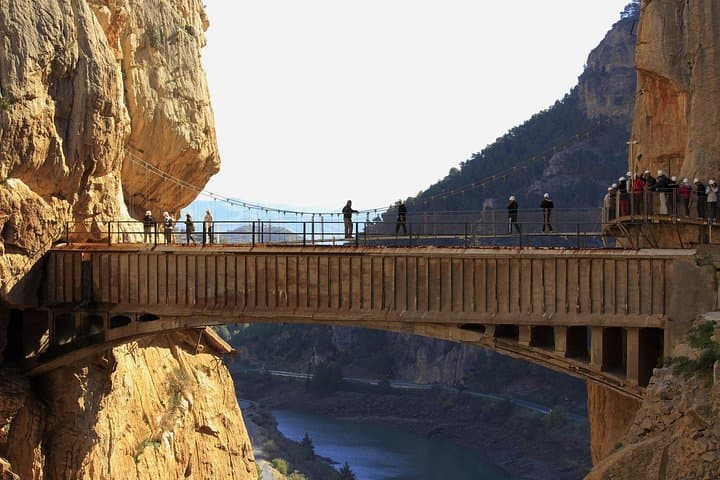

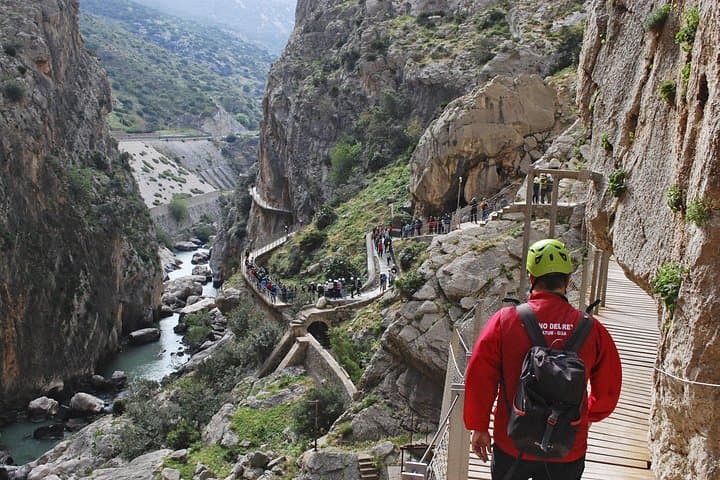
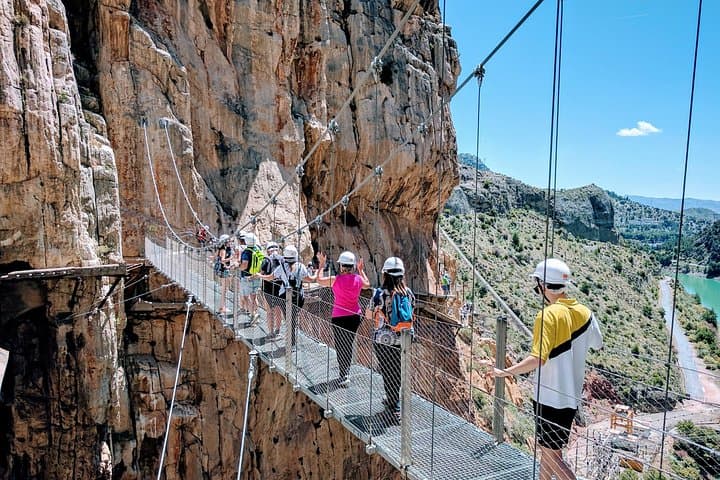
You step onto a narrow strip of concrete and wood and the gorge takes over: a river far below threads jade and slate, wind threads through limestone walls, and the path—barely a meter wide—presses you against a cliff. The Caminito del Rey doesn’t whisper; it makes a statement. Built for dam workers in the early 20th century and famously crossed by King Alfonso XIII, this engineered promenade now threads three kilometers of sheer rock, suspended up to 100 meters above the river in places.
You step onto a narrow strip of concrete and wood and the gorge takes over: a river far below threads jade and slate, wind threads through limestone walls, and the path—barely a meter wide—presses you against a cliff. The Caminito del Rey doesn’t whisper; it makes a statement. Built for dam workers in the early 20th century and famously crossed by King Alfonso XIII, this engineered promenade now threads three kilometers of sheer rock, suspended up to 100 meters above the river in places.
Geology here is blunt and dramatic: the Desfiladero de los Gaitanes carved over millions of years into banded limestone and dolomite. Glacial-runoff and the furious pulse of mountain streams gouged these walls into vertical ribs and narrow chutes, which workers later spanned with walkways and bridges. The result is both industrial archaeology and raw natural theatre—iron anchors and bolts meet feathered ledges where griffon vultures wheel.
Culturally, the trail sits between white Andalusian villages and the reservoir lakes that powered Málaga’s early hydroelectric ambitions. Local guides will point out small farm terraces and olive groves clinging to plateaus above the gorge—human persistence as much a part of the landscape as the rock.
Practicalities matter. The official walkway is one-way and roughly 3 km long; most people complete it in 2½–3 hours at a relaxed pace. The surface is generally flat and well-maintained—boardwalk, concrete, and metal bridges—but the exposure is constant: guard rails are reliable, but if you’re uncomfortable with heights the sensation is real. The tour from Málaga adds private round-trip transport and scheduled pickup, turning a one-hour drive into a full-day adventure (expect roughly 7 hours door-to-door including breaks).
Timing changes the experience. Morning light softens the cliffs and keeps summer heat at bay; late afternoon drapes the gorge in warmth and fewer crowds. Bring at least 1–1.5 liters of water, sun protection, and shoes with good grip—slick rock from morning mist can still surprise. Photo opportunities are constant; wide-angle lenses capture the scale, but also look for framed shots through the gaps in the railing.
Logistics tips: tickets sell out and are timed-entry—book in advance. The route is not technical, but the operator enforces safety rules and helmets are provided in places where required. After the walk, most drivers wait at the exit point; take the free time to refuel with a village lunch or a bench overlooking the reservoir.
Caminito del Rey is not a mountain summit or a scramble; it is a sustained conversation with cliff and river—a place where human industry and geology meet on a narrow, unforgettable stage.