THE ADVENTURE COLLECTIVE® · Independent discovery and booking for outdoor travel

Two days through Northern Vietnam’s highlands that focus on Can Cau’s Saturday market and Bac Ha’s Sunday market, with an overnight that lets you explore villages, Hoang A Tuong Palace and mountain viewpoints. Perfect for travelers seeking cultural immersion and accessible walking through ethnic communities.
Two days through Northern Vietnam’s highlands that focus on Can Cau’s Saturday market and Bac Ha’s Sunday market, with an overnight that lets you explore villages, Hoang A Tuong Palace and mountain viewpoints. Perfect for travelers seeking cultural immersion and accessible walking through ethnic communities.
At first light Can Cau opens like a living map: traders arrange woven cloth and handicrafts on tarps, buffaloes stand patient at the edge of the square, and mountain paths still wear last night’s fog. Voices in H’Mong, Dao and Tay rise and fall with the market’s rhythm while the road from Sapa carves switchbacks down into terraced valleys.
Verified experiences and guided adventures in the surrounding area.
Operated by Saparis Horizon Travel · Bac Ha, Lao Cai
At first light Can Cau opens like a living map: traders arrange woven cloth and handicrafts on tarps, buffaloes stand patient at the edge of the square, and mountain paths still wear last night’s fog. Voices in H’Mong, Dao and Tay rise and fall with the market’s rhythm while the road from Sapa carves switchbacks down into terraced valleys.
This two-day circuit threads local history and landscape. The markets are centuries-old meeting points where barter and social ties matter as much as price tags; Hoang A Tuong Palace in Bac Ha hints at the region’s recent dynastic past under the H’Mong leader. Geologically, the route moves through steep sandstone and shale ridges shaped by rivers, giving the valleys dramatic drops and viewpoints where rice terraces notch the hillsides.
Culturally the trip puts you close to daily life: village homes, corn-wine stalls, and traditional costume sellers. Expect open-air trading of livestock, textiles and fresh mountain produce; photography rewards restraint and a friendly ask.
Practically, the tour departs Sapa early and covers roughly 60–80 km of mountain roads—plan for 2–3 hours of driving between stops. Elevations vary from about 900–1,500 m; trails in villages are rocky and often muddy after rain. Bring cash (VND), sturdy shoes for uneven ground, and a light rain shell. Can Cau runs Saturdays; Bac Ha is busiest on Sunday.
An overnight in Bac Ha provides a relaxed pace to absorb markets at dawn and visit Hoang A Tuong Palace before the return drive to Sapa. Travel with respect, keep plastic out of the valleys, and expect an intimate, sensory portrait of northern Vietnam.
Can Cau Market takes place on Saturdays; Bac Ha Market is busiest on Sundays—timing your trip to include both is essential.
No advanced fitness is required; the tour involves short, easy walks in markets and villages but uneven ground and some stairs are common.
Guides typically speak English; some minority sellers may not, so guides can help negotiate and translate.
Yes—the tour includes one night in Bac Ha at a hotel or homestay as stated in the itinerary.
Saparis Horizon Travel operates guided outdoor trips and adventures with an emphasis on safety, stewardship, and memorable experiences.
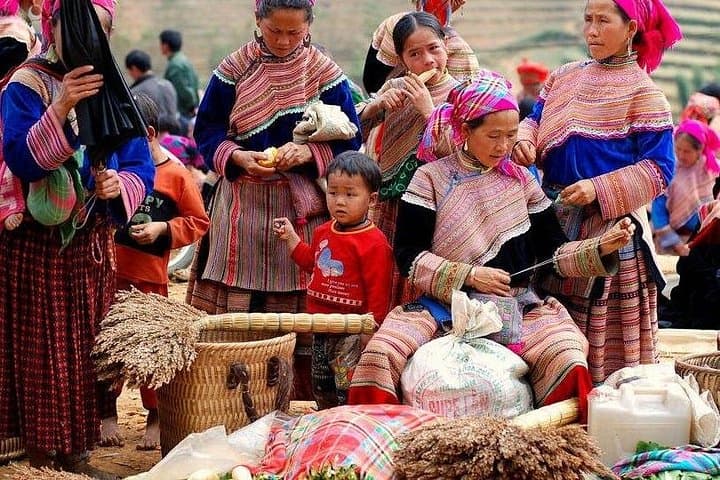


At first light Can Cau opens like a living map: traders arrange woven cloth and handicrafts on tarps, buffaloes stand patient at the edge of the square, and mountain paths still wear last night’s fog. Voices in H’Mong, Dao and Tay rise and fall with the market’s rhythm while the road from Sapa carves switchbacks down into terraced valleys.
At first light Can Cau opens like a living map: traders arrange woven cloth and handicrafts on tarps, buffaloes stand patient at the edge of the square, and mountain paths still wear last night’s fog. Voices in H’Mong, Dao and Tay rise and fall with the market’s rhythm while the road from Sapa carves switchbacks down into terraced valleys.
This two-day circuit threads local history and landscape. The markets are centuries-old meeting points where barter and social ties matter as much as price tags; Hoang A Tuong Palace in Bac Ha hints at the region’s recent dynastic past under the H’Mong leader. Geologically, the route moves through steep sandstone and shale ridges shaped by rivers, giving the valleys dramatic drops and viewpoints where rice terraces notch the hillsides.
Culturally the trip puts you close to daily life: village homes, corn-wine stalls, and traditional costume sellers. Expect open-air trading of livestock, textiles and fresh mountain produce; photography rewards restraint and a friendly ask.
Practically, the tour departs Sapa early and covers roughly 60–80 km of mountain roads—plan for 2–3 hours of driving between stops. Elevations vary from about 900–1,500 m; trails in villages are rocky and often muddy after rain. Bring cash (VND), sturdy shoes for uneven ground, and a light rain shell. Can Cau runs Saturdays; Bac Ha is busiest on Sunday.
An overnight in Bac Ha provides a relaxed pace to absorb markets at dawn and visit Hoang A Tuong Palace before the return drive to Sapa. Travel with respect, keep plastic out of the valleys, and expect an intimate, sensory portrait of northern Vietnam.