THE ADVENTURE COLLECTIVE® · Independent discovery and booking for outdoor travel

A private, full‑day loop from Cape Town that stitches Bo‑Kaap’s colorful streets to seal colonies, African penguins, and the dramatic tip of Africa. Expect coastal drives, a 40‑minute seal cruise, boardwalk penguin viewing and short hikes to Cape Point.
A private, full‑day loop from Cape Town that stitches Bo‑Kaap’s colorful streets to seal colonies, African penguins, and the dramatic tip of Africa. Expect coastal drives, a 40‑minute seal cruise, boardwalk penguin viewing and short hikes to Cape Point.
The day begins before the Atlantic wind has had its fill. Your guide meets you in Cape Town’s CBD and, as the city slips away, the road climbs toward the Twelve Apostles — a ribbon of ocean and sandstone that makes the car feel like a theater seat. First stop is Bo‑Kaap: a cluster of painted gables and narrow streets where Cape Malay culture announces itself with spice shops and the scent of simmering curries. It’s a quick cultural primer before the coastline takes over.
Verified experiences and guided adventures in the surrounding area.
Operated by Wish2C Tours & Shuttles · Cape Town, Western Cape
The day begins before the Atlantic wind has had its fill. Your guide meets you in Cape Town’s CBD and, as the city slips away, the road climbs toward the Twelve Apostles — a ribbon of ocean and sandstone that makes the car feel like a theater seat. First stop is Bo‑Kaap: a cluster of painted gables and narrow streets where Cape Malay culture announces itself with spice shops and the scent of simmering curries. It’s a quick cultural primer before the coastline takes over.
From Camps Bay the route follows the glinting rim of Chapman’s Peak Drive. The cliffs here are living geology — folded Cape Supergroup sandstone etched by wind and sea — and the viewpoint pauses long enough for a sharp photo and a deeper breath. In Hout Bay, a short 40‑minute boat cruise takes you toward Duiker Island, where Cape fur seals cluster by the thousands; the colony’s bark and tumble put marine life on full display and give a clear sense of the ecosystem that drives local fisheries and tourism.
The trip moves from seals to penguins at Boulders Beach in Simon’s Town. The walkable boardwalks (roughly 1 km of viewing paths) thread between sheltered bays so you can watch endangered African penguins go about their comical, efficient business without disturbing them. Respect the rails — the penguins are protected and their recovery is fragile.
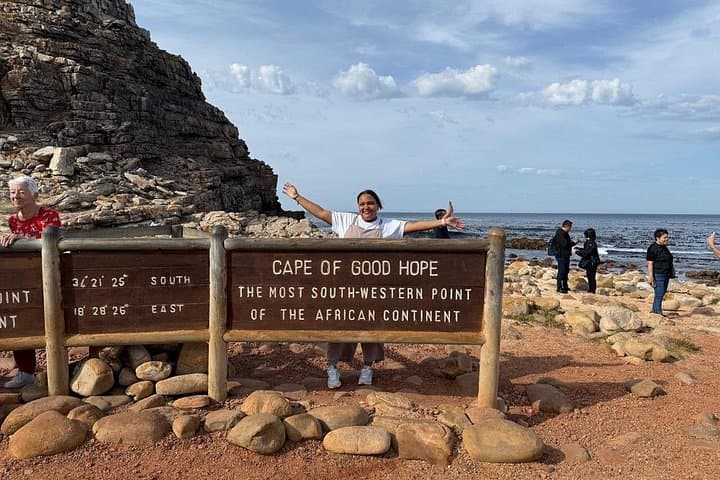
The final act is Cape Point and the Cape of Good Hope. Geologically, this is where the Peninsula’s hard sandstones yield to shattered shale and quartzites; oceanographically, it’s where the cold Benguela and warm Agulhas currents brush shoulders. Hikes to the old lighthouse range from a short, steep 800 m climb to a 2–3 km round‑trip on uneven rock with roughly 200 m elevation gain if you start lower; the Flying Dutchman funicular is an easy alternative. Views here are expansive and changing — bring a jacket.
Practicalities shape the experience: the full day runs about eight hours, with private transport and an English‑speaking guide included. Admissions to national parks, funicular rides, and meals are typically extra, so have a card or rand on hand. Footwear should handle rocky boardwalks and wind-scoured paths; layers are essential — sunshine can turn to wind-slap in minutes. Finally, leave no trace: keep to paths, don’t feed wildlife, and bring binoculars rather than closest-possible approaches. Follow these basics and the Cape Peninsula becomes less a checklist and more a day that moves at the tempo of sea and sky.
This private full‑day tour runs about eight hours, with pickup and drop‑off in Cape Town.
Admissions and funicular rides are typically not included—bring a card or South African rand to cover those costs.
Boardwalks put you within good viewing distance, but barriers are in place to protect the penguins—close contact is not allowed.
A 40‑minute seal cruise is part of the itinerary, but confirm at booking if boat fares are included in your specific package.
The supplier notes wheelchair‑accessible options for transport and some sites, but access on boardwalks and at Cape Point may be limited—ask at booking.
There’s time for lunch near Cape Point or a takeaway; bring snacks and water for the drive and shorter stops.
Wish2C Tours & Shuttles operates guided outdoor trips and adventures with an emphasis on safety, stewardship, and memorable experiences.


The day begins before the Atlantic wind has had its fill. Your guide meets you in Cape Town’s CBD and, as the city slips away, the road climbs toward the Twelve Apostles — a ribbon of ocean and sandstone that makes the car feel like a theater seat. First stop is Bo‑Kaap: a cluster of painted gables and narrow streets where Cape Malay culture announces itself with spice shops and the scent of simmering curries. It’s a quick cultural primer before the coastline takes over.
The day begins before the Atlantic wind has had its fill. Your guide meets you in Cape Town’s CBD and, as the city slips away, the road climbs toward the Twelve Apostles — a ribbon of ocean and sandstone that makes the car feel like a theater seat. First stop is Bo‑Kaap: a cluster of painted gables and narrow streets where Cape Malay culture announces itself with spice shops and the scent of simmering curries. It’s a quick cultural primer before the coastline takes over.
From Camps Bay the route follows the glinting rim of Chapman’s Peak Drive. The cliffs here are living geology — folded Cape Supergroup sandstone etched by wind and sea — and the viewpoint pauses long enough for a sharp photo and a deeper breath. In Hout Bay, a short 40‑minute boat cruise takes you toward Duiker Island, where Cape fur seals cluster by the thousands; the colony’s bark and tumble put marine life on full display and give a clear sense of the ecosystem that drives local fisheries and tourism.
The trip moves from seals to penguins at Boulders Beach in Simon’s Town. The walkable boardwalks (roughly 1 km of viewing paths) thread between sheltered bays so you can watch endangered African penguins go about their comical, efficient business without disturbing them. Respect the rails — the penguins are protected and their recovery is fragile.
The final act is Cape Point and the Cape of Good Hope. Geologically, this is where the Peninsula’s hard sandstones yield to shattered shale and quartzites; oceanographically, it’s where the cold Benguela and warm Agulhas currents brush shoulders. Hikes to the old lighthouse range from a short, steep 800 m climb to a 2–3 km round‑trip on uneven rock with roughly 200 m elevation gain if you start lower; the Flying Dutchman funicular is an easy alternative. Views here are expansive and changing — bring a jacket.
Practicalities shape the experience: the full day runs about eight hours, with private transport and an English‑speaking guide included. Admissions to national parks, funicular rides, and meals are typically extra, so have a card or rand on hand. Footwear should handle rocky boardwalks and wind-scoured paths; layers are essential — sunshine can turn to wind-slap in minutes. Finally, leave no trace: keep to paths, don’t feed wildlife, and bring binoculars rather than closest-possible approaches. Follow these basics and the Cape Peninsula becomes less a checklist and more a day that moves at the tempo of sea and sky.