THE ADVENTURE COLLECTIVE® · Independent discovery and booking for outdoor travel

Spend a day tracing Cappadocia’s volcanic past and Byzantine presence on the Red Tour: Göreme’s cave churches, Pasabag’s fairy chimneys and Devrent’s animal rocks, with a hands-on stop in Avanos for pottery. Packed with geology, culture and practical tips, this 8‑hour route is an efficient primer on the region.
Spend a day tracing Cappadocia’s volcanic past and Byzantine presence on the Red Tour: Göreme’s cave churches, Pasabag’s fairy chimneys and Devrent’s animal rocks, with a hands-on stop in Avanos for pottery. Packed with geology, culture and practical tips, this 8‑hour route is an efficient primer on the region.
The minivan eases away from a Göreme hotel as the morning light chisels the valley into sharp relief. Outside the window, pillars of soft rock—fairy chimneys—stand like weathered columns guarding a landscape that seems invented for exploration. Your guide counts heads, passes around steaming simit, and points out a distant village where cave houses still host guests.
Verified experiences and guided adventures in the surrounding area.
Operated by Turkey Tours Company · Goreme, Nevşehir
The minivan eases away from a Göreme hotel as the morning light chisels the valley into sharp relief. Outside the window, pillars of soft rock—fairy chimneys—stand like weathered columns guarding a landscape that seems invented for exploration. Your guide counts heads, passes around steaming simit, and points out a distant village where cave houses still host guests.
The Red Tour compresses Cappadocia’s long story into a single day. Volcanic eruptions millions of years ago laid down pumice and ash that hardened into tuff; over time wind and water carved that soft stone into hoodoos and mushroom-capped chimneys. Humans carved into that same rock, digging homes, monasteries and churches. At the Göreme Open-Air Museum you move through Byzantine cave churches, their frescoes—rarely disturbed—offering a direct line to 10th- to 12th-century monastic life.
Geology and culture overlap along the route. In Pasabag (Monks Valley) the twin- and triple-capped chimneys have the look of a sculptor’s experiment; in Devrent Valley, erosion teases pareidolia—rocks that suggest camels, seals, even a profile resembling a face. Avanos, set on the red-brown banks of the Kızılırmak River, sends you to a pottery workshop where centuries-old techniques meet a modern wheel; the town is also home to carpet-weaving cooperatives, where patterns map family histories.
Practicalities: the tour runs about eight hours with hotel pickup in Göreme and Ürgüp. Expect 1–3 km of walking spread across several stops—mostly level or short stair sections—so mobility is easy but surfaces are uneven and dusty. The Göreme Open-Air Museum admission is about €20 (you can pay the guide for a skip‑the‑line ticket). Lunch and air-conditioned transport are included.
Timing matters: early mornings bring softer light and fewer crowds at overlooks; mid-afternoon is warm but good for pottery demonstrations. Wear grippy shoes for cave floors, carry a sun hat and 1–2 liters of water, and bring cash for small artisan purchases and entrance fees. If you have mobility concerns, ask ahead—some cave interiors have low thresholds and stairs.
For a day that moves between ancient frescoes, otherworldly rock forms and hands-on craft, the Red Tour is compact, informative and surprisingly tactile. It’s a good first introduction to Cappadocia’s geology and living traditions, with enough photo stops and cultural context to plan deeper follow-ups—an afternoon in Avanos, or a hike through a quieter valley when you return.
The Red Tour lasts about eight hours, typically with morning pickup and afternoon return to Göreme/Ürgüp.
Admission (~€20) is not always included; you can pay the guide for a skip-the-line ticket or bring cash to purchase at the site.
Yes—pickups are commonly offered across Göreme and Ürgüp; confirm your hotel at booking and be ready 20–30 minutes before the scheduled pickup window.
Yes—it's labeled easy with short walks, but some cave interiors have low steps; notify the operator of mobility needs when booking.
Lunch is included and usually features regional dishes; if you have dietary restrictions, note them at booking so the operator can accommodate you.
Weekdays and early season (spring or late fall) have fewer tourists; mornings are quieter at major viewpoints for photography.
Turkey Tours Company operates guided outdoor trips and adventures with an emphasis on safety, stewardship, and memorable experiences.
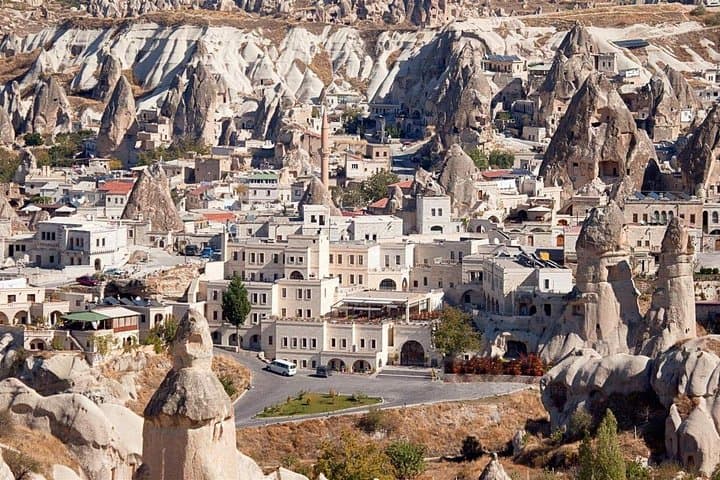


The minivan eases away from a Göreme hotel as the morning light chisels the valley into sharp relief. Outside the window, pillars of soft rock—fairy chimneys—stand like weathered columns guarding a landscape that seems invented for exploration. Your guide counts heads, passes around steaming simit, and points out a distant village where cave houses still host guests.
The minivan eases away from a Göreme hotel as the morning light chisels the valley into sharp relief. Outside the window, pillars of soft rock—fairy chimneys—stand like weathered columns guarding a landscape that seems invented for exploration. Your guide counts heads, passes around steaming simit, and points out a distant village where cave houses still host guests.
The Red Tour compresses Cappadocia’s long story into a single day. Volcanic eruptions millions of years ago laid down pumice and ash that hardened into tuff; over time wind and water carved that soft stone into hoodoos and mushroom-capped chimneys. Humans carved into that same rock, digging homes, monasteries and churches. At the Göreme Open-Air Museum you move through Byzantine cave churches, their frescoes—rarely disturbed—offering a direct line to 10th- to 12th-century monastic life.
Geology and culture overlap along the route. In Pasabag (Monks Valley) the twin- and triple-capped chimneys have the look of a sculptor’s experiment; in Devrent Valley, erosion teases pareidolia—rocks that suggest camels, seals, even a profile resembling a face. Avanos, set on the red-brown banks of the Kızılırmak River, sends you to a pottery workshop where centuries-old techniques meet a modern wheel; the town is also home to carpet-weaving cooperatives, where patterns map family histories.
Practicalities: the tour runs about eight hours with hotel pickup in Göreme and Ürgüp. Expect 1–3 km of walking spread across several stops—mostly level or short stair sections—so mobility is easy but surfaces are uneven and dusty. The Göreme Open-Air Museum admission is about €20 (you can pay the guide for a skip‑the‑line ticket). Lunch and air-conditioned transport are included.
Timing matters: early mornings bring softer light and fewer crowds at overlooks; mid-afternoon is warm but good for pottery demonstrations. Wear grippy shoes for cave floors, carry a sun hat and 1–2 liters of water, and bring cash for small artisan purchases and entrance fees. If you have mobility concerns, ask ahead—some cave interiors have low thresholds and stairs.
For a day that moves between ancient frescoes, otherworldly rock forms and hands-on craft, the Red Tour is compact, informative and surprisingly tactile. It’s a good first introduction to Cappadocia’s geology and living traditions, with enough photo stops and cultural context to plan deeper follow-ups—an afternoon in Avanos, or a hike through a quieter valley when you return.