THE ADVENTURE COLLECTIVE® · Independent discovery and booking for outdoor travel

Drop beneath the jungle and into subterranean cathedrals: Tak Be Ha and Tak Be Lum offer cavern diving through ancient limestone formations just inland from Playa del Carmen. These recently opened cenotes reward certified divers with dramatic flowstones, shafts of light and near-perfect visibility.
Drop beneath the jungle and into subterranean cathedrals: Tak Be Ha and Tak Be Lum offer cavern diving through ancient limestone formations just inland from Playa del Carmen. These recently opened cenotes reward certified divers with dramatic flowstones, shafts of light and near-perfect visibility.
You drop from the sunlight into a green-black mouth of jungle and the world narrows to a circle of breath and bubbles. The cenote accepts you without hurry: a column of filtered light pierces the water and reveals a cathedral of calcite—stalactites hanging like chandeliers, stalagmites rising from the floor, and passageways that run off into dark corridors. In Tak Be Ha and Tak Be Lum, part of the Nohoch Nah Chich system near Dos Ojos, the caves feel alive—water moving a polite but insistent current, sediment sitting like dust until a fin stirs it and the whole chamber exhales.
Verified experiences and guided adventures in the surrounding area.
Operated by Diversland Mexico · Playa del Carmen, Quintana Roo
You drop from the sunlight into a green-black mouth of jungle and the world narrows to a circle of breath and bubbles. The cenote accepts you without hurry: a column of filtered light pierces the water and reveals a cathedral of calcite—stalactites hanging like chandeliers, stalagmites rising from the floor, and passageways that run off into dark corridors. In Tak Be Ha and Tak Be Lum, part of the Nohoch Nah Chich system near Dos Ojos, the caves feel alive—water moving a polite but insistent current, sediment sitting like dust until a fin stirs it and the whole chamber exhales.
These cenotes were closed to most visitors until recently; with access opened, certified divers can now peer into formations that took millennia to grow. Geologically they're limestone karst: rainwater dissolved bedrock, created voids, and when the sea level rose and fell, those voids flooded. What you see—flowstones, curtains, soda straws—are slow, patient architecture. Culturally, cenotes were sacred to the Maya: entrances to the underworld and places for ritual offerings. Today, guides balance safety and stewardship, pointing out features and the odd blind fish that calls these lightless rooms home.
Expect two guided dives totaling about five hours from pickup in Playa del Carmen. The profile is cave-oriented cavern diving: long horizontal galleries, tight restrictions in places, and dramatic haloclines where fresh and salt water meet. Visibility is typically excellent—crystal clear layers punctuated by shafts of sunlight—and the formations are the main draw; marine life is sparse but prehistoric-feeling small fish and crustaceans can be seen in pools and niches.
Practical notes: evidence of Open Water certification is required for certified dives; cavern or cave training is strongly recommended. Minimum age is 15. The operator provides two tanks, weights, belts, bottled water and snacks; hotel pickup across the Riviera Maya is usually included. Avoid diving within 24 hours of flying, and travelers with back, heart, or pregnancy concerns should not participate.
Logistics: wear a snug wetsuit (water in cenotes can be cool depending on season), bring a primary and backup light for tight passages, and keep your kit simple—reducing drag helps protect fragile formations. Go early for softer light and fewer groups; late afternoon visits can mean more boats and higher sediment. Respect the site: no touching, no fins-on-floor, and use only reef-safe sunscreen if needed.
For divers, these cenotes are a study in contrasts—the hush of subterranean rooms compared to the riot of the surface jungle. The reward is not fish, but space: the sensation of moving through a slow-made world, guided by your light and the careful hand of an experienced guide.
Yes—evidence of an Open Water Diver certification (PADI or equivalent) is required; cavern or cave training is strongly recommended for overhead environments.
Minimum age is 15 years for cenote diving with this operator.
The excursion is approximately five hours and includes two dives with two tanks provided.
Marine life is limited—expect small blind fish and troglobitic crustaceans rather than tropical reef species; the primary draw is the geological formations.
Yes—hotel pickup and drop-off across Playa del Carmen, Cancun and the Riviera Maya are typically included; details are confirmed at booking.
No—this activity is not recommended for pregnant participants or those with significant spinal, cardiovascular, or other qualifying medical conditions.
Diversland Mexico operates guided outdoor trips and adventures with an emphasis on safety, stewardship, and memorable experiences.

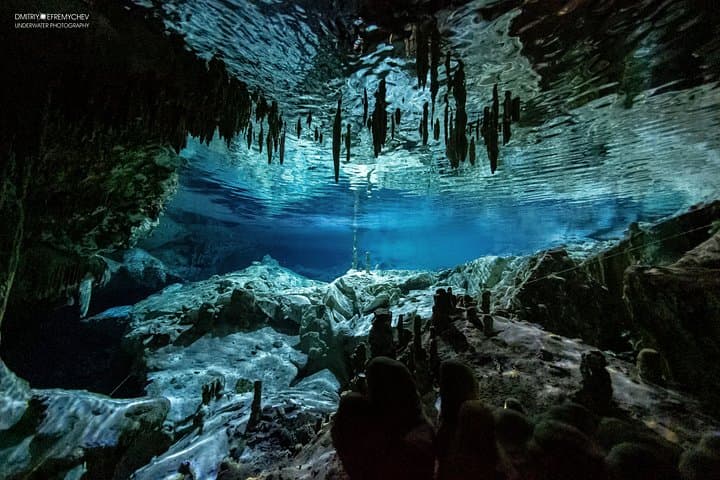


You drop from the sunlight into a green-black mouth of jungle and the world narrows to a circle of breath and bubbles. The cenote accepts you without hurry: a column of filtered light pierces the water and reveals a cathedral of calcite—stalactites hanging like chandeliers, stalagmites rising from the floor, and passageways that run off into dark corridors. In Tak Be Ha and Tak Be Lum, part of the Nohoch Nah Chich system near Dos Ojos, the caves feel alive—water moving a polite but insistent current, sediment sitting like dust until a fin stirs it and the whole chamber exhales.
You drop from the sunlight into a green-black mouth of jungle and the world narrows to a circle of breath and bubbles. The cenote accepts you without hurry: a column of filtered light pierces the water and reveals a cathedral of calcite—stalactites hanging like chandeliers, stalagmites rising from the floor, and passageways that run off into dark corridors. In Tak Be Ha and Tak Be Lum, part of the Nohoch Nah Chich system near Dos Ojos, the caves feel alive—water moving a polite but insistent current, sediment sitting like dust until a fin stirs it and the whole chamber exhales.
These cenotes were closed to most visitors until recently; with access opened, certified divers can now peer into formations that took millennia to grow. Geologically they're limestone karst: rainwater dissolved bedrock, created voids, and when the sea level rose and fell, those voids flooded. What you see—flowstones, curtains, soda straws—are slow, patient architecture. Culturally, cenotes were sacred to the Maya: entrances to the underworld and places for ritual offerings. Today, guides balance safety and stewardship, pointing out features and the odd blind fish that calls these lightless rooms home.
Expect two guided dives totaling about five hours from pickup in Playa del Carmen. The profile is cave-oriented cavern diving: long horizontal galleries, tight restrictions in places, and dramatic haloclines where fresh and salt water meet. Visibility is typically excellent—crystal clear layers punctuated by shafts of sunlight—and the formations are the main draw; marine life is sparse but prehistoric-feeling small fish and crustaceans can be seen in pools and niches.
Practical notes: evidence of Open Water certification is required for certified dives; cavern or cave training is strongly recommended. Minimum age is 15. The operator provides two tanks, weights, belts, bottled water and snacks; hotel pickup across the Riviera Maya is usually included. Avoid diving within 24 hours of flying, and travelers with back, heart, or pregnancy concerns should not participate.
Logistics: wear a snug wetsuit (water in cenotes can be cool depending on season), bring a primary and backup light for tight passages, and keep your kit simple—reducing drag helps protect fragile formations. Go early for softer light and fewer groups; late afternoon visits can mean more boats and higher sediment. Respect the site: no touching, no fins-on-floor, and use only reef-safe sunscreen if needed.
For divers, these cenotes are a study in contrasts—the hush of subterranean rooms compared to the riot of the surface jungle. The reward is not fish, but space: the sensation of moving through a slow-made world, guided by your light and the careful hand of an experienced guide.