THE ADVENTURE COLLECTIVE® · Independent discovery and booking for outdoor travel

A private day trip links My Son’s ruined Cham temples with the vertical caves and pagodas of the Marble Mountains. Expect steep steps, humid heat, and striking contrasts between ancient brick towers and marble caverns.
A private day trip links My Son’s ruined Cham temples with the vertical caves and pagodas of the Marble Mountains. Expect steep steps, humid heat, and striking contrasts between ancient brick towers and marble caverns.
You step out of an air-conditioned car into a breath of warm, salty air and the low hum of motorbikes — the coast behind you, green rice paddies ahead, and a line of weathered stone rising from the plain. The day splits itself between two contrasting landscapes: the intimate ruins of My Son and the vertical cliffs and caverns of the Marble Mountains.
Verified experiences and guided adventures in the surrounding area.
Operated by longtravel-hoian · Da Nang, Da Nang
You step out of an air-conditioned car into a breath of warm, salty air and the low hum of motorbikes — the coast behind you, green rice paddies ahead, and a line of weathered stone rising from the plain. The day splits itself between two contrasting landscapes: the intimate ruins of My Son and the vertical cliffs and caverns of the Marble Mountains.
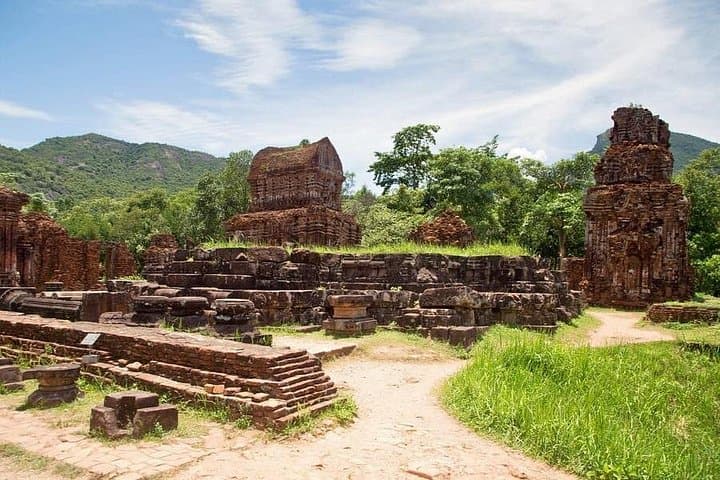
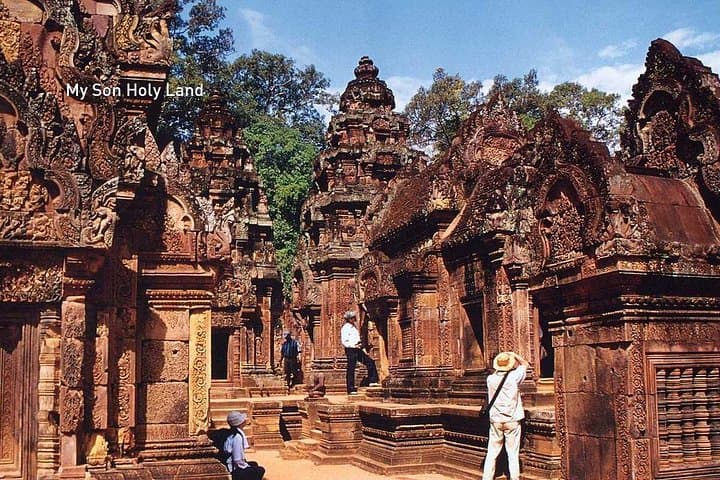
My Son was a religious center of the Champa kingdom from the 4th to the 14th century, its brick towers once dedicated to Shiva and now partially collapsed but still eloquent of an Indianized Southeast Asia. Geologically, the Marble Mountains are five marble-and-limestone outcrops named for the five elements; Thuy Son (Water) is the highest and offers cliff-top views, cave shrines and carved stairways. Buddhist shrines occupy natural caverns while local stone-carving workshops continue a centuries-old craft—direct quarrying has been restricted in recent years to protect the formations.
Expect uneven stone surfaces, steep steps and humid heat; each site typically involves about 60–120 minutes of on-foot exploration. The tour runs roughly eight hours with private pickup from Da Nang or Hoi An, and admission fees are often paid on-site. Bring sun protection and a refillable bottle — vendors exist but shade is limited — and plan an early start to dodge midday crowds and rain bands common in monsoon months.
Practical: wear sturdy shoes, carry cash for entry and tips, and allow time for slow photography at the temples and for the stair climb up Thuy Son. The contrast between Champa brickwork and the Marble Mountains’ polished grottoes makes this a compact day that reads like two different chapters of central Vietnam.
Admission fees are typically not included and are paid on-site; have small denominations of local currency available.
Yes — infants can ride on laps; the itinerary is low-impact in transit but involves stairs and uneven terrain at both sites.
Driving from Da Nang/Hoi An to My Son and then to Marble Mountains with return typically fills an 8-hour day; expect 60–90 minutes between Da Nang and My Son depending on traffic.
Yes — Thuy Son has stair access and viewpoints, but the climb includes steep steps and narrow passages; wear good shoes and take breaks.
longtravel-hoian operates guided outdoor trips and adventures with an emphasis on safety, stewardship, and memorable experiences.


You step out of an air-conditioned car into a breath of warm, salty air and the low hum of motorbikes — the coast behind you, green rice paddies ahead, and a line of weathered stone rising from the plain. The day splits itself between two contrasting landscapes: the intimate ruins of My Son and the vertical cliffs and caverns of the Marble Mountains.
You step out of an air-conditioned car into a breath of warm, salty air and the low hum of motorbikes — the coast behind you, green rice paddies ahead, and a line of weathered stone rising from the plain. The day splits itself between two contrasting landscapes: the intimate ruins of My Son and the vertical cliffs and caverns of the Marble Mountains.
My Son was a religious center of the Champa kingdom from the 4th to the 14th century, its brick towers once dedicated to Shiva and now partially collapsed but still eloquent of an Indianized Southeast Asia. Geologically, the Marble Mountains are five marble-and-limestone outcrops named for the five elements; Thuy Son (Water) is the highest and offers cliff-top views, cave shrines and carved stairways. Buddhist shrines occupy natural caverns while local stone-carving workshops continue a centuries-old craft—direct quarrying has been restricted in recent years to protect the formations.
Expect uneven stone surfaces, steep steps and humid heat; each site typically involves about 60–120 minutes of on-foot exploration. The tour runs roughly eight hours with private pickup from Da Nang or Hoi An, and admission fees are often paid on-site. Bring sun protection and a refillable bottle — vendors exist but shade is limited — and plan an early start to dodge midday crowds and rain bands common in monsoon months.
Practical: wear sturdy shoes, carry cash for entry and tips, and allow time for slow photography at the temples and for the stair climb up Thuy Son. The contrast between Champa brickwork and the Marble Mountains’ polished grottoes makes this a compact day that reads like two different chapters of central Vietnam.