THE ADVENTURE COLLECTIVE® · Independent discovery and booking for outdoor travel

This full‑day tour from Chiang Mai combines contemporary temple art, a soak at a hot spring, and a scenic Mekong boat crossing into Laos. Expect long drives, short uneven walks at temples, and a passport‑required river hop to Don Sao Island.
This full‑day tour from Chiang Mai combines contemporary temple art, a soak at a hot spring, and a scenic Mekong boat crossing into Laos. Expect long drives, short uneven walks at temples, and a passport‑required river hop to Don Sao Island.
Early light on a 12‑hour day trip from Chiang Mai turns the winding highway into a moving panorama: steam rising from a roadside hot spring, a white façade flashing like a mirror at Wat Rong Khun, and the Mekong broadening into slow, deliberate water that dares you to cross to Laos.
Verified experiences and guided adventures in the surrounding area.
Operated by Oh-Hoo · Chiang Rai, Chiang Rai Province
Early light on a 12‑hour day trip from Chiang Mai turns the winding highway into a moving panorama: steam rising from a roadside hot spring, a white façade flashing like a mirror at Wat Rong Khun, and the Mekong broadening into slow, deliberate water that dares you to cross to Laos.
The region sits on the northern edge of the Shan Plateau, where folded hills feed alluvial terraces and the Mekong has long shaped trade and culture. Wat Rong Khun (the White Temple) is a modern devotional project by artist Chalermchai Kositpipat, while Wat Rong Seua Ten (the Blue Temple) showcases contemporary Buddhist iconography in cobalt and gold. The Golden Triangle has a fraught past as a center of opium commerce but today functions as a historic junction where three nations share river, market life, and cuisine. Don Sao Island and nearby villages illustrate rapid economic change—casinos, markets, and special economic zones beside traditional weaving workshops and hill‑tribe communities.
Practically: expect long minivan transfers, short walks on uneven surfaces, and a border crossing by boat—bring your passport and small Lao kip or Thai baht. Dress respectfully for temples (covered shoulders and long pants recommended), carry sun protection and a refillable water bottle, and plan for a full day away from Chiang Mai or Chiang Rai. The day balances scenic river time, accessible cultural sites, and a taste of cross‑border Laos—best for travelers ready for a long but richly varied day outdoors.
Yes—crossing the Mekong to Laos requires a passport; check visa requirements for your nationality before travel.
Most entrance fees and some activities may not be included—confirm with the operator; the itinerary notes admissions are generally not included.
Children can join but expect long driving periods; infants must sit on laps and some children’s tickets apply—verify age pricing before booking.
Limited mobility may be challenging: several stops involve uneven steps and short walks; contact the operator to discuss specific needs.
Oh-Hoo operates guided outdoor trips and adventures with an emphasis on safety, stewardship, and memorable experiences.
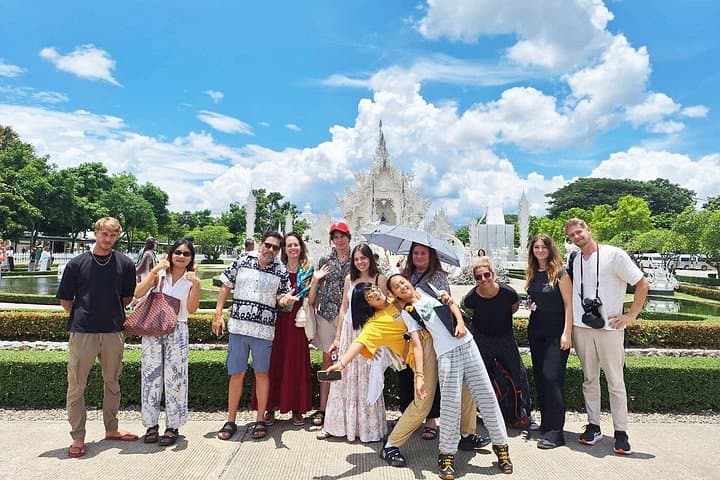


Early light on a 12‑hour day trip from Chiang Mai turns the winding highway into a moving panorama: steam rising from a roadside hot spring, a white façade flashing like a mirror at Wat Rong Khun, and the Mekong broadening into slow, deliberate water that dares you to cross to Laos.
Early light on a 12‑hour day trip from Chiang Mai turns the winding highway into a moving panorama: steam rising from a roadside hot spring, a white façade flashing like a mirror at Wat Rong Khun, and the Mekong broadening into slow, deliberate water that dares you to cross to Laos.
The region sits on the northern edge of the Shan Plateau, where folded hills feed alluvial terraces and the Mekong has long shaped trade and culture. Wat Rong Khun (the White Temple) is a modern devotional project by artist Chalermchai Kositpipat, while Wat Rong Seua Ten (the Blue Temple) showcases contemporary Buddhist iconography in cobalt and gold. The Golden Triangle has a fraught past as a center of opium commerce but today functions as a historic junction where three nations share river, market life, and cuisine. Don Sao Island and nearby villages illustrate rapid economic change—casinos, markets, and special economic zones beside traditional weaving workshops and hill‑tribe communities.
Practically: expect long minivan transfers, short walks on uneven surfaces, and a border crossing by boat—bring your passport and small Lao kip or Thai baht. Dress respectfully for temples (covered shoulders and long pants recommended), carry sun protection and a refillable water bottle, and plan for a full day away from Chiang Mai or Chiang Rai. The day balances scenic river time, accessible cultural sites, and a taste of cross‑border Laos—best for travelers ready for a long but richly varied day outdoors.