THE ADVENTURE COLLECTIVE® · Independent discovery and booking for outdoor travel

Explore Chicago’s formative skyscrapers on a focused 90-minute loop that pairs street-level storytelling with selective interior access to landmarks like the Rookery and Auditorium Building. Perfect for history-minded walkers and architecture fans.
Explore Chicago’s formative skyscrapers on a focused 90-minute loop that pairs street-level storytelling with selective interior access to landmarks like the Rookery and Auditorium Building. Perfect for history-minded walkers and architecture fans.
The city opens like a ledger as you gather on Michigan Avenue: limestone and brick rising in deliberate rhythms, the El clacking in the distance and the Chicago River daring you to look up. On this 90-minute loop you move through the era that remade the skyline, stopping under ornate cornices, through narrow alleys of steel-frame facades and into plazas where sightlines force you to study how structure became style.
Verified experiences and guided adventures in the surrounding area.
The city opens like a ledger as you gather on Michigan Avenue: limestone and brick rising in deliberate rhythms, the El clacking in the distance and the Chicago River daring you to look up. On this 90-minute loop you move through the era that remade the skyline, stopping under ornate cornices, through narrow alleys of steel-frame facades and into plazas where sightlines force you to study how structure became style.
Start at the Fine Arts Building and follow docent-led narration through Burnham & Root’s Rookery and Adler & Sullivan’s Auditorium Building, touching on innovations—metal-frame skeletons, passenger elevators and refined acoustical engineering—that grew from the ashes of the 1871 fire. The Marquette and Monadnock buildings show two answers to height and ornament: one celebrating metal expression, the other mass and polish. The tour also includes admission to the Chicago Architecture Center galleries, where models and photographs trace the Loop’s transformation beside Lake Michigan’s influence on the city grid and river alignment.
Practically, expect paved sidewalks and urban crossings, occasional indoor stops, and the chance that interior access may change with building schedules. Wear supportive walking shoes, bring a charged phone for photos and transit connections, and arrive 10 minutes early to check in at 410 S. Michigan Ave. The route is accessible and suitable for most fitness levels, but young children may find the pace brisk. For anyone curious about how engineering, commerce and civic rebuilding shaped modern cities, this concentrated walk delivers history, detail and a direct line to Chicago’s architectural grit and ingenuity.
Yes — the meeting point, sidewalks and most stops are wheelchair accessible; however, access to historic interiors can vary by building and may be subject to change.
No — the ticket includes admission to the Chicago Architecture Center galleries and some interior views like the Rookery when available, but access can be restricted due to building schedules or private events.
Children are allowed but the tour is not recommended for very young children due to pace and attention needed to appreciate architectural details.
The tour runs in light rain; guides may adjust stops to emphasize covered interiors. For heavy weather check the cancellation policy and contact the operator for updates.
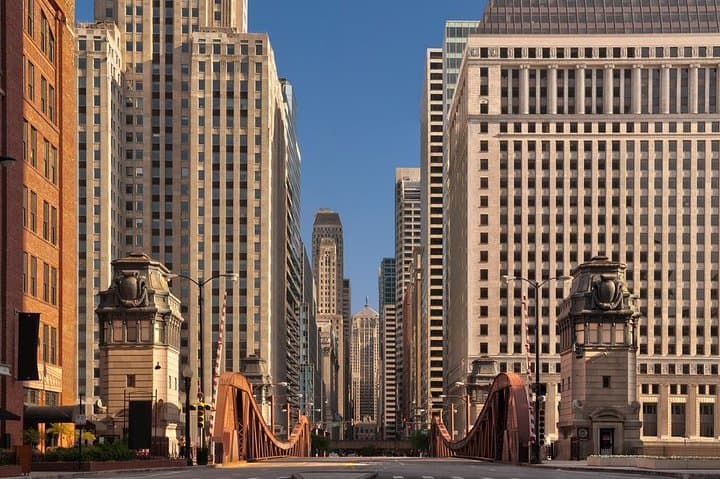
The city opens like a ledger as you gather on Michigan Avenue: limestone and brick rising in deliberate rhythms, the El clacking in the distance and the Chicago River daring you to look up. On this 90-minute loop you move through the era that remade the skyline, stopping under ornate cornices, through narrow alleys of steel-frame facades and into plazas where sightlines force you to study how structure became style.
The city opens like a ledger as you gather on Michigan Avenue: limestone and brick rising in deliberate rhythms, the El clacking in the distance and the Chicago River daring you to look up. On this 90-minute loop you move through the era that remade the skyline, stopping under ornate cornices, through narrow alleys of steel-frame facades and into plazas where sightlines force you to study how structure became style.
Start at the Fine Arts Building and follow docent-led narration through Burnham & Root’s Rookery and Adler & Sullivan’s Auditorium Building, touching on innovations—metal-frame skeletons, passenger elevators and refined acoustical engineering—that grew from the ashes of the 1871 fire. The Marquette and Monadnock buildings show two answers to height and ornament: one celebrating metal expression, the other mass and polish. The tour also includes admission to the Chicago Architecture Center galleries, where models and photographs trace the Loop’s transformation beside Lake Michigan’s influence on the city grid and river alignment.
Practically, expect paved sidewalks and urban crossings, occasional indoor stops, and the chance that interior access may change with building schedules. Wear supportive walking shoes, bring a charged phone for photos and transit connections, and arrive 10 minutes early to check in at 410 S. Michigan Ave. The route is accessible and suitable for most fitness levels, but young children may find the pace brisk. For anyone curious about how engineering, commerce and civic rebuilding shaped modern cities, this concentrated walk delivers history, detail and a direct line to Chicago’s architectural grit and ingenuity.