THE ADVENTURE COLLECTIVE® · Independent discovery and booking for outdoor travel

Skip the crowds and let a local guide lead your private two-hour Christmas walk through Bath’s Abbey, Pulteney Bridge, festive market and the Royal Crescent. Rich in history, warmth and practical stops for seasonal treats.
Skip the crowds and let a local guide lead your private two-hour Christmas walk through Bath’s Abbey, Pulteney Bridge, festive market and the Royal Crescent. Rich in history, warmth and practical stops for seasonal treats.
A hush falls over the stone as you step out from under the buttresses of Bath Abbey and into a cold, bright winter afternoon. Steam drifts off the River Avon, which threads a cool ribbon through the city and seems eager to carry the smell of roasting chestnuts along with it. Your guide—stout with local history and quick with a joke—leads a small private group past the double row of stalls that make the Bath Christmas Market glow, while the spires and Georgian facades stand quiet and punctual like old friends watching the lights.
Verified experiences and guided adventures in the surrounding area.
Operated by Opatrip England · Bath, Somerset
A hush falls over the stone as you step out from under the buttresses of Bath Abbey and into a cold, bright winter afternoon. Steam drifts off the River Avon, which threads a cool ribbon through the city and seems eager to carry the smell of roasting chestnuts along with it. Your guide—stout with local history and quick with a joke—leads a small private group past the double row of stalls that make the Bath Christmas Market glow, while the spires and Georgian facades stand quiet and punctual like old friends watching the lights.
Bath’s core is both Roman and Georgian: Romans built baths here around thermal springs that still bubble beneath the city’s honey-coloured limestone; 18th-century builders later claimed that same stone to sculpt the uniform crescents and terraces that define Bath’s skyline. That geology matters—the warm springs are born of rainwater that sinks through Mendip and Cotswold limestone, dives deep, warms, and resurfaces mineral-rich and inviting. At Christmas, those layers of time wear seasonal trim: wreaths on fanlights, small lights threaded across Pulteney Bridge’s shopfronts, and the Royal Crescent framed with a hush of oak garlands.
The itinerary is compact, conversational, and guided—Bath Abbey, a long look at Pulteney Bridge’s shop-lined spans, a meander through the market, an outside view of the modern Thermae Bath Spa, and a final stop at the Royal Crescent. The guide packs historical context—why the bridge was built, how Georgian urban planning shaped social life, even the stories of traders on the Avon—while leaving room for you to browse stalls for mulled wine, handmade pottery, and locally smoked salmon.
Practicalities frame the magic: the walk lasts about two hours, starts at Bath Abbey and finishes at Royal Crescent, and is private for your group only. The route uses cobbled streets and paved walks; footwear with grip matters. Expect cold, possibly wet weather—Bath winters are crisp and changeable—and bring a small daypack to stash purchases. If you want to warm up in the water, Thermae Bath Spa accepts separate reservations; the tour treats it as an exterior stop only.
For photographers, early evening blue hour and the market lights are irresistible. For planners, book early in December weekends to avoid crowds; the tour offers instant confirmation and a flexible cancellation window up to 24 hours prior. This is a walk that hands you both the facts and the feeling of Bath at Christmas: historic, straightforward, and quietly celebratory.
No—this is an exterior walking tour; admissions and spa sessions must be booked separately.
The tour is private for your booking; contact the operator for specific group size limits before booking if you have a large party.
The route uses paved and cobbled streets; it’s classified as easy but some uneven surfaces and steps may pose challenges—notify the operator of accessibility needs when booking.
The tour runs in most weather; the cancellation policy allows a full refund if canceled at least 24 hours in advance, but operators typically proceed in light rain—dress appropriately.
Meet at Bath Abbey for the start; the tour concludes at the Royal Crescent, making it easy to continue exploring nearby cafés or museums.
No—refreshments are available for purchase during the market stop; you can sample treats as you go.
Opatrip England operates guided outdoor trips and adventures with an emphasis on safety, stewardship, and memorable experiences.


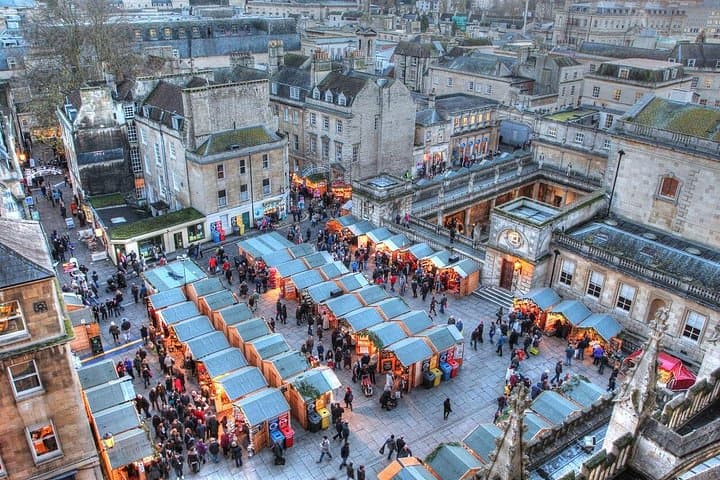

A hush falls over the stone as you step out from under the buttresses of Bath Abbey and into a cold, bright winter afternoon. Steam drifts off the River Avon, which threads a cool ribbon through the city and seems eager to carry the smell of roasting chestnuts along with it. Your guide—stout with local history and quick with a joke—leads a small private group past the double row of stalls that make the Bath Christmas Market glow, while the spires and Georgian facades stand quiet and punctual like old friends watching the lights.
A hush falls over the stone as you step out from under the buttresses of Bath Abbey and into a cold, bright winter afternoon. Steam drifts off the River Avon, which threads a cool ribbon through the city and seems eager to carry the smell of roasting chestnuts along with it. Your guide—stout with local history and quick with a joke—leads a small private group past the double row of stalls that make the Bath Christmas Market glow, while the spires and Georgian facades stand quiet and punctual like old friends watching the lights.
Bath’s core is both Roman and Georgian: Romans built baths here around thermal springs that still bubble beneath the city’s honey-coloured limestone; 18th-century builders later claimed that same stone to sculpt the uniform crescents and terraces that define Bath’s skyline. That geology matters—the warm springs are born of rainwater that sinks through Mendip and Cotswold limestone, dives deep, warms, and resurfaces mineral-rich and inviting. At Christmas, those layers of time wear seasonal trim: wreaths on fanlights, small lights threaded across Pulteney Bridge’s shopfronts, and the Royal Crescent framed with a hush of oak garlands.
The itinerary is compact, conversational, and guided—Bath Abbey, a long look at Pulteney Bridge’s shop-lined spans, a meander through the market, an outside view of the modern Thermae Bath Spa, and a final stop at the Royal Crescent. The guide packs historical context—why the bridge was built, how Georgian urban planning shaped social life, even the stories of traders on the Avon—while leaving room for you to browse stalls for mulled wine, handmade pottery, and locally smoked salmon.
Practicalities frame the magic: the walk lasts about two hours, starts at Bath Abbey and finishes at Royal Crescent, and is private for your group only. The route uses cobbled streets and paved walks; footwear with grip matters. Expect cold, possibly wet weather—Bath winters are crisp and changeable—and bring a small daypack to stash purchases. If you want to warm up in the water, Thermae Bath Spa accepts separate reservations; the tour treats it as an exterior stop only.
For photographers, early evening blue hour and the market lights are irresistible. For planners, book early in December weekends to avoid crowds; the tour offers instant confirmation and a flexible cancellation window up to 24 hours prior. This is a walk that hands you both the facts and the feeling of Bath at Christmas: historic, straightforward, and quietly celebratory.