THE ADVENTURE COLLECTIVE® · Independent discovery and booking for outdoor travel

Cross a long pedestrian bridge into Civita di Bagnoregio, a village slowly eroding into the Valle dei Calanchi, then wander Bomarzo’s surreal Monster Park. This full-day trip from Civitavecchia pairs stark geology with Renaissance eccentricity—perfect for culture-minded hikers.
Cross a long pedestrian bridge into Civita di Bagnoregio, a village slowly eroding into the Valle dei Calanchi, then wander Bomarzo’s surreal Monster Park. This full-day trip from Civitavecchia pairs stark geology with Renaissance eccentricity—perfect for culture-minded hikers.
You step off the shuttle in the port fog and the landscape opens: a ribbon of road gives way to rolling clay badlands, and a three-hundred-meter pedestrian bridge appears like the last artery into another time. Civita di Bagnoregio perches on a crumbling tuff spur; wind and rain have been carving its flanks for millennia, and the town seems to breathe with each gust, daring you to cross.
Verified experiences and guided adventures in the surrounding area.
Operated by MyloveItaly Travel&Experiences · Bagnoregio, Lazio
You step off the shuttle in the port fog and the landscape opens: a ribbon of road gives way to rolling clay badlands, and a three-hundred-meter pedestrian bridge appears like the last artery into another time. Civita di Bagnoregio perches on a crumbling tuff spur; wind and rain have been carving its flanks for millennia, and the town seems to breathe with each gust, daring you to cross.
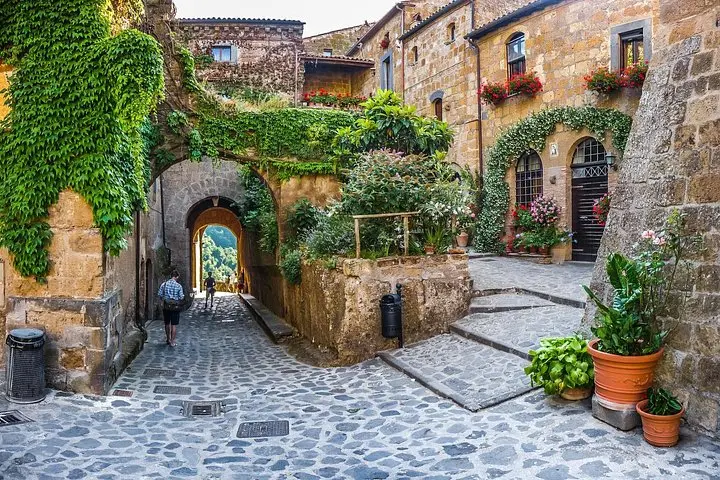
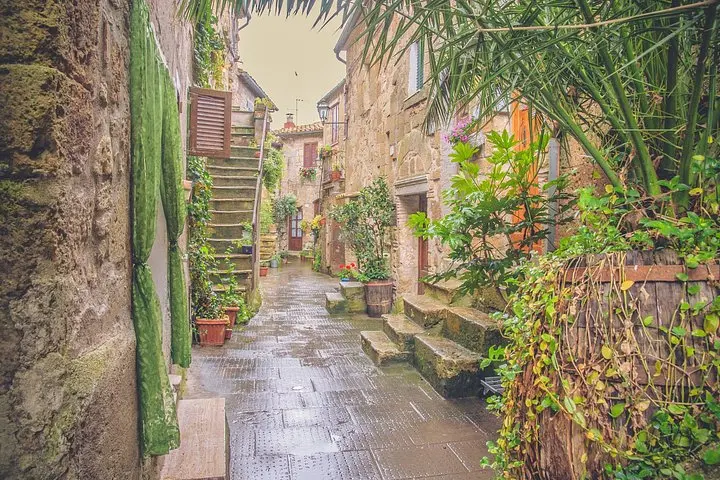
The village’s Romanesque arch—an Etruscan remnant—still marks the entry where narrow lanes funnel to a high piazza. Geology here rules the story: friable volcanic tuf and clay have formed the Valle dei Calanchi, gullied slopes that eat at foundations and give the place its “dying city” name. Later in the day the tour moves east to Bomarzo’s Parco dei Mostri, a Renaissance garden where larger-than-life stone figures overturn perspective and animate the trees; the work of Prince Vicino Orsini and architect Pirro Ligorio turns myth into monumental stone play.
Culturally, both sites show how Italians layered Etruscan, Romanesque and Renaissance influence across fragile terrain. Expect paved pedestrian access in Civita and uneven, often damp paths in Bomarzo. Wear sturdy shoes, bring water and allow time to linger on viewpoints—the canyon below is a moving piece of landscape art. Photography is rewarding at mid-morning or late afternoon when light sculpts the badlands and statues cast dramatic shadows.
Practical notes: the full-day shared tour runs around 8–9 hours with round-trip transfer from Civitavecchia, entrance fees included. Comfortable shoes, sun protection and a light jacket are sensible; accessibility is limited by stairs and narrow streets. This is a day that pairs geology and Renaissance oddity into a single, quietly unforgettable route.
The shared transfer is about 1 to 1.5 hours each way depending on traffic and ship location; total tour time is roughly 8–9 hours.
Yes; the tour includes entrance fees for both Civita di Bagnoregio and Bomarzo’s Monster Park.
The bridge and village have steps and narrow streets, so mobility is limited and the tour is not fully wheelchair-accessible.
Yes—children may join but must be accompanied by an adult; note the exposed bridge and uneven paths.
MyloveItaly Travel&Experiences operates guided outdoor trips and adventures with an emphasis on safety, stewardship, and memorable experiences.
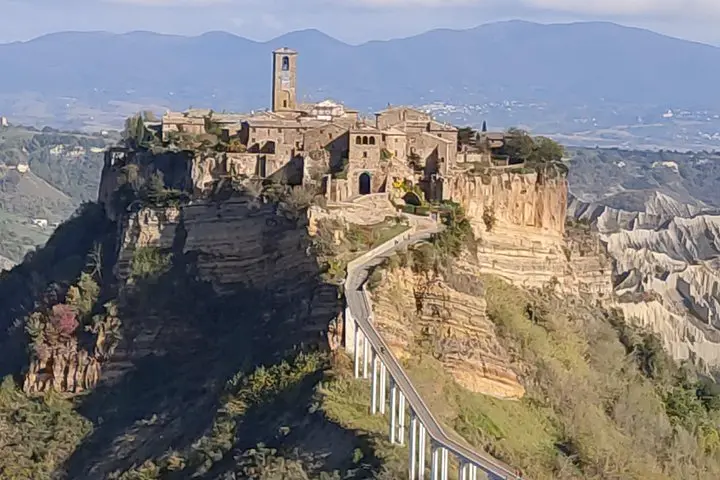
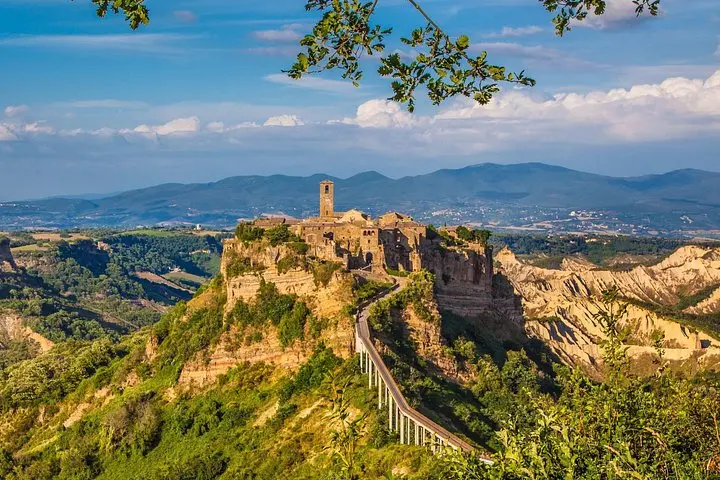
You step off the shuttle in the port fog and the landscape opens: a ribbon of road gives way to rolling clay badlands, and a three-hundred-meter pedestrian bridge appears like the last artery into another time. Civita di Bagnoregio perches on a crumbling tuff spur; wind and rain have been carving its flanks for millennia, and the town seems to breathe with each gust, daring you to cross.
You step off the shuttle in the port fog and the landscape opens: a ribbon of road gives way to rolling clay badlands, and a three-hundred-meter pedestrian bridge appears like the last artery into another time. Civita di Bagnoregio perches on a crumbling tuff spur; wind and rain have been carving its flanks for millennia, and the town seems to breathe with each gust, daring you to cross.
The village’s Romanesque arch—an Etruscan remnant—still marks the entry where narrow lanes funnel to a high piazza. Geology here rules the story: friable volcanic tuf and clay have formed the Valle dei Calanchi, gullied slopes that eat at foundations and give the place its “dying city” name. Later in the day the tour moves east to Bomarzo’s Parco dei Mostri, a Renaissance garden where larger-than-life stone figures overturn perspective and animate the trees; the work of Prince Vicino Orsini and architect Pirro Ligorio turns myth into monumental stone play.
Culturally, both sites show how Italians layered Etruscan, Romanesque and Renaissance influence across fragile terrain. Expect paved pedestrian access in Civita and uneven, often damp paths in Bomarzo. Wear sturdy shoes, bring water and allow time to linger on viewpoints—the canyon below is a moving piece of landscape art. Photography is rewarding at mid-morning or late afternoon when light sculpts the badlands and statues cast dramatic shadows.
Practical notes: the full-day shared tour runs around 8–9 hours with round-trip transfer from Civitavecchia, entrance fees included. Comfortable shoes, sun protection and a light jacket are sensible; accessibility is limited by stairs and narrow streets. This is a day that pairs geology and Renaissance oddity into a single, quietly unforgettable route.