THE ADVENTURE COLLECTIVE® · Independent discovery and booking for outdoor travel

A seven-day ascent that moves from tropical forest to arctic summit, the Machame ("Whiskey") route balances acclimatization with high-altitude payoff. Expect rainforest trails, the surreal Shira Plateau, a pre-dawn summit push, and panoramic views of Kibo and Mawenzi.
A seven-day ascent that moves from tropical forest to arctic summit, the Machame ("Whiskey") route balances acclimatization with high-altitude payoff. Expect rainforest trails, the surreal Shira Plateau, a pre-dawn summit push, and panoramic views of Kibo and Mawenzi.
A cold headlamp beam threads the dark as a line of climbers winds up from Barafu Camp. The mountain breathes around them—an Arctic wind that prods and tests resolve—until Stella Point lights the sky and the summit of Uhuru Peak reveals itself against a flaming sunrise. The Machame, or “Whiskey,” route is a seven-day arc from rainforest to Arctic, designed to give you time on the mountain for both acclimatization and spectacle.
Verified experiences and guided adventures in the surrounding area.
Operated by Guide Private · Moshi, Kilimanjaro Region
A cold headlamp beam threads the dark as a line of climbers winds up from Barafu Camp. The mountain breathes around them—an Arctic wind that prods and tests resolve—until Stella Point lights the sky and the summit of Uhuru Peak reveals itself against a flaming sunrise. The Machame, or “Whiskey,” route is a seven-day arc from rainforest to Arctic, designed to give you time on the mountain for both acclimatization and spectacle.
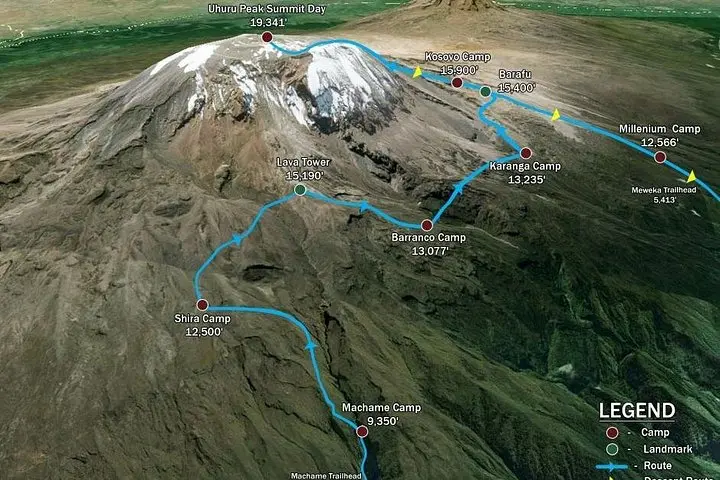
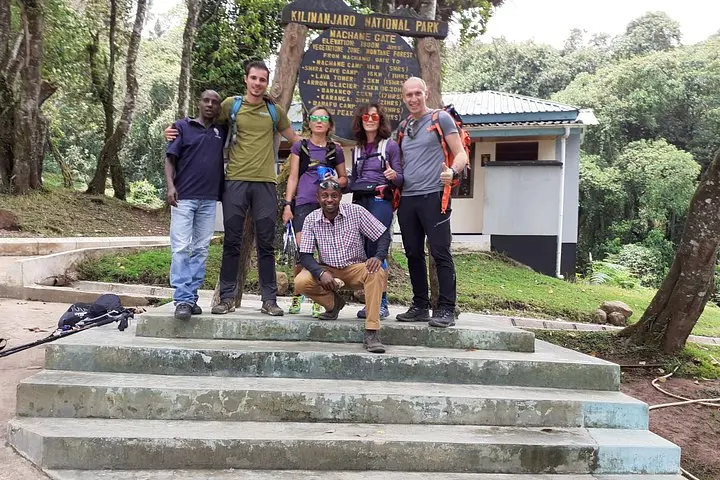
Your journey begins in Moshi with a 50-minute drive to Machame Gate. Trails climb through dense rain forest, where moss hangs from ancient branches and colobus monkeys watch with wary curiosity. Over a week you cross distinct habitats: heath and moorland on the Shira Plateau, the strange senecio and lobelia groves, a stark alpine desert around Lava Tower, and finally the arctic slopes near Kibo. Day-by-day specifics: Day 1 covers about 11 km (5–7 hours) from 5,380 ft to 9,350 ft; Day 3 reaches Lava Tower at 15,190 ft for crucial acclimatization; the summit push is a 5 km, 7–8 hour pre-dawn ascent from Barafu (15,331 ft) to Uhuru Peak (19,341 ft), followed by a long descent to Mweka.
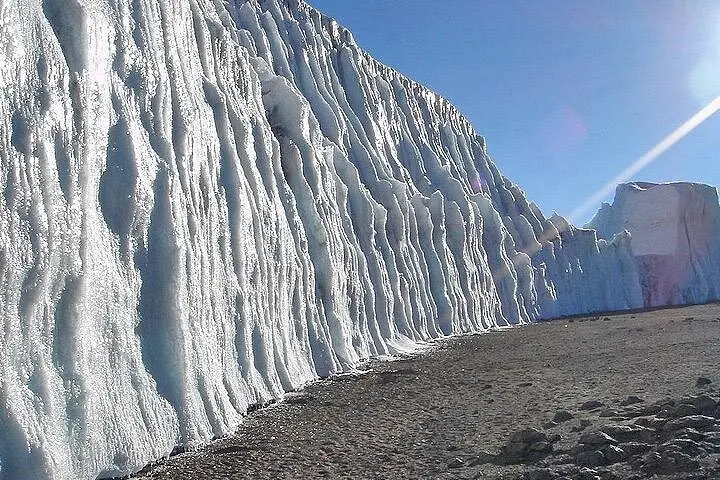
Kilimanjaro is a freestanding stratovolcano with three volcanic cones—Kibo, Mawenzi and Shira—whose glaciers once crowned the summit; those ice fields have been retreating for decades. The climb moves you through land stewarded by the Chagga people; many guides and porters are local, and the park’s permit fees support conservation and communities.
Practically, the Machame route is challenging rather than technical: no ropes or crampons are required in normal conditions, but altitude and loose scree demand respect. Acclimatization is built into the schedule—Lava Tower and Karanga are deliberate pauses. Expect rocky trails, steep steps like the Barranco Wall (a non-technical but steep 900 ft climb), and mud lower down.
Pack for extremes: layered clothing for cold summit nights, sturdy boots and trekking poles for knees on descent, and a reliable sleep system for high camps. Hydration and slow pacing are as important as fitness; many groups use a 1:2 walker-to-porter ratio so you can conserve energy. Be prepared for abrupt weather changes, and honor the mountain by minimizing waste—leave no trace and tip porters fairly.
For travelers who want spectacle with structure, the Machame 7-day climb is engineered to maximize summit odds while giving daily variety—rain forest, plateau panoramas, volcanic towers—and a sunrise at Stella Point that rarely disappoints.
No technical mountaineering skills are required for the Machame route, but prior multi-day trekking experience and good fitness are important due to altitude and long summit day.
June–October are the driest and most popular months with the most stable summit conditions; September–October can be slightly less crowded.
Acute mountain sickness is common at high elevations; the 7-day itinerary includes acclimatization stops (e.g., Lava Tower) and guides monitor symptoms, using descent and medical intervention when needed.
Yes—this trek includes guided camps, meals as listed, and crew who set up communal tents; bring personal sleeping bags and liners as required.
Climbers must have Kilimanjaro National Park permits and pay park and rescue fees; reputable operators handle permits and provide the necessary paperwork.
Tipping is customary; budgets vary but many groups allocate about $200–$300 per climber for the crew, distributed by the head guide.
Guide Private operates guided outdoor trips and adventures with an emphasis on safety, stewardship, and memorable experiences.
A cold headlamp beam threads the dark as a line of climbers winds up from Barafu Camp. The mountain breathes around them—an Arctic wind that prods and tests resolve—until Stella Point lights the sky and the summit of Uhuru Peak reveals itself against a flaming sunrise. The Machame, or “Whiskey,” route is a seven-day arc from rainforest to Arctic, designed to give you time on the mountain for both acclimatization and spectacle.
A cold headlamp beam threads the dark as a line of climbers winds up from Barafu Camp. The mountain breathes around them—an Arctic wind that prods and tests resolve—until Stella Point lights the sky and the summit of Uhuru Peak reveals itself against a flaming sunrise. The Machame, or “Whiskey,” route is a seven-day arc from rainforest to Arctic, designed to give you time on the mountain for both acclimatization and spectacle.
Your journey begins in Moshi with a 50-minute drive to Machame Gate. Trails climb through dense rain forest, where moss hangs from ancient branches and colobus monkeys watch with wary curiosity. Over a week you cross distinct habitats: heath and moorland on the Shira Plateau, the strange senecio and lobelia groves, a stark alpine desert around Lava Tower, and finally the arctic slopes near Kibo. Day-by-day specifics: Day 1 covers about 11 km (5–7 hours) from 5,380 ft to 9,350 ft; Day 3 reaches Lava Tower at 15,190 ft for crucial acclimatization; the summit push is a 5 km, 7–8 hour pre-dawn ascent from Barafu (15,331 ft) to Uhuru Peak (19,341 ft), followed by a long descent to Mweka.
Kilimanjaro is a freestanding stratovolcano with three volcanic cones—Kibo, Mawenzi and Shira—whose glaciers once crowned the summit; those ice fields have been retreating for decades. The climb moves you through land stewarded by the Chagga people; many guides and porters are local, and the park’s permit fees support conservation and communities.
Practically, the Machame route is challenging rather than technical: no ropes or crampons are required in normal conditions, but altitude and loose scree demand respect. Acclimatization is built into the schedule—Lava Tower and Karanga are deliberate pauses. Expect rocky trails, steep steps like the Barranco Wall (a non-technical but steep 900 ft climb), and mud lower down.
Pack for extremes: layered clothing for cold summit nights, sturdy boots and trekking poles for knees on descent, and a reliable sleep system for high camps. Hydration and slow pacing are as important as fitness; many groups use a 1:2 walker-to-porter ratio so you can conserve energy. Be prepared for abrupt weather changes, and honor the mountain by minimizing waste—leave no trace and tip porters fairly.
For travelers who want spectacle with structure, the Machame 7-day climb is engineered to maximize summit odds while giving daily variety—rain forest, plateau panoramas, volcanic towers—and a sunrise at Stella Point that rarely disappoints.