THE ADVENTURE COLLECTIVE® · Independent discovery and booking for outdoor travel

Step onto the Coney Island boardwalk for a two-hour walking tour that maps the area's golden-age inventions, amusement-park lore, and culinary legends. A local guide connects the physics of rides to the neighborhood stories that made Coney Island famous.
Step onto the Coney Island boardwalk for a two-hour walking tour that maps the area's golden-age inventions, amusement-park lore, and culinary legends. A local guide connects the physics of rides to the neighborhood stories that made Coney Island famous.
The Parachute Jump rises like a rusty exclamation point against a brassy sky as the boardwalk hums beneath your feet. Sea-salt wind pushes at your jacket and carnival calls—metallic, insistently cheerful—drift from rides and stands. On the Made in Brooklyn Coney Island Nostalgia Tour, you follow a local guide through two hours of concentrated history: the arcades, the bones of early thrill engineering, the faded posters of sideshows and a skyline of roller-coaster silhouettes.
Verified experiences and guided adventures in the surrounding area.
Operated by Made in Brooklyn Tours · Brooklyn, New York
The Parachute Jump rises like a rusty exclamation point against a brassy sky as the boardwalk hums beneath your feet. Sea-salt wind pushes at your jacket and carnival calls—metallic, insistently cheerful—drift from rides and stands. On the Made in Brooklyn Coney Island Nostalgia Tour, you follow a local guide through two hours of concentrated history: the arcades, the bones of early thrill engineering, the faded posters of sideshows and a skyline of roller-coaster silhouettes.
This strip of sand and steel has been a public laboratory since the late 19th century. Coney Island grew from a seaside refuge into a proving ground for spectacle and invention: early electric lighting that made the night possible, experimental elevators and towers that flirted with the same ambitions as Manhattan's first skyscrapers, and amusement parks like Luna Park that packaged modernity into looping rides and mechanized wonders. The Parachute Jump, brought to Coney Island after the 1939 World's Fair, is an emblem of that era—no longer operating as a ride but standing as an index finger pointing back to audacious public entertainment.
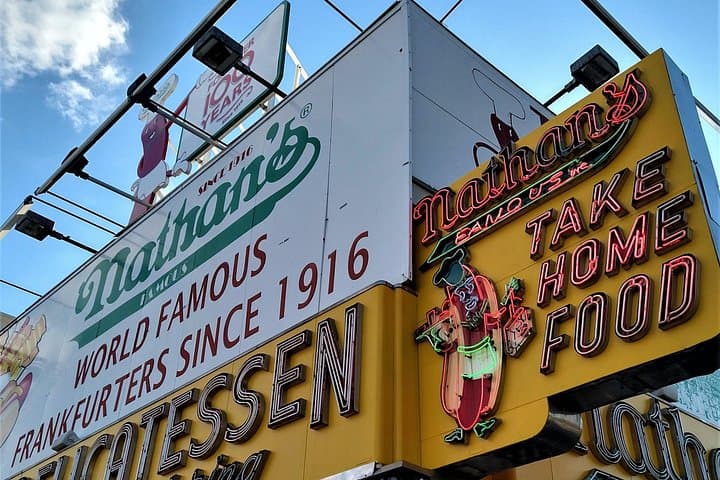
Culture here has always been a mix of the gritty and the celebratory. Immigrant communities shaped the food and music; Nathan's Famous turned a 1916 hot dog stand into a myth; the boardwalk has been a stage for working-class leisure, political rallies, and summer ballgames at Maimonides Park. The New York Aquarium, the oldest continually operating aquarium in the United States, anchors the eastern edge of the promenade with tanks and conservation programs that offset the commercial glare.
Practicalities are straightforward but firm. The tour meets at the boardwalk in front of the Parachute Jump behind Maimonides Park and departs at 12:30pm sharp—arrive ten minutes early. Expect about two hours of mostly level walking on boardwalk planks and paved promenades; the route ends at Nathan's Famous near the Stillwell Avenue subway station. Guides are Brooklyn natives and licensed NYC sightseeing guides who weave technical details (ride mechanics, dates, designers) into stories about community and industry.
What to bring: comfortable shoes for walking on wooden planks, sun protection, and a small bottle of water. The ocean will be both backdrop and actor—on windy days it dares you to stand at the rail and look past the breakers. Accessibility is excellent: surfaces and transit options are wheelchair accessible, and the tour is suitable for most fitness levels. Wear layers—the boardwalk temperature can shift quickly with onshore breezes.
This is a tour that asks you to look beneath bright lights: how an amusement district shaped social life and technological ambition, how a coastline absorbed innovation and immigrant energy, and how, while much has changed, the boardwalk still delivers the same direct pleasure it promised a century ago.
The meeting point is on the boardwalk in front of the Parachute Jump behind Maimonides Park; the tour ends at Nathan's Famous near the Coney Island – Stillwell Avenue subway station.
Yes—surfaces and transit options are wheelchair accessible, and the route uses level boardwalk and paved areas.
Expect roughly two hours of mostly flat walking along the boardwalk and nearby promenades—total distance varies but is manageable for most participants.
The tour is designed for ages 18 and over, per the operator's policy.
The tour operates in all weather conditions, but the operator reserves the right to cancel for severe weather; check your booking details and waiver links provided by the operator.
The tour ends at Nathan's Famous where you can buy food; guides usually ask that participants refrain from eating while moving to keep the group together.
Made in Brooklyn Tours operates guided outdoor trips and adventures with an emphasis on safety, stewardship, and memorable experiences.


The Parachute Jump rises like a rusty exclamation point against a brassy sky as the boardwalk hums beneath your feet. Sea-salt wind pushes at your jacket and carnival calls—metallic, insistently cheerful—drift from rides and stands. On the Made in Brooklyn Coney Island Nostalgia Tour, you follow a local guide through two hours of concentrated history: the arcades, the bones of early thrill engineering, the faded posters of sideshows and a skyline of roller-coaster silhouettes.
The Parachute Jump rises like a rusty exclamation point against a brassy sky as the boardwalk hums beneath your feet. Sea-salt wind pushes at your jacket and carnival calls—metallic, insistently cheerful—drift from rides and stands. On the Made in Brooklyn Coney Island Nostalgia Tour, you follow a local guide through two hours of concentrated history: the arcades, the bones of early thrill engineering, the faded posters of sideshows and a skyline of roller-coaster silhouettes.
This strip of sand and steel has been a public laboratory since the late 19th century. Coney Island grew from a seaside refuge into a proving ground for spectacle and invention: early electric lighting that made the night possible, experimental elevators and towers that flirted with the same ambitions as Manhattan's first skyscrapers, and amusement parks like Luna Park that packaged modernity into looping rides and mechanized wonders. The Parachute Jump, brought to Coney Island after the 1939 World's Fair, is an emblem of that era—no longer operating as a ride but standing as an index finger pointing back to audacious public entertainment.
Culture here has always been a mix of the gritty and the celebratory. Immigrant communities shaped the food and music; Nathan's Famous turned a 1916 hot dog stand into a myth; the boardwalk has been a stage for working-class leisure, political rallies, and summer ballgames at Maimonides Park. The New York Aquarium, the oldest continually operating aquarium in the United States, anchors the eastern edge of the promenade with tanks and conservation programs that offset the commercial glare.
Practicalities are straightforward but firm. The tour meets at the boardwalk in front of the Parachute Jump behind Maimonides Park and departs at 12:30pm sharp—arrive ten minutes early. Expect about two hours of mostly level walking on boardwalk planks and paved promenades; the route ends at Nathan's Famous near the Stillwell Avenue subway station. Guides are Brooklyn natives and licensed NYC sightseeing guides who weave technical details (ride mechanics, dates, designers) into stories about community and industry.
What to bring: comfortable shoes for walking on wooden planks, sun protection, and a small bottle of water. The ocean will be both backdrop and actor—on windy days it dares you to stand at the rail and look past the breakers. Accessibility is excellent: surfaces and transit options are wheelchair accessible, and the tour is suitable for most fitness levels. Wear layers—the boardwalk temperature can shift quickly with onshore breezes.
This is a tour that asks you to look beneath bright lights: how an amusement district shaped social life and technological ambition, how a coastline absorbed innovation and immigrant energy, and how, while much has changed, the boardwalk still delivers the same direct pleasure it promised a century ago.