THE ADVENTURE COLLECTIVE® · Independent discovery and booking for outdoor travel

Explore the Cradle of Humankind on a 5-hour tour to Maropeng and Sterkfontein Caves, where guided walks reveal fossils that shaped our understanding of human evolution. Expect cave steps, interactive exhibits, and a moderate amount of walking across uneven terrain.
Explore the Cradle of Humankind on a 5-hour tour to Maropeng and Sterkfontein Caves, where guided walks reveal fossils that shaped our understanding of human evolution. Expect cave steps, interactive exhibits, and a moderate amount of walking across uneven terrain.
You arrive on a pale, wind-scoured plain where grasslands press against limestone and the horizon feels unusually low — the Cradle of Humankind demands attention the moment you step from the vehicle.
Verified experiences and guided adventures in the surrounding area.
Operated by Pure diamond tours · Krugersdorp, Gauteng
You arrive on a pale, wind-scoured plain where grasslands press against limestone and the horizon feels unusually low — the Cradle of Humankind demands attention the moment you step from the vehicle.
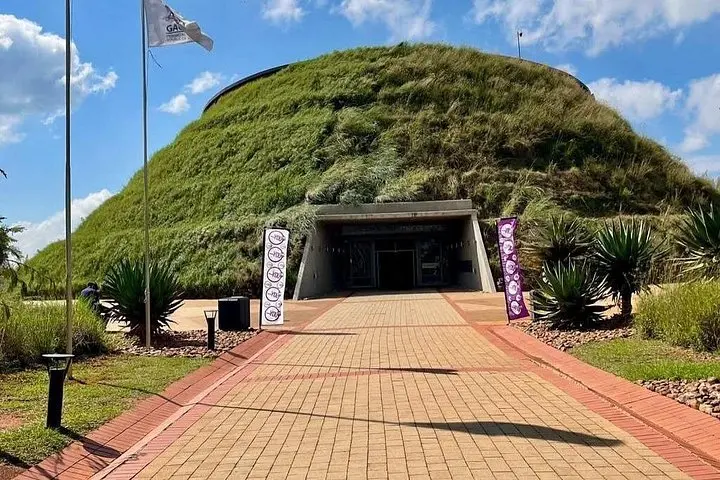
Begin at Maropeng, the visitors’ centre whose tumulus building guides you from the Big Bang to modern humans through interactive displays and a compact walk that frames the region's deep time. From there the route drops into Sterkfontein Caves: narrow passages, damp stone, and the steady drip of water that has preserved bones for millions of years. Guides lead at a calm pace, pointing out excavation finds such as "Mrs Ples" and the near-complete "Little Foot," explaining how shifting tectonics and limestone karst created channels that trapped and fossilized early hominins.
The landscape is shallowly folded dolomite country, dotted with sinkholes and fossil-rich doline deposits. Culturally, this is a living research landscape — paleontologists still work here — and local Setswana place names reflect long human presence on the plains.
Practical details: plan for roughly 4–5 hours including transfers, with about 1–2 km of easy-to-moderate walking across paved paths and uneven cave steps. Wear sturdy shoes and bring water; caves are cool and can be slippery. Photographs may be restricted inside dig areas, so check with guides. The tour suits travelers with moderate fitness; it’s not recommended for those with serious spinal or cardiovascular conditions or for late-stage pregnancy.
Timing your visit for morning light reduces crowds at Maropeng and gives the caves a quieter feel. Leave no trace — these fragile deposits are still being studied, and respecting marked paths helps preserve one of the planet’s most important archaeological archives.
The full experience is about 5 hours including Maropeng and a guided Sterkfontein cave visit; allow extra time for transfers.
Sterkfontein caves include uneven steps and low passages; the tour is not suitable for those with significant mobility limitations.
Yes — the tour includes admission to Maropeng and Sterkfontein as noted in the itinerary.
Children are welcome but supervision is required — cave passages can be narrow and slippery, and the content is most engaging for older children.
Pure diamond tours operates guided outdoor trips and adventures with an emphasis on safety, stewardship, and memorable experiences.

You arrive on a pale, wind-scoured plain where grasslands press against limestone and the horizon feels unusually low — the Cradle of Humankind demands attention the moment you step from the vehicle.
You arrive on a pale, wind-scoured plain where grasslands press against limestone and the horizon feels unusually low — the Cradle of Humankind demands attention the moment you step from the vehicle.
Begin at Maropeng, the visitors’ centre whose tumulus building guides you from the Big Bang to modern humans through interactive displays and a compact walk that frames the region's deep time. From there the route drops into Sterkfontein Caves: narrow passages, damp stone, and the steady drip of water that has preserved bones for millions of years. Guides lead at a calm pace, pointing out excavation finds such as "Mrs Ples" and the near-complete "Little Foot," explaining how shifting tectonics and limestone karst created channels that trapped and fossilized early hominins.
The landscape is shallowly folded dolomite country, dotted with sinkholes and fossil-rich doline deposits. Culturally, this is a living research landscape — paleontologists still work here — and local Setswana place names reflect long human presence on the plains.
Practical details: plan for roughly 4–5 hours including transfers, with about 1–2 km of easy-to-moderate walking across paved paths and uneven cave steps. Wear sturdy shoes and bring water; caves are cool and can be slippery. Photographs may be restricted inside dig areas, so check with guides. The tour suits travelers with moderate fitness; it’s not recommended for those with serious spinal or cardiovascular conditions or for late-stage pregnancy.
Timing your visit for morning light reduces crowds at Maropeng and gives the caves a quieter feel. Leave no trace — these fragile deposits are still being studied, and respecting marked paths helps preserve one of the planet’s most important archaeological archives.