THE ADVENTURE COLLECTIVE® · Independent discovery and booking for outdoor travel

Drive the Wildlife Loop and Needles Highway for up-close buffalo viewing, cathedral-like granite spires, and Iron Mountain Road’s pigtail bridges. This narrated 7–8 hour shared tour blends wildlife watching with geology, history, and practical stops for lunch and photos.
Drive the Wildlife Loop and Needles Highway for up-close buffalo viewing, cathedral-like granite spires, and Iron Mountain Road’s pigtail bridges. This narrated 7–8 hour shared tour blends wildlife watching with geology, history, and practical stops for lunch and photos.
A van eases off the two-lane shoulder and the landscape opens: low ridgelines of pine and oak, granite spires slicing the sky, and a ribbon of road that threads tunnels and hairpin turns. On the Custer State Park Wildlife Loop, a herd of buffalo—broad-shouldered, slow and deliberate—steps into view. Calves in spring wobble behind cows; a prairie dog pops its head from a mound like punctuation. The guide lowers the voice and the engine ticks as cameras lift.
Verified experiences and guided adventures in the surrounding area.
Operated by Affordable Adventures · Custer, South Dakota
A van eases off the two-lane shoulder and the landscape opens: low ridgelines of pine and oak, granite spires slicing the sky, and a ribbon of road that threads tunnels and hairpin turns. On the Custer State Park Wildlife Loop, a herd of buffalo—broad-shouldered, slow and deliberate—steps into view. Calves in spring wobble behind cows; a prairie dog pops its head from a mound like punctuation. The guide lowers the voice and the engine ticks as cameras lift.
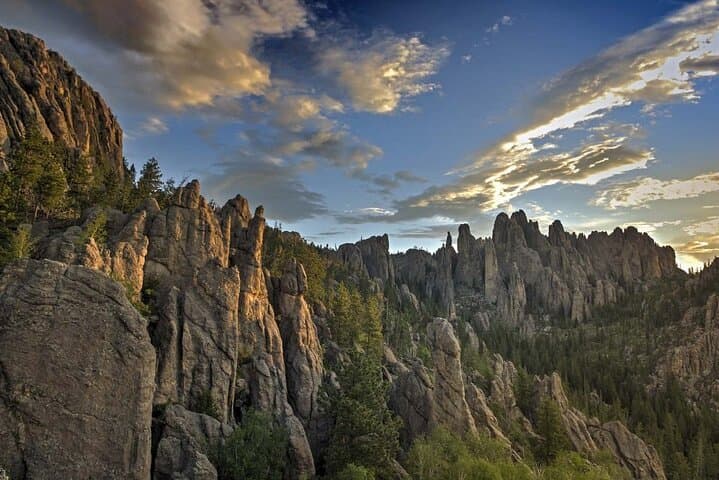
This shared 7–8 hour narrated drive stitches together the best of the southern Black Hills: a loop through Custer State Park for wildlife viewing, then up Needles Highway to the Needle’s Eye and Cathedral Spires, and over Iron Mountain Road where pigtail bridges and narrow tunnels frame distant views of Mount Rushmore. Geologically, the granite spires are the Black Hills’ ancient backbone—eroded batholiths revealing vertical cracks that weather into the sharp pinnacles you see at Cathedral Spires.
Cultural threads run tight here. The Black Hills are Lakota territory with long human histories that predate the park; later, Civilian Conservation Corps projects in the 1930s built much of the park infrastructure, shaping both access and conservation practices. Custer State Park itself was created as a game preserve and remains a working example of managed wildlife viewing—where bison and prairie species live in semi-wild conditions and occasional beggars—like the famous park burros—remind visitors that animals adapt quickly to human presence.
Practical guidance: expect a mostly seated day with several short stops for photos, restrooms and lunch. The tour covers a mix of paved park loops and twisting mountain highways; elevations typically range between about 4,700 and 5,500 feet, so mornings feel crisp. Bring binoculars and a telephoto lens for wildlife; patience is the real optical aid—animals move on their own schedule. Lunch can be purchased at Custer State Park Resort dining rooms or packed in advance; the tour allows time to buy food during a comfort stop.
Logistics are straightforward: shared groups are limited (small vans), bottled water, snacks and park entrance fees are included, and local pickup is usually provided from Rapid City-area hotels. Peak wildlife months are spring for calves and fall for dramatic light, but summer delivers the most stable road access. Safety notes: stay inside the vehicle around bison and keep clear distances—these animals act with deliberate force.
For travelers who want a compact immersion in Black Hills natural history, this drive is concentrated and practical—an afternoon of geology, wildlife encounters and cinematic mountain roads that leaves you with clear photos, clearer context, and a real sense of the land’s scale.
The tour lasts about 7–8 hours, including multiple stops for wildlife viewing, restroom breaks and lunch.
Buffalo are commonly seen on the Wildlife Loop, especially in spring and early fall, but wildlife sightings cannot be guaranteed.
Lunch is not included, but the itinerary includes a stop where you can buy lunch at Custer State Park Resort dining rooms; snacks and bottled water are provided.
Yes—there are scheduled comfort stops near the State Game Lodge and visitor centers along the route.
Yes—this is an easy-paced, seated tour suitable for all ages; infant seats are available on request.
Remain in the vehicle, keep windows partially closed, and follow the guide’s instructions—do not approach or feed wildlife.
Affordable Adventures operates guided outdoor trips and adventures with an emphasis on safety, stewardship, and memorable experiences.

A van eases off the two-lane shoulder and the landscape opens: low ridgelines of pine and oak, granite spires slicing the sky, and a ribbon of road that threads tunnels and hairpin turns. On the Custer State Park Wildlife Loop, a herd of buffalo—broad-shouldered, slow and deliberate—steps into view. Calves in spring wobble behind cows; a prairie dog pops its head from a mound like punctuation. The guide lowers the voice and the engine ticks as cameras lift.
A van eases off the two-lane shoulder and the landscape opens: low ridgelines of pine and oak, granite spires slicing the sky, and a ribbon of road that threads tunnels and hairpin turns. On the Custer State Park Wildlife Loop, a herd of buffalo—broad-shouldered, slow and deliberate—steps into view. Calves in spring wobble behind cows; a prairie dog pops its head from a mound like punctuation. The guide lowers the voice and the engine ticks as cameras lift.
This shared 7–8 hour narrated drive stitches together the best of the southern Black Hills: a loop through Custer State Park for wildlife viewing, then up Needles Highway to the Needle’s Eye and Cathedral Spires, and over Iron Mountain Road where pigtail bridges and narrow tunnels frame distant views of Mount Rushmore. Geologically, the granite spires are the Black Hills’ ancient backbone—eroded batholiths revealing vertical cracks that weather into the sharp pinnacles you see at Cathedral Spires.
Cultural threads run tight here. The Black Hills are Lakota territory with long human histories that predate the park; later, Civilian Conservation Corps projects in the 1930s built much of the park infrastructure, shaping both access and conservation practices. Custer State Park itself was created as a game preserve and remains a working example of managed wildlife viewing—where bison and prairie species live in semi-wild conditions and occasional beggars—like the famous park burros—remind visitors that animals adapt quickly to human presence.
Practical guidance: expect a mostly seated day with several short stops for photos, restrooms and lunch. The tour covers a mix of paved park loops and twisting mountain highways; elevations typically range between about 4,700 and 5,500 feet, so mornings feel crisp. Bring binoculars and a telephoto lens for wildlife; patience is the real optical aid—animals move on their own schedule. Lunch can be purchased at Custer State Park Resort dining rooms or packed in advance; the tour allows time to buy food during a comfort stop.
Logistics are straightforward: shared groups are limited (small vans), bottled water, snacks and park entrance fees are included, and local pickup is usually provided from Rapid City-area hotels. Peak wildlife months are spring for calves and fall for dramatic light, but summer delivers the most stable road access. Safety notes: stay inside the vehicle around bison and keep clear distances—these animals act with deliberate force.
For travelers who want a compact immersion in Black Hills natural history, this drive is concentrated and practical—an afternoon of geology, wildlife encounters and cinematic mountain roads that leaves you with clear photos, clearer context, and a real sense of the land’s scale.