THE ADVENTURE COLLECTIVE® · Independent discovery and booking for outdoor travel

Cycle quiet country lanes from Tissamaharama through Magampura to the Kirinda coast, skirting paddy fields and small villages. This four-hour guided ride offers close-up encounters with rural Sri Lankan life and easy terrain suited to riders with moderate fitness.
Cycle quiet country lanes from Tissamaharama through Magampura to the Kirinda coast, skirting paddy fields and small villages. This four-hour guided ride offers close-up encounters with rural Sri Lankan life and easy terrain suited to riders with moderate fitness.
A tuk-tuk breathes you out at the edge of Tissamaharama as dawn skims the paddy fields. You clip on a helmet supplied by the guide, and a narrow lane threads between flooded rice paddies and low hedgerows. The air smells of wet earth and coconut husk smoke; water buffalo lift their heads like slow sentries while egrets hop along the dikes.
Verified experiences and guided adventures in the surrounding area.
Operated by Beyond Escapes · Tissamaharama, Southern Province
A tuk-tuk breathes you out at the edge of Tissamaharama as dawn skims the paddy fields. You clip on a helmet supplied by the guide, and a narrow lane threads between flooded rice paddies and low hedgerows. The air smells of wet earth and coconut husk smoke; water buffalo lift their heads like slow sentries while egrets hop along the dikes.
This ride follows centuries-old routes that connect inland farming settlements to the southern coast. Geologically the area is coastal plain—flat, with sandy loams and freshwater tanks (man-made reservoirs) that farmers have managed for generations. Kirinda, the coastal endpoint, is a fishing village with a small temple and local stories tied to regional maritime history.
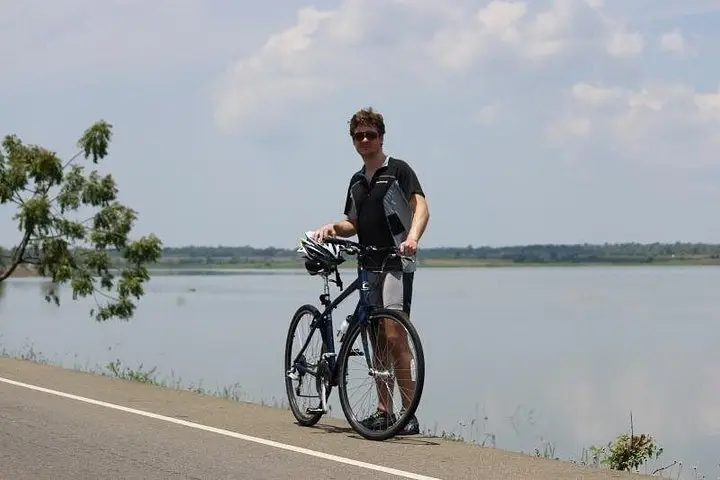
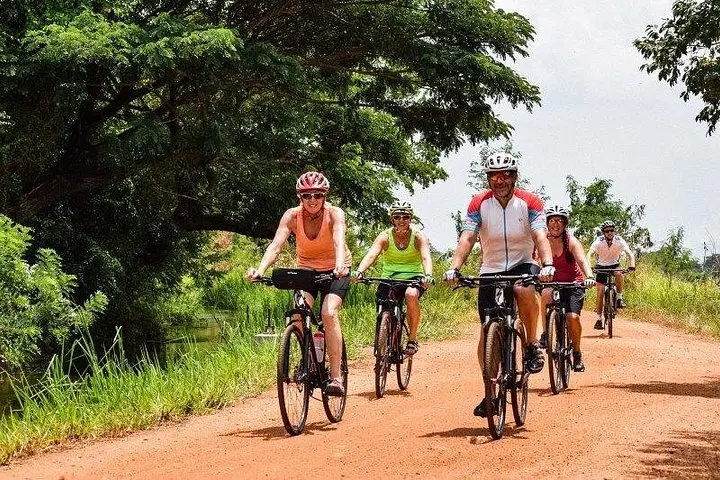
Expect roughly 20–30 km of cycling over four hours on a mix of quiet paved roads and packed-earth lanes, with minimal elevation gain. The terrain is forgiving but narrow; watch for tuk-tuks, livestock, and potholes. The guide's role is practical—route choice, traffic management, and cultural introductions—so you'll get a window into rural daily life: village markets, roadside tea stalls, and small-scale rice farming.
Practical pointers: start early to avoid the midday heat, bring at least 1–1.5 liters of water, wear closed-toe shoes and sun protection, and use insect repellent for stops near standing water. Weather can shift quickly during monsoon periods—operators may reschedule. Respect homes and fields, keep noise low, and carry small change for snacks or donations at village shops.
Yes—if you have basic cycling experience and moderate fitness; the roads are mostly flat but narrow and require traffic awareness.
Bicycle and helmet use, tuk-tuk transfers for pick-up/drop-off, an English-speaking cycling guide, and snacks are included.
The scheduled duration is about four hours, covering roughly 20–30 km with minimal elevation gain—moderate exertion at an easy-to-steady pace.
Operators may cancel or reschedule in heavy rain; check the 24-hour cancellation window and have flexible plans for monsoon season.
Beyond Escapes operates guided outdoor trips and adventures with an emphasis on safety, stewardship, and memorable experiences.

A tuk-tuk breathes you out at the edge of Tissamaharama as dawn skims the paddy fields. You clip on a helmet supplied by the guide, and a narrow lane threads between flooded rice paddies and low hedgerows. The air smells of wet earth and coconut husk smoke; water buffalo lift their heads like slow sentries while egrets hop along the dikes.
A tuk-tuk breathes you out at the edge of Tissamaharama as dawn skims the paddy fields. You clip on a helmet supplied by the guide, and a narrow lane threads between flooded rice paddies and low hedgerows. The air smells of wet earth and coconut husk smoke; water buffalo lift their heads like slow sentries while egrets hop along the dikes.
This ride follows centuries-old routes that connect inland farming settlements to the southern coast. Geologically the area is coastal plain—flat, with sandy loams and freshwater tanks (man-made reservoirs) that farmers have managed for generations. Kirinda, the coastal endpoint, is a fishing village with a small temple and local stories tied to regional maritime history.
Expect roughly 20–30 km of cycling over four hours on a mix of quiet paved roads and packed-earth lanes, with minimal elevation gain. The terrain is forgiving but narrow; watch for tuk-tuks, livestock, and potholes. The guide's role is practical—route choice, traffic management, and cultural introductions—so you'll get a window into rural daily life: village markets, roadside tea stalls, and small-scale rice farming.
Practical pointers: start early to avoid the midday heat, bring at least 1–1.5 liters of water, wear closed-toe shoes and sun protection, and use insect repellent for stops near standing water. Weather can shift quickly during monsoon periods—operators may reschedule. Respect homes and fields, keep noise low, and carry small change for snacks or donations at village shops.