THE ADVENTURE COLLECTIVE® · Independent discovery and booking for outdoor travel

Cross the Aegean in about 90 minutes from Pythagorio to Kusadasi, then trade a lively Turkish bazaar for the marble avenues of ancient Ephesus. This full-day shore excursion pairs a scenic boat crossing with guided history and free time to explore.
Cross the Aegean in about 90 minutes from Pythagorio to Kusadasi, then trade a lively Turkish bazaar for the marble avenues of ancient Ephesus. This full-day shore excursion pairs a scenic boat crossing with guided history and free time to explore.
You step onto the small ferry at Pythagorio just after dawn; the Aegean is cool and blue, the boat cutting a steady line toward Turkey. Sea spray taps your sunglasses and the distant silhouette of Güvercinada — the island of birds — grows until the fingerlike breakwater of Kusadasi fills the horizon. The crossing takes about 90 minutes, then the day unfolds between a bustling Turkish bazaar and the sun-warmed marble of ancient Ephesus.
Verified experiences and guided adventures in the surrounding area.
Operated by Cretan Holidays · Pythagorio, Samos
You step onto the small ferry at Pythagorio just after dawn; the Aegean is cool and blue, the boat cutting a steady line toward Turkey. Sea spray taps your sunglasses and the distant silhouette of Güvercinada — the island of birds — grows until the fingerlike breakwater of Kusadasi fills the horizon. The crossing takes about 90 minutes, then the day unfolds between a bustling Turkish bazaar and the sun-warmed marble of ancient Ephesus.
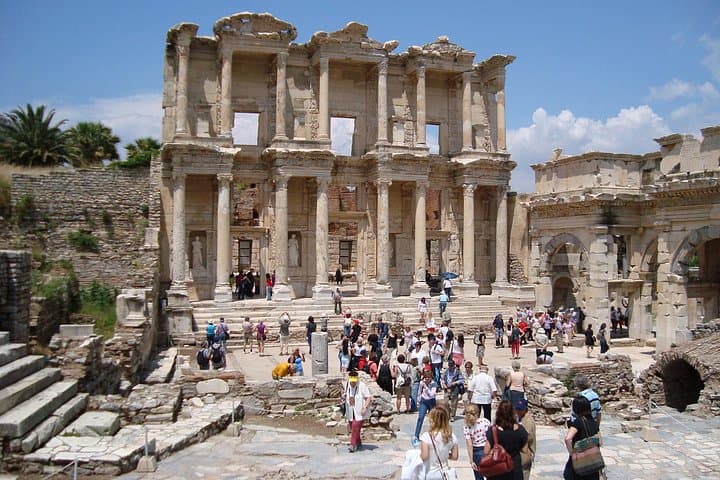
Ephesus began as an Ionian port city, later rebuilt under Roman rule; its marble streets, theater and library speak to layers of Greek and Roman urban design and to coastal geology that has changed the shoreline over millennia. Kusadasi’s bazaar reflects Ottoman and modern trading traditions — a place of spices, textiles and loud bargaining — while nearby Selçuk and the terraces of Ephesus offer quieter archaeological focus.
Expect cobbled lanes, sun-baked ruins and a rhythmic exchange between sea and city: boats bring visitors, markets push for attention, and the currents of history push back through stone. Practicalities matter: passports and an e-visa for Turkey, a 30-minute pre-departure check for passport control in Pythagorio, and a willingness to walk on uneven surfaces in open sun.
Plan your day around timing — the tour allocates a few hours for Kusadasi and an optional guided visit to Ephesus — wear sturdy shoes, carry water, and keep a light layer for the boat. With straightforward logistics and dramatic contrasts between market life and classical ruin, this day trip is a compact lesson in the Aegean’s cross-cultural geography.
Most travelers require an e‑visa obtained in advance at evisa.gov.tr; check nationality rules and carry your passport.
The crossing from Pythagorio to Kusadasi is roughly 90 minutes each way, depending on sea conditions.
Admission is not included in this excursion; if you join the optional guided visit expect to pay the archaeological site fee on arrival or via your guide.
Ephesus has uneven surfaces and many steps; travelers with limited mobility may find some areas inaccessible—check specifics with the operator before booking.
Cretan Holidays operates guided outdoor trips and adventures with an emphasis on safety, stewardship, and memorable experiences.


You step onto the small ferry at Pythagorio just after dawn; the Aegean is cool and blue, the boat cutting a steady line toward Turkey. Sea spray taps your sunglasses and the distant silhouette of Güvercinada — the island of birds — grows until the fingerlike breakwater of Kusadasi fills the horizon. The crossing takes about 90 minutes, then the day unfolds between a bustling Turkish bazaar and the sun-warmed marble of ancient Ephesus.
You step onto the small ferry at Pythagorio just after dawn; the Aegean is cool and blue, the boat cutting a steady line toward Turkey. Sea spray taps your sunglasses and the distant silhouette of Güvercinada — the island of birds — grows until the fingerlike breakwater of Kusadasi fills the horizon. The crossing takes about 90 minutes, then the day unfolds between a bustling Turkish bazaar and the sun-warmed marble of ancient Ephesus.
Ephesus began as an Ionian port city, later rebuilt under Roman rule; its marble streets, theater and library speak to layers of Greek and Roman urban design and to coastal geology that has changed the shoreline over millennia. Kusadasi’s bazaar reflects Ottoman and modern trading traditions — a place of spices, textiles and loud bargaining — while nearby Selçuk and the terraces of Ephesus offer quieter archaeological focus.
Expect cobbled lanes, sun-baked ruins and a rhythmic exchange between sea and city: boats bring visitors, markets push for attention, and the currents of history push back through stone. Practicalities matter: passports and an e-visa for Turkey, a 30-minute pre-departure check for passport control in Pythagorio, and a willingness to walk on uneven surfaces in open sun.
Plan your day around timing — the tour allocates a few hours for Kusadasi and an optional guided visit to Ephesus — wear sturdy shoes, carry water, and keep a light layer for the boat. With straightforward logistics and dramatic contrasts between market life and classical ruin, this day trip is a compact lesson in the Aegean’s cross-cultural geography.