THE ADVENTURE COLLECTIVE® · Independent discovery and booking for outdoor travel

A full‑day private drive from Agadir into the Anti‑Atlas that pairs Tafraoute’s painted rocks and traditional granaries with Tiznit’s fortified medina and silver workshops. Expect long drives, short walks, and hands‑on cultural encounters with local artisans.
A full‑day private drive from Agadir into the Anti‑Atlas that pairs Tafraoute’s painted rocks and traditional granaries with Tiznit’s fortified medina and silver workshops. Expect long drives, short walks, and hands‑on cultural encounters with local artisans.
You step out of Agadir's coastal air into a car that threads south into the Anti‑Atlas — the road climbs, olive and argan trees blur by, and the landscape hardens into rounded granite boulders that seem to defy gravity.
Verified experiences and guided adventures in the surrounding area.
Operated by Agharass Tours · Agadir, Souss-Massa
You step out of Agadir's coastal air into a car that threads south into the Anti‑Atlas — the road climbs, olive and argan trees blur by, and the landscape hardens into rounded granite boulders that seem to defy gravity.
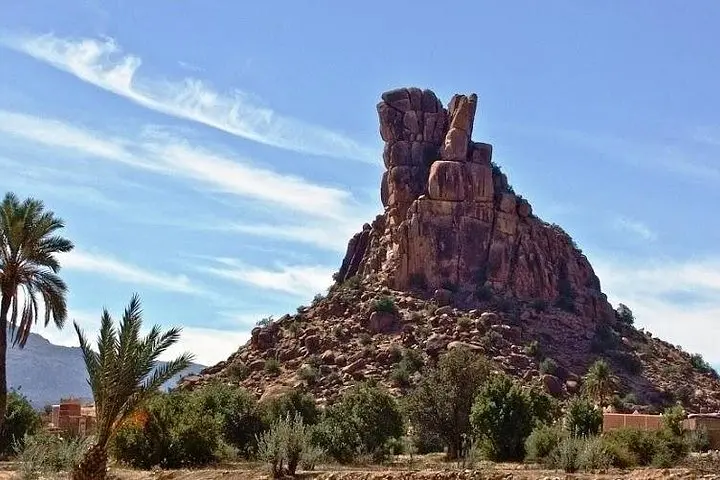
In Tafraoute the rocks wear color: the painted boulders and smooth, wind‑scoured domes form a low mountain stage where women in traditional Berber dress move through small markets and valley hamlets. Geologically, the Anti‑Atlas is old crust, its granite shaped by millions of years of erosion; culturally, this is Berber country where small stone granaries like Imchguiguilen and Tizergane record community food storage practices that predate modern supply chains.
The day continues to Tiznit, a fortified silver city with a compact medina, ring walls and narrow lanes of jewelry workshops. Tiznit’s silversmithing boomed in the late 19th century under Sultan Hassan I and remains a living craft — expect to see hand‑hammered belts, amulets and filigree earrings.
Practical side: this is a long, full‑day private transfer (roughly 10–12 hours door‑to‑door). Driving covers winding mountain roads and stretches of paved highway; wear supportive shoes for town exploration, bring sun protection and cash for market purchases, and allow time for photo stops and relaxed bargaining.
Timing: start early to avoid midday heat and to make the most of both stops. Hydrate between towns; the vehicle gives shade, but village shade is limited. The mix of geology, craft and living tradition makes the route a compact portrait of southern Moroccan life.
Yes — the tour includes hotel pickup and drop‑off in Agadir; confirm your pickup address when booking.
Walking is limited to exploring the medina, jewelry stalls and short approaches to granaries and painted rocks — generally light, but on uneven ground.
Lunch in Tafraoute is provided as part of the itinerary; check dietary needs with the operator in advance.
This is a private tour and most operators will adjust timing or stops on request, subject to schedule and minimum participant rules.
Agharass Tours operates guided outdoor trips and adventures with an emphasis on safety, stewardship, and memorable experiences.
You step out of Agadir's coastal air into a car that threads south into the Anti‑Atlas — the road climbs, olive and argan trees blur by, and the landscape hardens into rounded granite boulders that seem to defy gravity.
You step out of Agadir's coastal air into a car that threads south into the Anti‑Atlas — the road climbs, olive and argan trees blur by, and the landscape hardens into rounded granite boulders that seem to defy gravity.
In Tafraoute the rocks wear color: the painted boulders and smooth, wind‑scoured domes form a low mountain stage where women in traditional Berber dress move through small markets and valley hamlets. Geologically, the Anti‑Atlas is old crust, its granite shaped by millions of years of erosion; culturally, this is Berber country where small stone granaries like Imchguiguilen and Tizergane record community food storage practices that predate modern supply chains.
The day continues to Tiznit, a fortified silver city with a compact medina, ring walls and narrow lanes of jewelry workshops. Tiznit’s silversmithing boomed in the late 19th century under Sultan Hassan I and remains a living craft — expect to see hand‑hammered belts, amulets and filigree earrings.
Practical side: this is a long, full‑day private transfer (roughly 10–12 hours door‑to‑door). Driving covers winding mountain roads and stretches of paved highway; wear supportive shoes for town exploration, bring sun protection and cash for market purchases, and allow time for photo stops and relaxed bargaining.
Timing: start early to avoid midday heat and to make the most of both stops. Hydrate between towns; the vehicle gives shade, but village shade is limited. The mix of geology, craft and living tradition makes the route a compact portrait of southern Moroccan life.