THE ADVENTURE COLLECTIVE® · Independent discovery and booking for outdoor travel

Combine the stony Agafay Desert with foothill villages of the High Atlas on a full-day trip from Marrakech. Expect village walks, mint tea with a Berber family, and a short camel trek across rocky desert plains.
Combine the stony Agafay Desert with foothill villages of the High Atlas on a full-day trip from Marrakech. Expect village walks, mint tea with a Berber family, and a short camel trek across rocky desert plains.
You leave Marrakech mid-morning and the city’s ochre walls blur into a widening horizon of folded mountains and stony plains.
Verified experiences and guided adventures in the surrounding area.
Operated by RMT Tours · Marrakech, Marrakech-Safi
You leave Marrakech mid-morning and the city’s ochre walls blur into a widening horizon of folded mountains and stony plains.
The drive climbs toward the High Atlas, where terraced fields and Berber villages cling to slopes and the road offers the first clear views of Imlil and the Kik Plateau. Geologically the High Atlas is a young, uplifted range of folded sedimentary and volcanic rock; below it the Agafay is not sand but a moonlike expanse of gravel and sculpted stone where light and shadow sharpen ridgelines.
Culturally the day is a compact lesson in rural Morocco: a stop at Amizmiz or a weekly souk connects you to farmers and traders; a cup of mint tea in a Berber home and a shared lunch in Tnirt introduce local cuisine and hospitality; short village walks reveal flat stone streets, earthen houses and terraces.
The afternoon turns to the Agafay plateau for a gentle camel trek across wind-carved rock—photogenic, accessible, and quieter than the Sahara caravans. Expect mostly paved and graded dirt roads with short on-foot sections; Imlil sits near 1,740 m elevation but the day’s walking has minimal sustained gain.
Practical: plan for an 8–10 hour day with hotel pickup and drop-off, carry sun protection, cash for souks and tips, and wear closed-toe shoes for village paths and the camel trek. The route is suitable for most fitness levels and offers a concentrated mix of geology, culture, and accessible desert scenery.
Most departures begin around 9:00 AM and return to Marrakech in the early evening, typically 8–10 hours total.
Yes — the camel trek included is short and guided, designed for novice riders with assistance mounting and dismounting.
Lunch in a Berber home is usually included; bring cash for additional snacks, tea at souks, or personal purchases.
Transport and many areas are accessible, but village streets and the camel area can be uneven—check with the operator for specific accessibility needs.
RMT Tours operates guided outdoor trips and adventures with an emphasis on safety, stewardship, and memorable experiences.


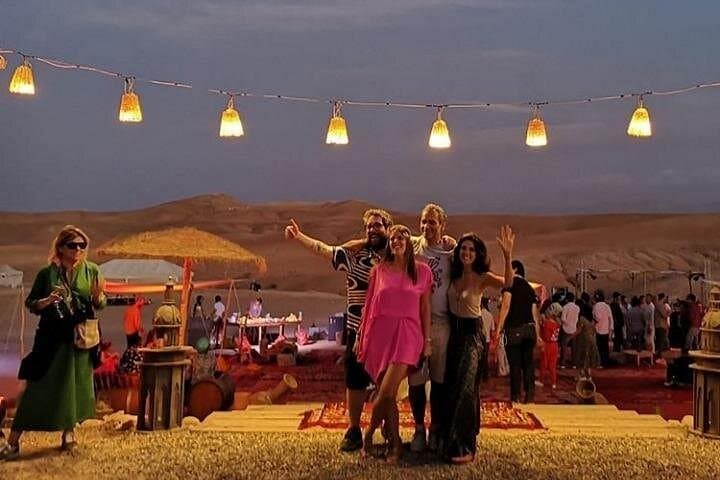
You leave Marrakech mid-morning and the city’s ochre walls blur into a widening horizon of folded mountains and stony plains.
You leave Marrakech mid-morning and the city’s ochre walls blur into a widening horizon of folded mountains and stony plains.
The drive climbs toward the High Atlas, where terraced fields and Berber villages cling to slopes and the road offers the first clear views of Imlil and the Kik Plateau. Geologically the High Atlas is a young, uplifted range of folded sedimentary and volcanic rock; below it the Agafay is not sand but a moonlike expanse of gravel and sculpted stone where light and shadow sharpen ridgelines.
Culturally the day is a compact lesson in rural Morocco: a stop at Amizmiz or a weekly souk connects you to farmers and traders; a cup of mint tea in a Berber home and a shared lunch in Tnirt introduce local cuisine and hospitality; short village walks reveal flat stone streets, earthen houses and terraces.
The afternoon turns to the Agafay plateau for a gentle camel trek across wind-carved rock—photogenic, accessible, and quieter than the Sahara caravans. Expect mostly paved and graded dirt roads with short on-foot sections; Imlil sits near 1,740 m elevation but the day’s walking has minimal sustained gain.
Practical: plan for an 8–10 hour day with hotel pickup and drop-off, carry sun protection, cash for souks and tips, and wear closed-toe shoes for village paths and the camel trek. The route is suitable for most fitness levels and offers a concentrated mix of geology, culture, and accessible desert scenery.