THE ADVENTURE COLLECTIVE® · Independent discovery and booking for outdoor travel

Spend a day moving from the jungle-cradled temple ruins of My Son to the lantern-lit streets of Hoi An. This private transfer pairs guided exploration of Champa monuments with a walk through a UNESCO-listed trading town.
Spend a day moving from the jungle-cradled temple ruins of My Son to the lantern-lit streets of Hoi An. This private transfer pairs guided exploration of Champa monuments with a walk through a UNESCO-listed trading town.
You slide out of a private car onto a sun-steeped valley rim where red-brick towers poke through low jungle—My Son’s ruins present themselves like a book left open to the Champa kingdom. The driver waits as a bumbling buggy drops you at the clustered sanctuaries; later, the same road eases you into Hoi An’s narrow lanes where lanterns collect on the Thu Bon River like quiet promises.
Verified experiences and guided adventures in the surrounding area.
Operated by Danang Private Taxi · Hoi An, Quang Nam
You slide out of a private car onto a sun-steeped valley rim where red-brick towers poke through low jungle—My Son’s ruins present themselves like a book left open to the Champa kingdom. The driver waits as a bumbling buggy drops you at the clustered sanctuaries; later, the same road eases you into Hoi An’s narrow lanes where lanterns collect on the Thu Bon River like quiet promises.
My Son was the spiritual heart of the Champa from roughly the 4th to 13th centuries, constructed from fired brick and decorated with carved sandstone. Geologically the valley is sheltered, hemmed by low karst ridges and dense tropical vegetation that both conceal and preserve sculpture. Hoi An, by contrast, grew as a trading port between the 15th and 19th centuries; its wooden merchant houses, the covered Japanese Bridge and assembly halls show Chinese, Japanese and European influences meeting on a narrow estuary.
Expect short, uneven walks through My Son’s temple groups—some paths are muddy after rain—and cobbled streets in Hoi An where bicycles and scooters thread the alleys. Practical notes: travel time from Da Nang is about 60–90 minutes each way, wear closed shoes for the temple grounds, carry water and modest clothing to enter sacred areas. Bring small change for local markets, and schedule My Son in the cooler morning hours to avoid midday heat.
This day pairs archaeology with living town culture: history on stone, and everyday life by lantern light—both are best experienced slowly and respectfully.
Expect approximately 60–90 minutes each way depending on traffic; travel from Hoi An is shorter at roughly 45 minutes.
Admissions to My Son and Hoi An highlights are typically included in guided packages—confirm with the operator before booking.
The driving and roads are fine for children, but stroller access is limited at My Son due to uneven terrain; infant seats are available in cars.
Most full-day private transfers can be tailored—ask about adding local craft villages, a riverside lunch, or a silk workshop in Hoi An.
Danang Private Taxi operates guided outdoor trips and adventures with an emphasis on safety, stewardship, and memorable experiences.
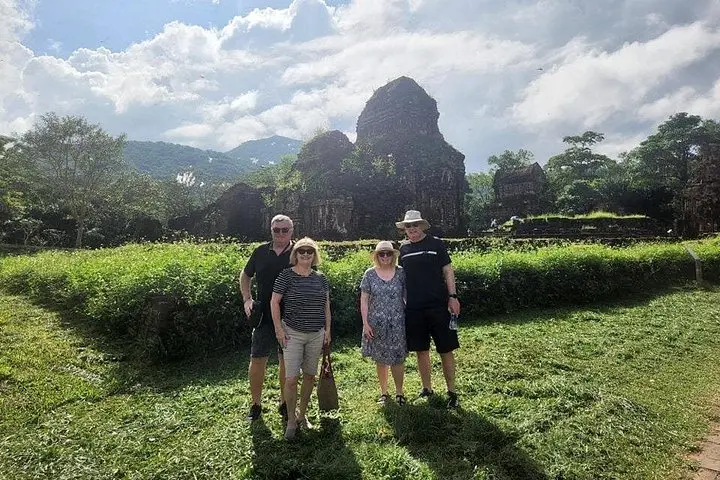



You slide out of a private car onto a sun-steeped valley rim where red-brick towers poke through low jungle—My Son’s ruins present themselves like a book left open to the Champa kingdom. The driver waits as a bumbling buggy drops you at the clustered sanctuaries; later, the same road eases you into Hoi An’s narrow lanes where lanterns collect on the Thu Bon River like quiet promises.
You slide out of a private car onto a sun-steeped valley rim where red-brick towers poke through low jungle—My Son’s ruins present themselves like a book left open to the Champa kingdom. The driver waits as a bumbling buggy drops you at the clustered sanctuaries; later, the same road eases you into Hoi An’s narrow lanes where lanterns collect on the Thu Bon River like quiet promises.
My Son was the spiritual heart of the Champa from roughly the 4th to 13th centuries, constructed from fired brick and decorated with carved sandstone. Geologically the valley is sheltered, hemmed by low karst ridges and dense tropical vegetation that both conceal and preserve sculpture. Hoi An, by contrast, grew as a trading port between the 15th and 19th centuries; its wooden merchant houses, the covered Japanese Bridge and assembly halls show Chinese, Japanese and European influences meeting on a narrow estuary.
Expect short, uneven walks through My Son’s temple groups—some paths are muddy after rain—and cobbled streets in Hoi An where bicycles and scooters thread the alleys. Practical notes: travel time from Da Nang is about 60–90 minutes each way, wear closed shoes for the temple grounds, carry water and modest clothing to enter sacred areas. Bring small change for local markets, and schedule My Son in the cooler morning hours to avoid midday heat.
This day pairs archaeology with living town culture: history on stone, and everyday life by lantern light—both are best experienced slowly and respectfully.