THE ADVENTURE COLLECTIVE® · Independent discovery and booking for outdoor travel

Spend a day above Chiang Mai on Thailand’s highest peak: hike the Kew Mae Pan trail, feel the spray of Wachirathan Waterfall, and meet hill-tribe villages while an English-speaking guide handles transport and logistics.
Spend a day above Chiang Mai on Thailand’s highest peak: hike the Kew Mae Pan trail, feel the spray of Wachirathan Waterfall, and meet hill-tribe villages while an English-speaking guide handles transport and logistics.
Morning mist clings to the slopes as the van climbs out of Chiang Mai; moss-dark trunks slide past the windows and the air cools until you can see your breath. At Doi Inthanon, Thailand’s highest peak juts from the northern highlands, a granite shoulder capped in cloud forest and crowned with twin chedis.
Verified experiences and guided adventures in the surrounding area.
Operated by Trips Planners · Chiang Mai, Chiang Mai
Morning mist clings to the slopes as the van climbs out of Chiang Mai; moss-dark trunks slide past the windows and the air cools until you can see your breath. At Doi Inthanon, Thailand’s highest peak juts from the northern highlands, a granite shoulder capped in cloud forest and crowned with twin chedis.
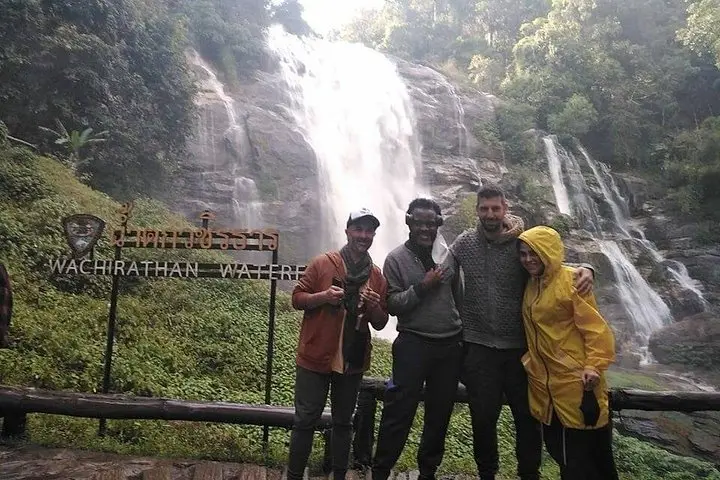
Geology here is compacted metamorphic rock—older than the surrounding lowlands—carving deep ravines and feeding several powerful falls, including Wachirathan, whose spray dares you to step closer. The park was designated in 1972 to protect those upland ecosystems and the hill-tribe communities—Hmong and Karen—whose villages sit on stepped terraces and sell woven handicrafts.
On a guided day trip you’ll hike the Kew Mae Pan Nature Trail (roughly 2.8 km, marked boardwalks and steep sections), visit viewpoints at the summit, sample local produce at the Royal Agricultural Research Center, and pause at watchful waterfalls. Cultural stops give a brief window into Hmong and Karen livelihoods—handicrafts, coffee, and highland farming—without an overnight stay.
Practical edge: expect sharp temperature swings—dawn can be near 10°C (50°F) in cool months—so layer. Trails are variable: compact dirt, exposed roots, and boardwalk; good footing matters. Bring water, a waterproof layer during the monsoon, and give yourself time for roadside photo stops; travel time from Chiang Mai is roughly 1.5–2 hours each way. The route is well-suited to fit into a single long day, offering botanical variety, brisk viewpoints, and a measured dose of cultural contact all within accessible reach of Chiang Mai.
The main route is about 2.7–2.8 km round-trip on marked boardwalks and forest trail; expect 1–1.5 hours with stops.
The tour involves uphill walking and some stairs; those with limited mobility should consider skipping steep sections—infants must sit on laps during transport.
Most organized day tours include park admission and a set-menu lunch at the Royal Agricultural Research Center; confirm with the operator before booking.
November–February (cool, dry season) yields the clearest skies and cooler temperatures; mornings still offer the best visibility year-round.
Trips Planners operates guided outdoor trips and adventures with an emphasis on safety, stewardship, and memorable experiences.

Morning mist clings to the slopes as the van climbs out of Chiang Mai; moss-dark trunks slide past the windows and the air cools until you can see your breath. At Doi Inthanon, Thailand’s highest peak juts from the northern highlands, a granite shoulder capped in cloud forest and crowned with twin chedis.
Morning mist clings to the slopes as the van climbs out of Chiang Mai; moss-dark trunks slide past the windows and the air cools until you can see your breath. At Doi Inthanon, Thailand’s highest peak juts from the northern highlands, a granite shoulder capped in cloud forest and crowned with twin chedis.
Geology here is compacted metamorphic rock—older than the surrounding lowlands—carving deep ravines and feeding several powerful falls, including Wachirathan, whose spray dares you to step closer. The park was designated in 1972 to protect those upland ecosystems and the hill-tribe communities—Hmong and Karen—whose villages sit on stepped terraces and sell woven handicrafts.
On a guided day trip you’ll hike the Kew Mae Pan Nature Trail (roughly 2.8 km, marked boardwalks and steep sections), visit viewpoints at the summit, sample local produce at the Royal Agricultural Research Center, and pause at watchful waterfalls. Cultural stops give a brief window into Hmong and Karen livelihoods—handicrafts, coffee, and highland farming—without an overnight stay.
Practical edge: expect sharp temperature swings—dawn can be near 10°C (50°F) in cool months—so layer. Trails are variable: compact dirt, exposed roots, and boardwalk; good footing matters. Bring water, a waterproof layer during the monsoon, and give yourself time for roadside photo stops; travel time from Chiang Mai is roughly 1.5–2 hours each way. The route is well-suited to fit into a single long day, offering botanical variety, brisk viewpoints, and a measured dose of cultural contact all within accessible reach of Chiang Mai.