THE ADVENTURE COLLECTIVE® · Independent discovery and booking for outdoor travel

Turn a transfer day between Dresden and Prague into a concentrated field trip through the Elbe Sandstone Mountains. This private seven-hour tour pairs Bastei Bridge’s cliff-top panoramas with the tight rock corridors of Tisa Rocks, plus a hearty regional lunch.
Turn a transfer day between Dresden and Prague into a concentrated field trip through the Elbe Sandstone Mountains. This private seven-hour tour pairs Bastei Bridge’s cliff-top panoramas with the tight rock corridors of Tisa Rocks, plus a hearty regional lunch.
The minivan hums away from Dresden’s baroque center before the river gives up its last reflections of tiled roofs and church spires. Within half an hour the city unwinds into a corridor of beech and spruce, the highway threading toward the Elbe Sandstone Mountains. Your guide slides open a map and, between stories of Saxon kings and border smuggling, points to a jagged silhouette on the horizon: the Bastei.
Verified experiences and guided adventures in the surrounding area.
Operated by Saxon Tours · Dresden, Saxony
The minivan hums away from Dresden’s baroque center before the river gives up its last reflections of tiled roofs and church spires. Within half an hour the city unwinds into a corridor of beech and spruce, the highway threading toward the Elbe Sandstone Mountains. Your guide slides open a map and, between stories of Saxon kings and border smuggling, points to a jagged silhouette on the horizon: the Bastei.
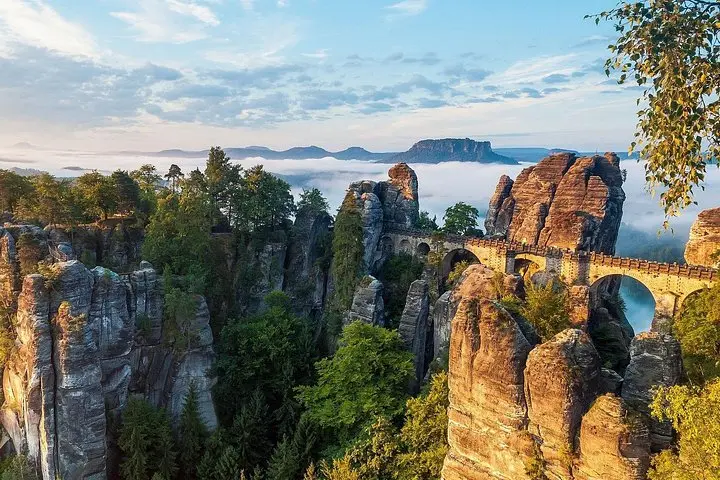
At the Bastei Bridge the rocks themselves seem to lean toward the valley to get a better look. The viewpoint delivers a raw, wind-etched panorama — spires of sandstone, the braided Elbe far below, and forest that presses right up to the cliff edge. The bridge, an iron structure cradled by ancient stone, was built to shepherd 19th-century travelers to the best vantage points and still funnels visitors to the same cinematic spots.
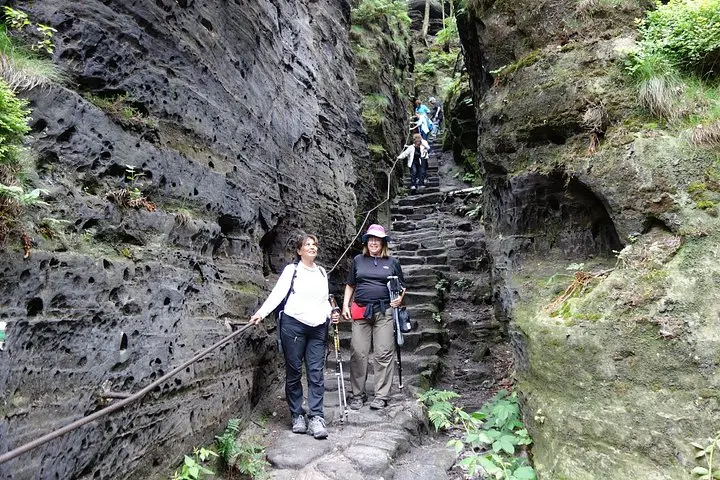
Geology here is patient and theatrical. The Elbe Sandstone massif is a Cretaceous formation carved over millennia by water and freeze-thaw cycles into towers, chimneys and narrow passages. Cross the border into the Czech Republic and the rock language changes name only — Tisa Rocks (Tiské stěny) is a labyrinth of vertical walls, natural corridors and precarious stairways that invite slow exploration and short, sharp climbs.
Culturally this route traces a Central European seam: Saxon fortresses like Königstein and the former military sites near Terezín speak to shifting borders and layered histories. The towns you pass are compact and practical — beer halls and bakeries that function as both refueling stations and living museums.
Practical guidance: the door-to-door journey runs about seven hours including two main stops and a restaurant lunch. Walking at Bastei is easy to moderate — expect 0.5–1.5 km of paved and rocky paths with roughly 100–200 m of elevation change from the nearest parking. Tisa Rocks involves narrow stone steps and route-finding inside the labyrinth for 1.5–3 km; some sections require hands for balance. Carry comfortable shoes with grip, a lightweight rain layer, and water. Border crossing is nominal within Schengen, but carry ID; Czech Republic uses the Czech koruna so bring a card or a small amount of cash for snacks.
Timing matters: mornings catch the soft light on the sandstone and thinner crowds. The tour is private and customizable — ask about adding Königstein or the sobering historical site at Terezín if you prefer fortresses or memorials. For photographers, golden-hour light sculpts the rocks; hikers will find short, satisfying climbs; food lovers will appreciate a proper hot lunch before the final stretch into Prague.
The private tour lasts about seven hours, departing from downtown Dresden with hotel pickup and dropping guests off in Prague city center.
Walking is generally easy to moderate: short climbs, uneven paths and steps at viewpoints—no technical climbing required but steady shoes recommended.
Both Germany and Czech Republic are in Schengen, so routine passport control is rare, but you should carry a government ID or passport at all times.
Admission to the Tisa Rocks Labyrinth is included where specified in the itinerary; confirm at booking if you plan to add extra stops like Königstein.
Yes — the tour is private and the guide can adjust timing or add sites such as Königstein Fortress or the Terezín memorial on request.
Yes — the tour notes infant seats available and is family-friendly, though parents should supervise children in narrow or elevated rock sections.
Saxon Tours operates guided outdoor trips and adventures with an emphasis on safety, stewardship, and memorable experiences.
The minivan hums away from Dresden’s baroque center before the river gives up its last reflections of tiled roofs and church spires. Within half an hour the city unwinds into a corridor of beech and spruce, the highway threading toward the Elbe Sandstone Mountains. Your guide slides open a map and, between stories of Saxon kings and border smuggling, points to a jagged silhouette on the horizon: the Bastei.
The minivan hums away from Dresden’s baroque center before the river gives up its last reflections of tiled roofs and church spires. Within half an hour the city unwinds into a corridor of beech and spruce, the highway threading toward the Elbe Sandstone Mountains. Your guide slides open a map and, between stories of Saxon kings and border smuggling, points to a jagged silhouette on the horizon: the Bastei.
At the Bastei Bridge the rocks themselves seem to lean toward the valley to get a better look. The viewpoint delivers a raw, wind-etched panorama — spires of sandstone, the braided Elbe far below, and forest that presses right up to the cliff edge. The bridge, an iron structure cradled by ancient stone, was built to shepherd 19th-century travelers to the best vantage points and still funnels visitors to the same cinematic spots.
Geology here is patient and theatrical. The Elbe Sandstone massif is a Cretaceous formation carved over millennia by water and freeze-thaw cycles into towers, chimneys and narrow passages. Cross the border into the Czech Republic and the rock language changes name only — Tisa Rocks (Tiské stěny) is a labyrinth of vertical walls, natural corridors and precarious stairways that invite slow exploration and short, sharp climbs.
Culturally this route traces a Central European seam: Saxon fortresses like Königstein and the former military sites near Terezín speak to shifting borders and layered histories. The towns you pass are compact and practical — beer halls and bakeries that function as both refueling stations and living museums.
Practical guidance: the door-to-door journey runs about seven hours including two main stops and a restaurant lunch. Walking at Bastei is easy to moderate — expect 0.5–1.5 km of paved and rocky paths with roughly 100–200 m of elevation change from the nearest parking. Tisa Rocks involves narrow stone steps and route-finding inside the labyrinth for 1.5–3 km; some sections require hands for balance. Carry comfortable shoes with grip, a lightweight rain layer, and water. Border crossing is nominal within Schengen, but carry ID; Czech Republic uses the Czech koruna so bring a card or a small amount of cash for snacks.
Timing matters: mornings catch the soft light on the sandstone and thinner crowds. The tour is private and customizable — ask about adding Königstein or the sobering historical site at Terezín if you prefer fortresses or memorials. For photographers, golden-hour light sculpts the rocks; hikers will find short, satisfying climbs; food lovers will appreciate a proper hot lunch before the final stretch into Prague.