THE ADVENTURE COLLECTIVE® · Independent discovery and booking for outdoor travel

Ride in vintage Land Rovers into the Dubai Desert Conservation Reserve for dune bashing, camel rides, a falconry show and a four-course Bedouin-inspired dinner timed for sunset. This four-hour heritage safari blends adrenaline with cultural insights and wildlife spotting.
Ride in vintage Land Rovers into the Dubai Desert Conservation Reserve for dune bashing, camel rides, a falconry show and a four-course Bedouin-inspired dinner timed for sunset. This four-hour heritage safari blends adrenaline with cultural insights and wildlife spotting.
A vintage Land Rover rumbles away from Dubai’s paved edges and into a sea of wind-sculpted sand. Golden ridgelines rise and fall like slow ocean swells; the dunes seem to dare you forward as the sun tilts toward the western horizon. Leather seats creak, the engine murmurs, and in the distance a falcon wheels against a thinning blue.
Verified experiences and guided adventures in the surrounding area.
Operated by Tripline Tourism · Dubai, Dubai
A vintage Land Rover rumbles away from Dubai’s paved edges and into a sea of wind-sculpted sand. Golden ridgelines rise and fall like slow ocean swells; the dunes seem to dare you forward as the sun tilts toward the western horizon. Leather seats creak, the engine murmurs, and in the distance a falcon wheels against a thinning blue.
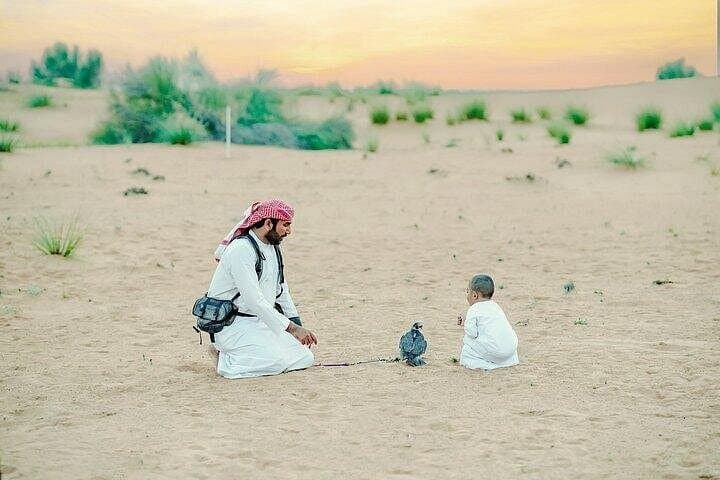
The experience layers modern Dubai against an older desert logic. The Dubai Desert Conservation Reserve protects patches of native dune habitat where Arabian oryx and gazelles roam—animals once nearly lost and now part of reintroduction efforts. Geologically the dunes are young, wind-born sheets of quartz and feldspar stained by iron oxides, sometimes forming faces up to 50–100 meters high. Culturally, the itinerary borrows directly from Bedouin tradition: camel riding as transport, falconry demonstrations as hunting heritage, henna and shared coffee as social ritual.
Practical guidance: this is a four-hour excursion that mixes driven dune bashing in vintage Land Rovers, brief walks on soft sand, a camel ride, and a four-course Arabic-style dinner at a camp timed for sunset. Expect no long mapped trails or technical climbs—terrain is loose sand and steep dune lips that can test ankles and knees. Bring sun protection, stable shoes, and at least 1–2 liters of water, and plan for motion on fast dune descents. Photography is excellent at golden hour; be respectful during live falconry and cultural performances. Travelers with spinal issues should avoid high-impact bashing; many operators provide transfers from Dubai and return after the camp dinner.
The experience is approximately four hours and typically includes hotel pickup/return, vintage Land Rover desert transfer, dune bashing, camel ride, falconry, henna, and a four-course Arabic-inspired dinner.
Infants can attend but must sit on a lap; operators generally permit strollers at the camp, though dune bashing may be unsuitable for very small children.
This program is not recommended for travelers with spinal injuries due to bumpy dune bashing and camel mounting; disclose medical issues when booking.
Late afternoon into sunset offers the most comfortable temperatures and the best light for photos; evenings can be cool so bring a light layer.
Tripline Tourism operates guided outdoor trips and adventures with an emphasis on safety, stewardship, and memorable experiences.

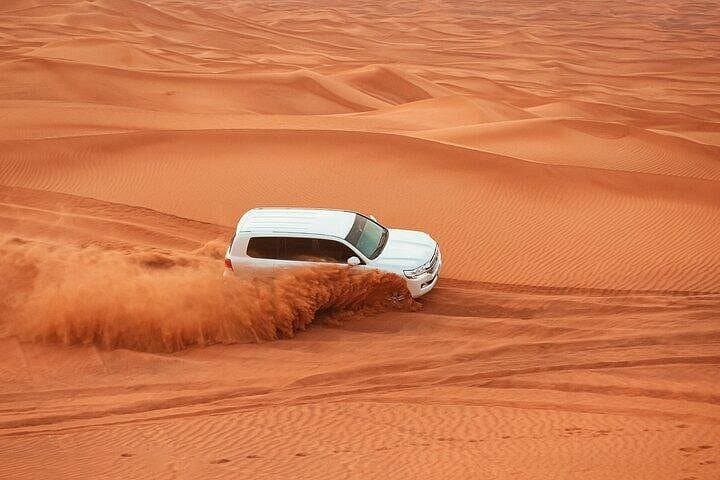

A vintage Land Rover rumbles away from Dubai’s paved edges and into a sea of wind-sculpted sand. Golden ridgelines rise and fall like slow ocean swells; the dunes seem to dare you forward as the sun tilts toward the western horizon. Leather seats creak, the engine murmurs, and in the distance a falcon wheels against a thinning blue.
A vintage Land Rover rumbles away from Dubai’s paved edges and into a sea of wind-sculpted sand. Golden ridgelines rise and fall like slow ocean swells; the dunes seem to dare you forward as the sun tilts toward the western horizon. Leather seats creak, the engine murmurs, and in the distance a falcon wheels against a thinning blue.
The experience layers modern Dubai against an older desert logic. The Dubai Desert Conservation Reserve protects patches of native dune habitat where Arabian oryx and gazelles roam—animals once nearly lost and now part of reintroduction efforts. Geologically the dunes are young, wind-born sheets of quartz and feldspar stained by iron oxides, sometimes forming faces up to 50–100 meters high. Culturally, the itinerary borrows directly from Bedouin tradition: camel riding as transport, falconry demonstrations as hunting heritage, henna and shared coffee as social ritual.
Practical guidance: this is a four-hour excursion that mixes driven dune bashing in vintage Land Rovers, brief walks on soft sand, a camel ride, and a four-course Arabic-style dinner at a camp timed for sunset. Expect no long mapped trails or technical climbs—terrain is loose sand and steep dune lips that can test ankles and knees. Bring sun protection, stable shoes, and at least 1–2 liters of water, and plan for motion on fast dune descents. Photography is excellent at golden hour; be respectful during live falconry and cultural performances. Travelers with spinal issues should avoid high-impact bashing; many operators provide transfers from Dubai and return after the camp dinner.