THE ADVENTURE COLLECTIVE® · Independent discovery and booking for outdoor travel

Cycle the UNESCO-listed Jatiluwih rice terraces on an assisted e-bike, following quiet lanes and dirt tracks beneath Batukaru’s slopes. Expect 2 hours of easy-to-moderate riding, temple stops, and a field-side Balinese lunch.
Cycle the UNESCO-listed Jatiluwih rice terraces on an assisted e-bike, following quiet lanes and dirt tracks beneath Batukaru’s slopes. Expect 2 hours of easy-to-moderate riding, temple stops, and a field-side Balinese lunch.
A morning fog peels back over sweeping green shelves of rice as riders clip into e-bikes at the foot of Batukaru.
Verified experiences and guided adventures in the surrounding area.
Operated by Explorcation Indonesia · Jatiluwih, Bali
A morning fog peels back over sweeping green shelves of rice as riders clip into e-bikes at the foot of Batukaru.
The route unfurls along quiet country lanes and narrow foottracks that edge the Jatiluwih terraces—UNESCO-listed agricultural landscapes shaped over centuries of subak irrigation. Stone bunds and canals direct water like old hands, while volcanic soil from nearby Batukaru feeds deep, dark paddies. Along the way, riders pass farmers tending plots, century-old temples tucked on ridgelines, and the occasional water buffalo watching the road with slow curiosity.
Geology here is quiet but present: volcanic slopes grade into terraced benches, offering repeated little climbs and sheltered descents. Culturally, the terraces are an active communal system; expect to see irrigation channels and small shrines that mark ownership and ritual cycles.
The e-bike segment on this tour runs about two hours—roughly 8–12 km of mixed paved rural lanes and compact dirt tracks—with modest elevation change (estimate 150–300 m cumulative). It’s paced for accessibility: the motor assists steeper pitches and helps maintain a relaxed sightseeing speed.
Practical notes: start early to avoid midday heat, carry water and sun protection, and wear closed-toe shoes for gravel sections. Guides usually include a stop at Besi Kalung temple and a field-side Balinese lunch. Reserve time for photos; the terraces shift color with light and cloud, and moving slowly on an e-bike is the best way to read the land.
The guided e-bike ride itself is about two hours, typically covering 8–12 km of mixed rural lanes and dirt tracks.
No advanced skills are required; basic bike handling is enough and the e-bike motor helps on climbs.
Bring small cash for optional snacks, donations at temples, or souvenirs—there are limited card facilities in the area.
Yes, but trails can be muddy and slippery; consider a morning slot, wear suitable footwear, and bring a rain jacket.
Explorcation Indonesia operates guided outdoor trips and adventures with an emphasis on safety, stewardship, and memorable experiences.

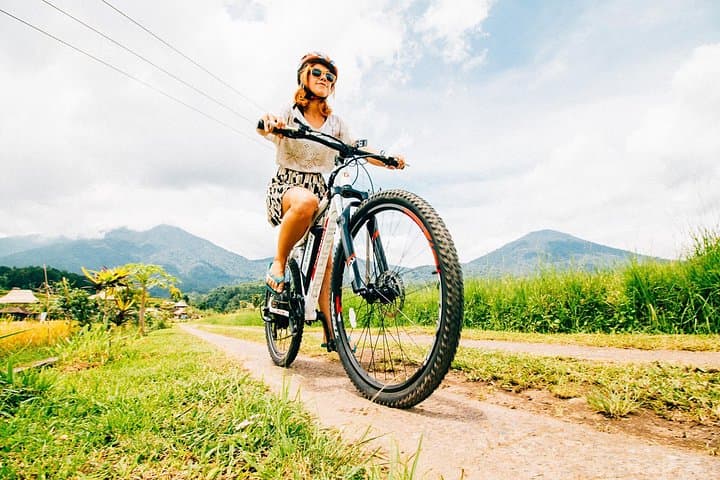

A morning fog peels back over sweeping green shelves of rice as riders clip into e-bikes at the foot of Batukaru.
A morning fog peels back over sweeping green shelves of rice as riders clip into e-bikes at the foot of Batukaru.
The route unfurls along quiet country lanes and narrow foottracks that edge the Jatiluwih terraces—UNESCO-listed agricultural landscapes shaped over centuries of subak irrigation. Stone bunds and canals direct water like old hands, while volcanic soil from nearby Batukaru feeds deep, dark paddies. Along the way, riders pass farmers tending plots, century-old temples tucked on ridgelines, and the occasional water buffalo watching the road with slow curiosity.
Geology here is quiet but present: volcanic slopes grade into terraced benches, offering repeated little climbs and sheltered descents. Culturally, the terraces are an active communal system; expect to see irrigation channels and small shrines that mark ownership and ritual cycles.
The e-bike segment on this tour runs about two hours—roughly 8–12 km of mixed paved rural lanes and compact dirt tracks—with modest elevation change (estimate 150–300 m cumulative). It’s paced for accessibility: the motor assists steeper pitches and helps maintain a relaxed sightseeing speed.
Practical notes: start early to avoid midday heat, carry water and sun protection, and wear closed-toe shoes for gravel sections. Guides usually include a stop at Besi Kalung temple and a field-side Balinese lunch. Reserve time for photos; the terraces shift color with light and cloud, and moving slowly on an e-bike is the best way to read the land.