THE ADVENTURE COLLECTIVE® · Independent discovery and booking for outdoor travel

Beat the crowds on an all-day cultural loop through Coba’s jungle pyramid, Tulum’s seaside ruins, and an underground cenote cave. Expect a long but rewarding day of walking, short swims, and local history narrated by an English-speaking guide.
Beat the crowds on an all-day cultural loop through Coba’s jungle pyramid, Tulum’s seaside ruins, and an underground cenote cave. Expect a long but rewarding day of walking, short swims, and local history narrated by an English-speaking guide.
Morning light slices through the jungle by the time the van pulls off the highway — humid air that smells of cut leaves and salt. You arrive at Coba before the crowds, where a stone plaza opens itself under a high canopy and the Nohoch Muul pyramid rises like a reserved challenge, its limestone faces warm underfoot.
Verified experiences and guided adventures in the surrounding area.
Operated by Holbox Magico · Playa del Carmen, Quintana Roo
Morning light slices through the jungle by the time the van pulls off the highway — humid air that smells of cut leaves and salt. You arrive at Coba before the crowds, where a stone plaza opens itself under a high canopy and the Nohoch Muul pyramid rises like a reserved challenge, its limestone faces warm underfoot.
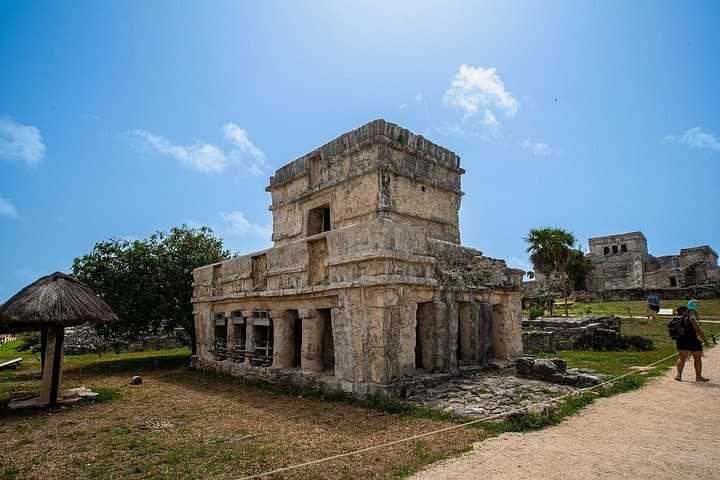
Coba and Tulum belong to two different chapters of Maya history: Coba as a sprawling inland hub connected by sacbeob (white roads), and Tulum as a late-postclassic walled port that faces the sea and the trade winds. Geologically the region is porous limestone: sinkholes and cenotes are the landscape’s lungs, collapsed caverns where groundwater sculpts stalactites and stalagmites in suspended silence.
Cultural rhythm here is deliberate — guides explain Maya cosmology, the role of cenotes as entrances to Xibalba, and the practical reasons cities clustered where they did. The cenote visit turns geology into theater: water that seems to hold the roof up with a dark, patient buoyancy and stalactites that drip history.
Practical guidance: start early, wear sturdy shoes that can get wet, and bring reef-safe sunscreen and a hat. Expect an 11–12 hour day including transport; entrance taxes to Tulum and Coba are paid on-site in Mexican pesos. Carry small bills for local vendors and a waterproof bag for phones. Fitness should be moderate — the tour includes walking on uneven stone, stairs, and short swims or snorkeling in the cenote with provided life vests and snorkel gear. Pace yourself, hydrate often, and let the jungle and sea set the rhythm of the day.
No — Tulum and Coba taxes are paid on-site in pesos and vary (approx. MXN 500–700); Sundays sometimes have reduced rates.
Yes — snorkeling and short swims are part of the cenote visit; life vests and snorkel gear are provided.
It requires a moderate fitness level: walking on uneven ground, climbing stairs at ruins, and brief snorkeling; not recommended for those with serious heart conditions.
Yes — pickup is provided from many hotels in the Playa del Carmen area, though exact pickup time is confirmed the afternoon before the tour.
Holbox Magico operates guided outdoor trips and adventures with an emphasis on safety, stewardship, and memorable experiences.



Morning light slices through the jungle by the time the van pulls off the highway — humid air that smells of cut leaves and salt. You arrive at Coba before the crowds, where a stone plaza opens itself under a high canopy and the Nohoch Muul pyramid rises like a reserved challenge, its limestone faces warm underfoot.
Morning light slices through the jungle by the time the van pulls off the highway — humid air that smells of cut leaves and salt. You arrive at Coba before the crowds, where a stone plaza opens itself under a high canopy and the Nohoch Muul pyramid rises like a reserved challenge, its limestone faces warm underfoot.
Coba and Tulum belong to two different chapters of Maya history: Coba as a sprawling inland hub connected by sacbeob (white roads), and Tulum as a late-postclassic walled port that faces the sea and the trade winds. Geologically the region is porous limestone: sinkholes and cenotes are the landscape’s lungs, collapsed caverns where groundwater sculpts stalactites and stalagmites in suspended silence.
Cultural rhythm here is deliberate — guides explain Maya cosmology, the role of cenotes as entrances to Xibalba, and the practical reasons cities clustered where they did. The cenote visit turns geology into theater: water that seems to hold the roof up with a dark, patient buoyancy and stalactites that drip history.
Practical guidance: start early, wear sturdy shoes that can get wet, and bring reef-safe sunscreen and a hat. Expect an 11–12 hour day including transport; entrance taxes to Tulum and Coba are paid on-site in Mexican pesos. Carry small bills for local vendors and a waterproof bag for phones. Fitness should be moderate — the tour includes walking on uneven stone, stairs, and short swims or snorkeling in the cenote with provided life vests and snorkel gear. Pace yourself, hydrate often, and let the jungle and sea set the rhythm of the day.