THE ADVENTURE COLLECTIVE® · Independent discovery and booking for outdoor travel

Cycle Eindhoven’s industrial-heart turned design hub on a two-hour guided tour that hits Strijp-S, Philipsdorp, and the Van Abbemuseum. Expect 10–15 km on flat, well-marked bike paths with local stories at every stop.
Cycle Eindhoven’s industrial-heart turned design hub on a two-hour guided tour that hits Strijp-S, Philipsdorp, and the Van Abbemuseum. Expect 10–15 km on flat, well-marked bike paths with local stories at every stop.
Pedaling out from an industrial yard turned creative quarter, the city opens like a practical map: wide cycle lanes, brick façades, and murals that angle toward the sky. The guide slips into local stories—Philips factories, worker housing, wartime changes—while the Dommel river edges the route, its slow current daring riders to pause at park benches and watch cyclists weave through daily life.
Verified experiences and guided adventures in the surrounding area.
Operated by City Tours Eindhoven · Eindhoven, North Brabant
Pedaling out from an industrial yard turned creative quarter, the city opens like a practical map: wide cycle lanes, brick façades, and murals that angle toward the sky. The guide slips into local stories—Philips factories, worker housing, wartime changes—while the Dommel river edges the route, its slow current daring riders to pause at park benches and watch cyclists weave through daily life.
Eindhoven’s history is visible in converted warehouses and the Van Abbemuseum’s modernist bulk; geology here is flat Dutch lowland—peaty soil and reclaimed plots—so elevation barely registers, which is why cycling is the city’s default. Culture favors design and technology: Strijp-S and Philipsdorp show how production plants became studios, shops, and late-night cafés. Expect stops at public art, former factory gates, and a statue of Gerard Philips with crisp local commentary on the city’s 19th–20th century industrial rise.
Practicalities are straightforward: the tour covers roughly 10–15 km over two hours, on paved cycle paths and quiet streets, with brief photo stops. Guides supply city bikes (three gears); basic bike-handling skills and an ability to stay balanced in traffic are all that’s required. Bring a light rain layer, water, and a phone for photos—the pace is conversational, not athletic. Start near central transit hubs for easy access; aim for mornings or early evenings when light favors photos and parks feel most alive.
Yes—your booking includes a city bike with three gears for the two-hour tour.
Helmets may not be supplied; bring your own if you prefer one for safety.
Tours typically start near a central, easy-to-find location close to public transport—confirm exact meeting details with the operator on booking.
The tour is rated easy and suitable for most ages, but participants must be able to ride a bike and follow city traffic rules.
City Tours Eindhoven operates guided outdoor trips and adventures with an emphasis on safety, stewardship, and memorable experiences.
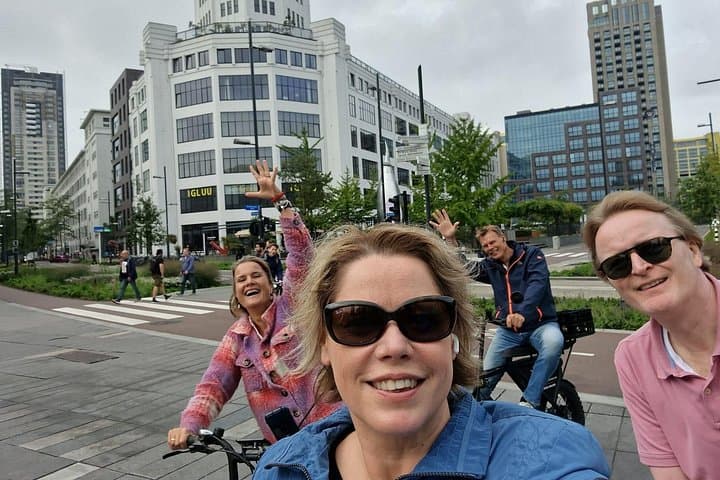


Pedaling out from an industrial yard turned creative quarter, the city opens like a practical map: wide cycle lanes, brick façades, and murals that angle toward the sky. The guide slips into local stories—Philips factories, worker housing, wartime changes—while the Dommel river edges the route, its slow current daring riders to pause at park benches and watch cyclists weave through daily life.
Pedaling out from an industrial yard turned creative quarter, the city opens like a practical map: wide cycle lanes, brick façades, and murals that angle toward the sky. The guide slips into local stories—Philips factories, worker housing, wartime changes—while the Dommel river edges the route, its slow current daring riders to pause at park benches and watch cyclists weave through daily life.
Eindhoven’s history is visible in converted warehouses and the Van Abbemuseum’s modernist bulk; geology here is flat Dutch lowland—peaty soil and reclaimed plots—so elevation barely registers, which is why cycling is the city’s default. Culture favors design and technology: Strijp-S and Philipsdorp show how production plants became studios, shops, and late-night cafés. Expect stops at public art, former factory gates, and a statue of Gerard Philips with crisp local commentary on the city’s 19th–20th century industrial rise.
Practicalities are straightforward: the tour covers roughly 10–15 km over two hours, on paved cycle paths and quiet streets, with brief photo stops. Guides supply city bikes (three gears); basic bike-handling skills and an ability to stay balanced in traffic are all that’s required. Bring a light rain layer, water, and a phone for photos—the pace is conversational, not athletic. Start near central transit hubs for easy access; aim for mornings or early evenings when light favors photos and parks feel most alive.