THE ADVENTURE COLLECTIVE® · Independent discovery and booking for outdoor travel

Travel from Madrid into the Sierra de Guadarrama to visit the monumental El Escorial monastery and the Valley of the Fallen. This guided half-day tour combines Renaissance architecture, mountain geology and panoramic viewpoints with practical transport and admissions included.
Travel from Madrid into the Sierra de Guadarrama to visit the monumental El Escorial monastery and the Valley of the Fallen. This guided half-day tour combines Renaissance architecture, mountain geology and panoramic viewpoints with practical transport and admissions included.
A coach slips away from Madrid and climbs into the pines of the Sierra de Guadarrama, the city shrinking behind you as granite ridges take over the horizon.
Verified experiences and guided adventures in the surrounding area.
Operated by Julia Travel S.L · San Lorenzo de El Escorial, Community of Madrid
A coach slips away from Madrid and climbs into the pines of the Sierra de Guadarrama, the city shrinking behind you as granite ridges take over the horizon.
At the Royal Monastery of San Lorenzo de El Escorial the air feels cool against stone: broad courtyards, the ordered geometry of a 16th-century Renaissance complex, and a library whose carved shelves seem to hold the weight of empire. Your guide moves between the Habsburg Palace, the Chapter House and the basilica, tracing Philip II’s design ambitions and the monastery’s role as both palace and pantheon.
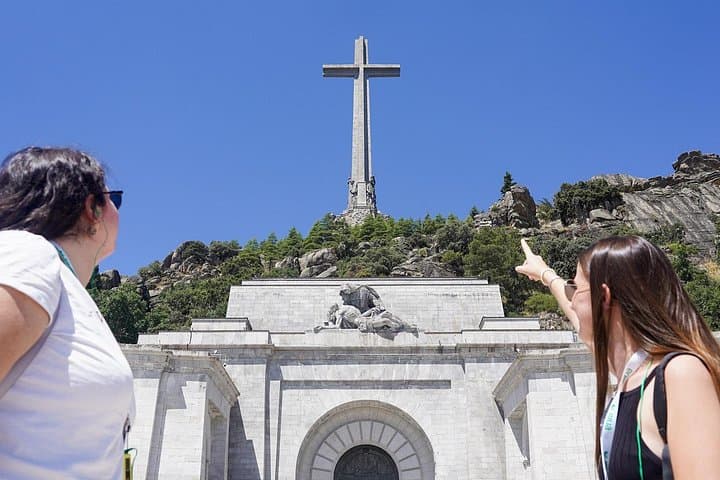
A short drive deeper into the mountains brings the Valley of the Fallen into view — a monumental cross rising above a tunnel of stone. The basilica is carved into the hillside; visiting it is a quiet, constrained experience (guides give commentary outside, entry is self-guided). The geology here is exposed granite and slate, formed by Iberian uplift and smoothed by millennia of weather; the terrain encourages viewpoints where the cross and monastery dominate different ridgelines.
Expect a balanced day of architecture, history and stark mountain scenery. Practical notes: the itinerary is about 5–6 hours, includes admissions and coach transport, and involves walking on uneven stone floors and steps. Bring water, dress respectfully for sacred sites, and allow time at overlooks — the landscape often feels like it’s watching you as much as you’re watching it.
Shared tours typically meet at a central office in Madrid; some private options include hotel pickup—confirm at booking.
Accessibility is limited: many interior areas and steps at El Escorial and the Valley have restricted access—contact the operator for specific arrangements.
Photography rules vary; exterior photography is fine, but interior restrictions may apply—follow onsite signage and staff guidance.
Lunch is not included; tours often pause near El Escorial or return to Madrid where you can find cafes—carry snacks for the journey.
Julia Travel S.L operates guided outdoor trips and adventures with an emphasis on safety, stewardship, and memorable experiences.


A coach slips away from Madrid and climbs into the pines of the Sierra de Guadarrama, the city shrinking behind you as granite ridges take over the horizon.
A coach slips away from Madrid and climbs into the pines of the Sierra de Guadarrama, the city shrinking behind you as granite ridges take over the horizon.
At the Royal Monastery of San Lorenzo de El Escorial the air feels cool against stone: broad courtyards, the ordered geometry of a 16th-century Renaissance complex, and a library whose carved shelves seem to hold the weight of empire. Your guide moves between the Habsburg Palace, the Chapter House and the basilica, tracing Philip II’s design ambitions and the monastery’s role as both palace and pantheon.
A short drive deeper into the mountains brings the Valley of the Fallen into view — a monumental cross rising above a tunnel of stone. The basilica is carved into the hillside; visiting it is a quiet, constrained experience (guides give commentary outside, entry is self-guided). The geology here is exposed granite and slate, formed by Iberian uplift and smoothed by millennia of weather; the terrain encourages viewpoints where the cross and monastery dominate different ridgelines.
Expect a balanced day of architecture, history and stark mountain scenery. Practical notes: the itinerary is about 5–6 hours, includes admissions and coach transport, and involves walking on uneven stone floors and steps. Bring water, dress respectfully for sacred sites, and allow time at overlooks — the landscape often feels like it’s watching you as much as you’re watching it.