THE ADVENTURE COLLECTIVE® · Independent discovery and booking for outdoor travel

Spend two full days with a private guide exploring Rapa Nui’s signature sites — Rano Raraku, Ahu Tongariki, Orongo and Anakena Beach. This compact, curated itinerary pairs cultural context with manageable walks on volcanic terrain.
Spend two full days with a private guide exploring Rapa Nui’s signature sites — Rano Raraku, Ahu Tongariki, Orongo and Anakena Beach. This compact, curated itinerary pairs cultural context with manageable walks on volcanic terrain.
Wind moves across volcanic slopes and the island answers with low, weathered faces: moai standing sentinel on stone platforms, the Pacific pressing at their backs.
Verified experiences and guided adventures in the surrounding area.
Operated by Kava Kava Tours · Hanga Roa, Valparaíso Region
Wind moves across volcanic slopes and the island answers with low, weathered faces: moai standing sentinel on stone platforms, the Pacific pressing at their backs.
Over two full days a private guide steers visitors through the core of Rapa Nui’s living archaeology — Rano Raraku’s tuff quarry where dozens of partly carved moai still lie, the towering ahu Tongariki with 15 re-erected statues, and the ceremonial village of Orongo on the rim of Rano Kau, where the Birdman competition once decided leadership.
Geologically young basaltic flows and tuff cones shaped a landscape of steep crater walls, compact coastal benches, and pockets of endemic plants surviving in gullies. Culturally, the Rapa Nui people carved and moved statues between roughly 1200–1600 CE; the island’s oral histories and recent archaeological work illuminate a complex society that adapted to isolation and environmental change.
Practically, expect a mix of short hikes and roadside stops: uneven volcanic rock underfoot, grassy crater rims exposed to wind, and a couple of brief beach walks at Anakena. Lunch is included on day one; national park admission is not — bring your ticket or purchase locally. The private format minimizes transfers and allows flexible pacing for photography, sunset at Tahai, or lingering at small quarries like Puna Pau.
Plan for sun, wind, and loose footing: layered clothing, sturdy shoes, sun protection, and at least 2 liters of water per person will keep the itinerary smooth. The island’s isolation rewards patience: give yourself time between stops to absorb the scale and the questions the moai still pose.
No — Parque Nacional Rapa Nui admission is not included; purchase in advance online or locally before visiting sites.
Yes — the tour notes infant seats are available and the itinerary is generally easy, but mobility constraints on uneven ground should be considered.
No — this activity is not valid for cruise passengers per the booking information.
Each day includes short walks up to about 1–2 hours total at multiple sites; most transitions are by private vehicle and pacing is flexible with a private guide.
Kava Kava Tours operates guided outdoor trips and adventures with an emphasis on safety, stewardship, and memorable experiences.


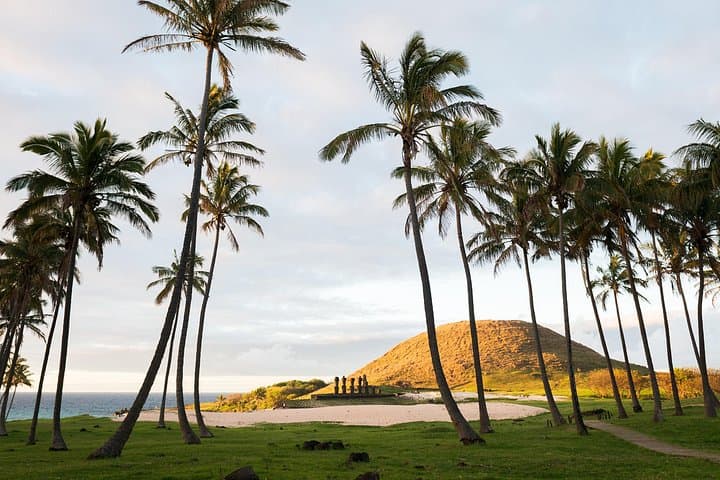

Wind moves across volcanic slopes and the island answers with low, weathered faces: moai standing sentinel on stone platforms, the Pacific pressing at their backs.
Wind moves across volcanic slopes and the island answers with low, weathered faces: moai standing sentinel on stone platforms, the Pacific pressing at their backs.
Over two full days a private guide steers visitors through the core of Rapa Nui’s living archaeology — Rano Raraku’s tuff quarry where dozens of partly carved moai still lie, the towering ahu Tongariki with 15 re-erected statues, and the ceremonial village of Orongo on the rim of Rano Kau, where the Birdman competition once decided leadership.
Geologically young basaltic flows and tuff cones shaped a landscape of steep crater walls, compact coastal benches, and pockets of endemic plants surviving in gullies. Culturally, the Rapa Nui people carved and moved statues between roughly 1200–1600 CE; the island’s oral histories and recent archaeological work illuminate a complex society that adapted to isolation and environmental change.
Practically, expect a mix of short hikes and roadside stops: uneven volcanic rock underfoot, grassy crater rims exposed to wind, and a couple of brief beach walks at Anakena. Lunch is included on day one; national park admission is not — bring your ticket or purchase locally. The private format minimizes transfers and allows flexible pacing for photography, sunset at Tahai, or lingering at small quarries like Puna Pau.
Plan for sun, wind, and loose footing: layered clothing, sturdy shoes, sun protection, and at least 2 liters of water per person will keep the itinerary smooth. The island’s isolation rewards patience: give yourself time between stops to absorb the scale and the questions the moai still pose.