THE ADVENTURE COLLECTIVE® · Independent discovery and booking for outdoor travel

Fly from Kathmandu into the Khumbu to land briefly at Kala Patthar and enjoy breakfast at the Hotel Everest View. This half-day heli tour delivers sweeping views of Everest, the Khumbu Icefall, and Lhotse with minimal trekking required.
Fly from Kathmandu into the Khumbu to land briefly at Kala Patthar and enjoy breakfast at the Hotel Everest View. This half-day heli tour delivers sweeping views of Everest, the Khumbu Icefall, and Lhotse with minimal trekking required.
The helicopter roars off the Kathmandu tarmac and, within an hour, the low clouds give way to a jagged skyline of ice and rock. From the cabin window the Khumbu Glacier snakes below and peaks like Ama Dablam and Lhotse push through the blue. The pilot lifts at Kala Patthar and the world feels thin — cold air pressing gently against the skin — giving visitors 10–15 minutes to step onto high-altitude scree for photos.
Verified experiences and guided adventures in the surrounding area.
Operated by Ace the Himalaya · Kathmandu, Bagmati Province
The helicopter roars off the Kathmandu tarmac and, within an hour, the low clouds give way to a jagged skyline of ice and rock. From the cabin window the Khumbu Glacier snakes below and peaks like Ama Dablam and Lhotse push through the blue. The pilot lifts at Kala Patthar and the world feels thin — cold air pressing gently against the skin — giving visitors 10–15 minutes to step onto high-altitude scree for photos.
This one-day heli tour threads modern flight over a landscape shaped by tectonics and glaciation. The Khumbu is part of Sagarmatha National Park, an area central to Sherpa culture and Himalayan climbing history; nearby Lukla and Tengboche mark classic trekking routes pioneered during the mid-20th-century Everest expeditions. The route reveals moraines, the Khumbu Icefall's fractured ice, and high ridgelines sculpted by millennia of freeze-thaw.
Practically, expect rapid altitude changes: the tour typically includes stops at Kala Patthar (≈5,500 m), a breakfast touchdown at the Hotel Everest View (3,880 m), and refueling in Lukla. Weather dictates schedules; clear mornings give the best visibility. Dress in insulated layers, bring a windproof shell, and limit time outside at higher stops. Cameras with neutral-density filters help manage glare from snow. Most operators limit passengers to five per aircraft and require basic medical fitness; those with cardiovascular or spinal issues should consult a physician.
For travelers short on time but seeking a visceral encounter with Everest, this flight delivers panoramic exposure to the high Himalaya with minimal hiking — a concentrated, high-altitude viewpoint into one of the planet’s most dramatic mountain systems.
The full experience typically runs 5–6 hours including transfers, flights, a breakfast stop, and short landings at high-altitude viewpoints.
Operators usually land at Kala Patthar and at the Hotel Everest View; direct landings at Everest Base Camp are not standard due to terrain and safety constraints.
Flights are conducted by experienced pilots and operators monitor weather closely; however, brief exposures at >5,000 m can affect those with heart or spinal conditions—consult your doctor if unsure.
Early mornings are typically clearest before afternoon cloud build-up; many tours schedule departures around dawn for optimal visibility.
Ace the Himalaya operates guided outdoor trips and adventures with an emphasis on safety, stewardship, and memorable experiences.
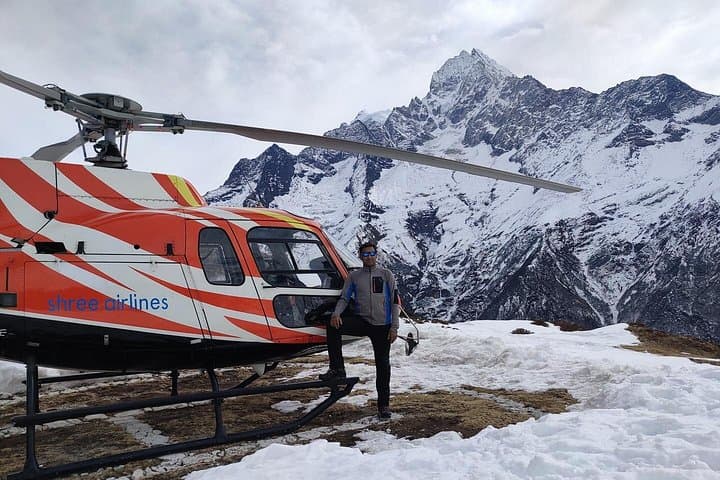


The helicopter roars off the Kathmandu tarmac and, within an hour, the low clouds give way to a jagged skyline of ice and rock. From the cabin window the Khumbu Glacier snakes below and peaks like Ama Dablam and Lhotse push through the blue. The pilot lifts at Kala Patthar and the world feels thin — cold air pressing gently against the skin — giving visitors 10–15 minutes to step onto high-altitude scree for photos.
The helicopter roars off the Kathmandu tarmac and, within an hour, the low clouds give way to a jagged skyline of ice and rock. From the cabin window the Khumbu Glacier snakes below and peaks like Ama Dablam and Lhotse push through the blue. The pilot lifts at Kala Patthar and the world feels thin — cold air pressing gently against the skin — giving visitors 10–15 minutes to step onto high-altitude scree for photos.
This one-day heli tour threads modern flight over a landscape shaped by tectonics and glaciation. The Khumbu is part of Sagarmatha National Park, an area central to Sherpa culture and Himalayan climbing history; nearby Lukla and Tengboche mark classic trekking routes pioneered during the mid-20th-century Everest expeditions. The route reveals moraines, the Khumbu Icefall's fractured ice, and high ridgelines sculpted by millennia of freeze-thaw.
Practically, expect rapid altitude changes: the tour typically includes stops at Kala Patthar (≈5,500 m), a breakfast touchdown at the Hotel Everest View (3,880 m), and refueling in Lukla. Weather dictates schedules; clear mornings give the best visibility. Dress in insulated layers, bring a windproof shell, and limit time outside at higher stops. Cameras with neutral-density filters help manage glare from snow. Most operators limit passengers to five per aircraft and require basic medical fitness; those with cardiovascular or spinal issues should consult a physician.
For travelers short on time but seeking a visceral encounter with Everest, this flight delivers panoramic exposure to the high Himalaya with minimal hiking — a concentrated, high-altitude viewpoint into one of the planet’s most dramatic mountain systems.