THE ADVENTURE COLLECTIVE® · Independent discovery and booking for outdoor travel

A compact, high-altitude classic: trek from Lukla to Everest Base Camp, summit Kala Patthar for sunrise views, then fly back to Kathmandu by helicopter. Expect long days, big elevation gains, and cultural stops in Sherpa villages.
A compact, high-altitude classic: trek from Lukla to Everest Base Camp, summit Kala Patthar for sunrise views, then fly back to Kathmandu by helicopter. Expect long days, big elevation gains, and cultural stops in Sherpa villages.
The sun is a hard rim of gold behind Everest as you stand on Kala Patthar (5,550m), wind pressing cold air into your face while the Khumbu Icefall sprawls below like a living map of crevasses. That sunrise — wide, immediate, uncompromising — is the payoff after days of river crossings, stone-stepped villages and high-alpine moraine.
Verified experiences and guided adventures in the surrounding area.
Operated by Bold Himalaya Treks and Travels Pvt Ltd · Lukla, Province No. 1
The sun is a hard rim of gold behind Everest as you stand on Kala Patthar (5,550m), wind pressing cold air into your face while the Khumbu Icefall sprawls below like a living map of crevasses. That sunrise — wide, immediate, uncompromising — is the payoff after days of river crossings, stone-stepped villages and high-alpine moraine.
This 10-day itinerary follows the classic Lukla–Phakding–Namche–Dingboche–Lobuche corridor through Sagarmatha National Park, a UNESCO-protected stretch of the High Himalaya. The geology is recent and violent: uplifted limestone and granite folded up by the Indian plate collision, with glaciers carving steep arêtes and depositing moraine fields that foreground Everest and Lhotse. Culturally, the route threads Sherpa villages, Buddhist monasteries like Tengboche and Tyangboche, and the Sherpa Museum in Namche where local history meets mountaineering legacy.
Expect 3–8 hour trekking days on mixed terrain — dirt trails, stone staircases, suspension bridges over the Dudh Koshi, rocky scree approaches near Gorak Shep — with cumulative altitude gain from ~2,800m (Lukla) to 5,364m (Everest Base Camp). Acclimatization days in Namche and Dingboche are built in; TIMS and Sagarmatha park fees are required (and typically included). The return helicopter flight to Kathmandu replaces the long downhill days, offering dramatic aerial views of the Khumbu valley and a quick transition back to the city.
Practical notes: pace conservatively, hydrate, monitor for altitude symptoms, carry layers for intense cold, and respect local customs and fragile alpine ecology. This trip balances high-mountain challenge with logistical convenience — the helicopter return turns a classic expedition into a compact, unforgettable experience.
Yes — a Sagarmatha National Park permit and TIMS card are required; reputable operators usually include them in the package.
The helicopter is an aerial transfer that replaces the long return trek; weather can delay flights, so schedule flexible onward travel in Kathmandu.
Most days range from 3–8 hours; total elevation gain from Lukla (~2,800m) to Everest Base Camp (5,364m) is roughly 2,500–2,800m over the itinerary with acclimatization stops.
Physically fit beginners with good preparation and respect for acclimatization can complete it, but prior multi-day trekking experience is recommended.
Bold Himalaya Treks and Travels Pvt Ltd operates guided outdoor trips and adventures with an emphasis on safety, stewardship, and memorable experiences.
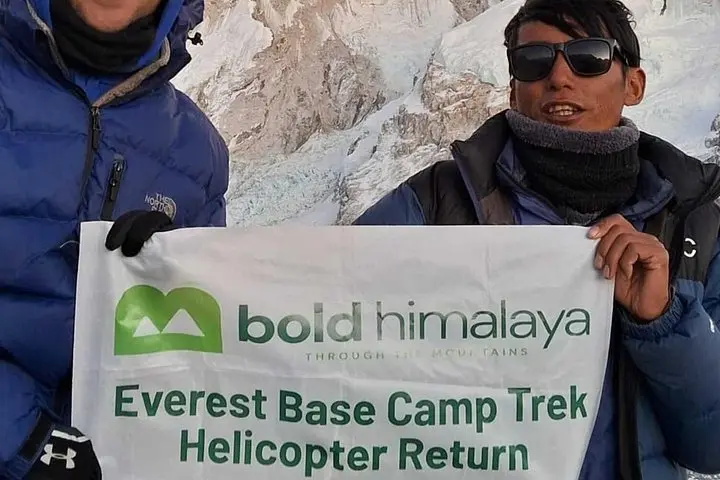
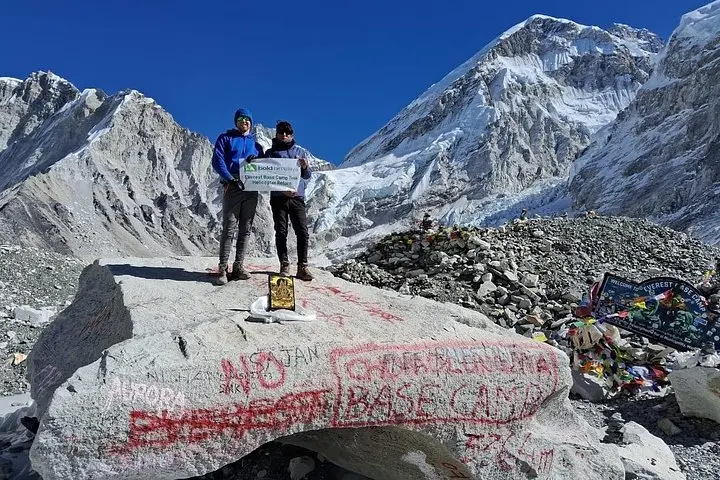
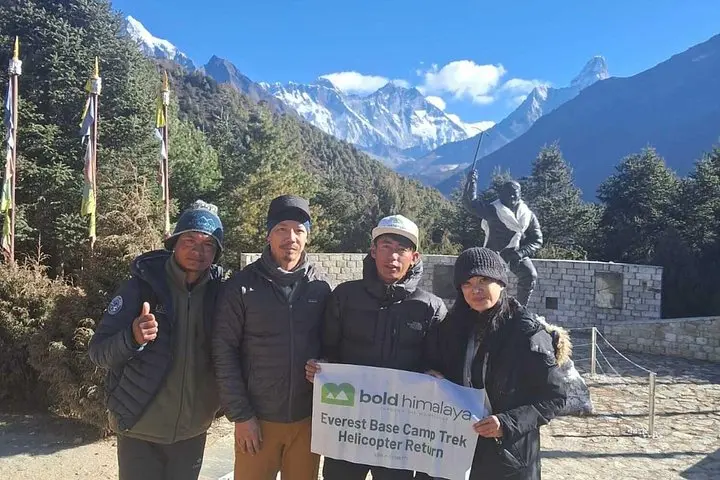
The sun is a hard rim of gold behind Everest as you stand on Kala Patthar (5,550m), wind pressing cold air into your face while the Khumbu Icefall sprawls below like a living map of crevasses. That sunrise — wide, immediate, uncompromising — is the payoff after days of river crossings, stone-stepped villages and high-alpine moraine.
The sun is a hard rim of gold behind Everest as you stand on Kala Patthar (5,550m), wind pressing cold air into your face while the Khumbu Icefall sprawls below like a living map of crevasses. That sunrise — wide, immediate, uncompromising — is the payoff after days of river crossings, stone-stepped villages and high-alpine moraine.
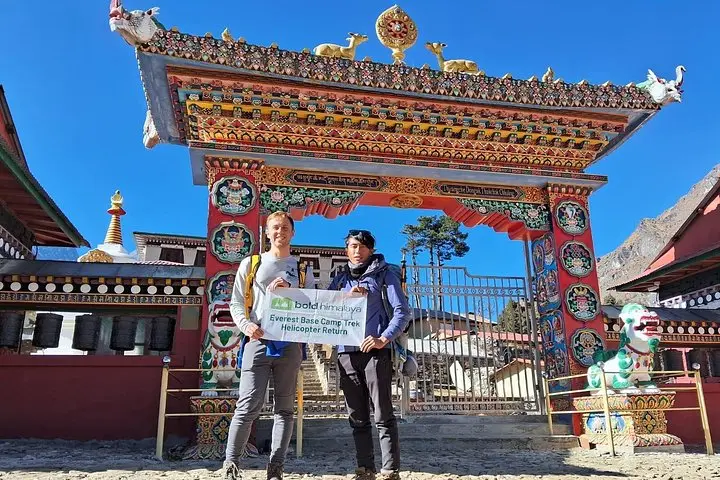
This 10-day itinerary follows the classic Lukla–Phakding–Namche–Dingboche–Lobuche corridor through Sagarmatha National Park, a UNESCO-protected stretch of the High Himalaya. The geology is recent and violent: uplifted limestone and granite folded up by the Indian plate collision, with glaciers carving steep arêtes and depositing moraine fields that foreground Everest and Lhotse. Culturally, the route threads Sherpa villages, Buddhist monasteries like Tengboche and Tyangboche, and the Sherpa Museum in Namche where local history meets mountaineering legacy.
Expect 3–8 hour trekking days on mixed terrain — dirt trails, stone staircases, suspension bridges over the Dudh Koshi, rocky scree approaches near Gorak Shep — with cumulative altitude gain from ~2,800m (Lukla) to 5,364m (Everest Base Camp). Acclimatization days in Namche and Dingboche are built in; TIMS and Sagarmatha park fees are required (and typically included). The return helicopter flight to Kathmandu replaces the long downhill days, offering dramatic aerial views of the Khumbu valley and a quick transition back to the city.
Practical notes: pace conservatively, hydrate, monitor for altitude symptoms, carry layers for intense cold, and respect local customs and fragile alpine ecology. This trip balances high-mountain challenge with logistical convenience — the helicopter return turns a classic expedition into a compact, unforgettable experience.