THE ADVENTURE COLLECTIVE® · Independent discovery and booking for outdoor travel

Trade city glow for a galaxy of stars and a safari-style run through the Fakahatchee Strand and Big Cypress. This four-hour guided jeep tour pairs daytime wildlife viewing with an unforgettable dark-sky stargazing experience.
Trade city glow for a galaxy of stars and a safari-style run through the Fakahatchee Strand and Big Cypress. This four-hour guided jeep tour pairs daytime wildlife viewing with an unforgettable dark-sky stargazing experience.
The jeep grinds through sawgrass, tires slushing over a ribbon of sand and wet leaf mold, and the Everglades opens like a slow-moving theater. By day the landscape is a mosaic of cypress domes and linear strand swamps; by night the same places become a stage for stars. Everglades Jeep Tours trades the hush of a city for the low hum of insects and the patient breathing of the wetlands, steering guests into Fakahatchee Strand State Park and the dark-sky reaches of Big Cypress where the Milky Way pours from horizon to horizon.
Verified experiences and guided adventures in the surrounding area.
Operated by Everglades Jeep Tours · Ochopee, Florida
The jeep grinds through sawgrass, tires slushing over a ribbon of sand and wet leaf mold, and the Everglades opens like a slow-moving theater. By day the landscape is a mosaic of cypress domes and linear strand swamps; by night the same places become a stage for stars. Everglades Jeep Tours trades the hush of a city for the low hum of insects and the patient breathing of the wetlands, steering guests into Fakahatchee Strand State Park and the dark-sky reaches of Big Cypress where the Milky Way pours from horizon to horizon.
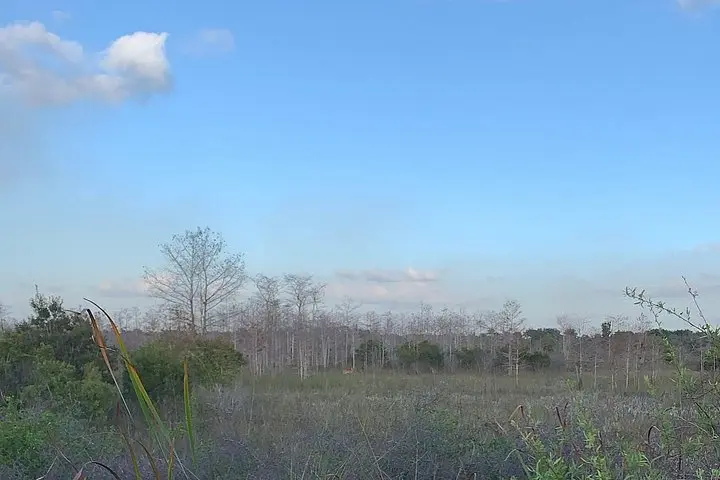
This is a landscape shaped by water. The Fakahatchee Strand is an ancient river of flooded cypress—fed not by a single channel but by seasonal rains that push a sheet of fresh water south. Geologically, the Everglades sits on a limestone plain carved by eons of ebb and flow; beneath the roots lies porous rock that filters and stores the region’s scarce freshwater. Human history here is layered: Indigenous peoples managed seasonal resources for millennia, 19th-century explorers and loggers later cut cypress and built crude tracks, and conservation battles in the 20th century reoriented the region toward preservation.
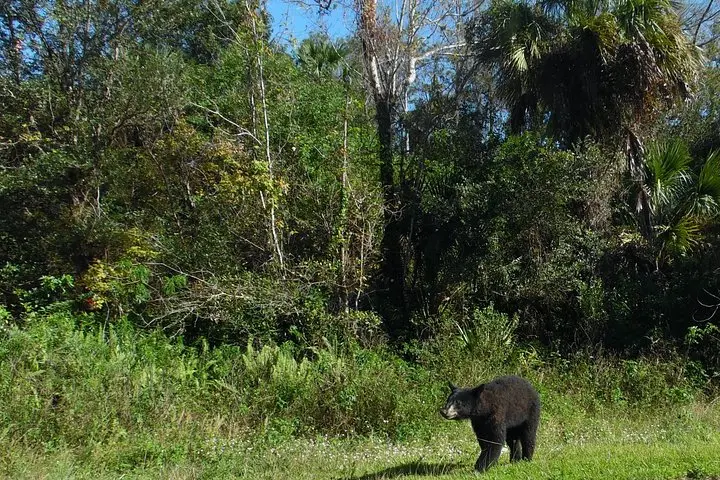
Culture in this corner of Florida is pragmatic and place-driven. Guides recount generations of knowledge—how to read alligator trails, where panthers move at dawn, and why invasive species are the urgency that haunts conservation work today. Local efforts focus on habitat connectivity and controlling pythons and invasive plants to protect native marshes and rare orchids, including the ghost orchid that sporadically appears in the Strand.
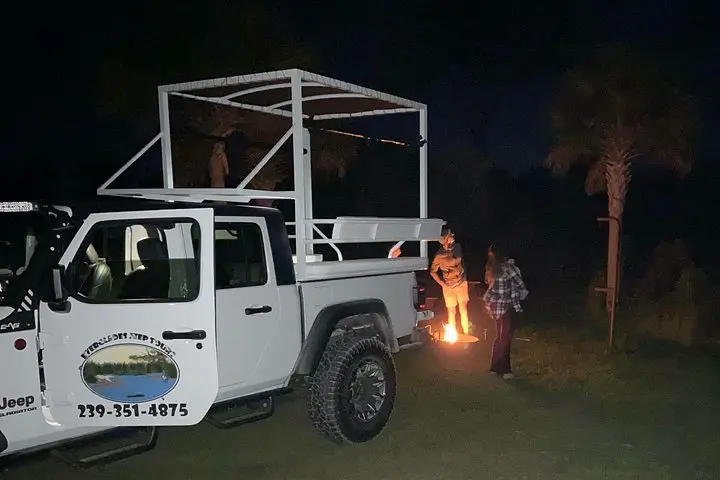
On a night tour, the landscape acquires personality: cypress domes seem to lean in, the dark sky daring you to look up. Guides use red-light flashlights and laser pointers to map constellations, but they also point out bioluminescent insects and the glint of an alligator’s eyes along a canal.
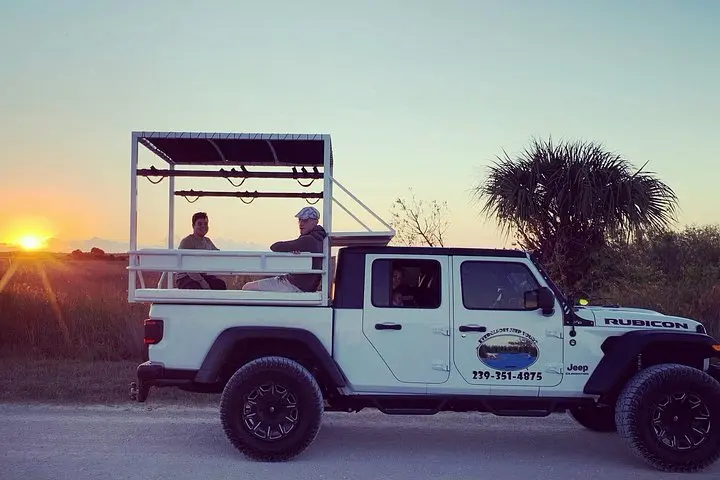
Practical guidance: tours are about four hours and suitable for most fitness levels—vehicles are custom safari jeeps with open sides and bench seats. Expect mosquitoes and seasonal humidity; use effective insect repellent and wear long sleeves at dusk. Footwear should be sturdy and closed-toe; the terrain at stops can be muddy and uneven. Bring a small daypack with water (though bottled water is provided), a headlamp for boarding after-dark, and a camera with a tripod for starfields. If you’re chasing wildlife, arrive during shoulder seasons (late fall to spring) when temperatures cool and animals are more active.
Booking tips: space is limited to small groups, so reserve in advance for night tours. Cancelling is typically allowed up to 24 hours prior. Respect park rules—stay on board unless directed, don’t feed wildlife, and leave no trace. For travelers wanting close-up nature without deep backcountry, this jeep safari offers an efficient, interpretive window into one of North America’s most singular wild places.
The total experience is about four hours, including time in Fakahatchee Strand and a night-sky stop in Big Cypress.
Yes—children can join but infants must sit on a lap; bring layers and ensure they tolerate insects and night conditions.
Panther sightings are rare; guides can point to likely habitats and signs, but spotting one can’t be guaranteed.
Pickup may be available from select hotels—confirm your pickup point during booking as options vary by location.
Restrooms are limited; tours typically include brief stops at park facilities when available—plan accordingly.
A camera with manual exposure, wide-aperture lens, tripod, and remote or timer are recommended for capturing starfields.
Everglades Jeep Tours operates guided outdoor trips and adventures with an emphasis on safety, stewardship, and memorable experiences.
The jeep grinds through sawgrass, tires slushing over a ribbon of sand and wet leaf mold, and the Everglades opens like a slow-moving theater. By day the landscape is a mosaic of cypress domes and linear strand swamps; by night the same places become a stage for stars. Everglades Jeep Tours trades the hush of a city for the low hum of insects and the patient breathing of the wetlands, steering guests into Fakahatchee Strand State Park and the dark-sky reaches of Big Cypress where the Milky Way pours from horizon to horizon.
The jeep grinds through sawgrass, tires slushing over a ribbon of sand and wet leaf mold, and the Everglades opens like a slow-moving theater. By day the landscape is a mosaic of cypress domes and linear strand swamps; by night the same places become a stage for stars. Everglades Jeep Tours trades the hush of a city for the low hum of insects and the patient breathing of the wetlands, steering guests into Fakahatchee Strand State Park and the dark-sky reaches of Big Cypress where the Milky Way pours from horizon to horizon.
This is a landscape shaped by water. The Fakahatchee Strand is an ancient river of flooded cypress—fed not by a single channel but by seasonal rains that push a sheet of fresh water south. Geologically, the Everglades sits on a limestone plain carved by eons of ebb and flow; beneath the roots lies porous rock that filters and stores the region’s scarce freshwater. Human history here is layered: Indigenous peoples managed seasonal resources for millennia, 19th-century explorers and loggers later cut cypress and built crude tracks, and conservation battles in the 20th century reoriented the region toward preservation.
Culture in this corner of Florida is pragmatic and place-driven. Guides recount generations of knowledge—how to read alligator trails, where panthers move at dawn, and why invasive species are the urgency that haunts conservation work today. Local efforts focus on habitat connectivity and controlling pythons and invasive plants to protect native marshes and rare orchids, including the ghost orchid that sporadically appears in the Strand.
On a night tour, the landscape acquires personality: cypress domes seem to lean in, the dark sky daring you to look up. Guides use red-light flashlights and laser pointers to map constellations, but they also point out bioluminescent insects and the glint of an alligator’s eyes along a canal.
Practical guidance: tours are about four hours and suitable for most fitness levels—vehicles are custom safari jeeps with open sides and bench seats. Expect mosquitoes and seasonal humidity; use effective insect repellent and wear long sleeves at dusk. Footwear should be sturdy and closed-toe; the terrain at stops can be muddy and uneven. Bring a small daypack with water (though bottled water is provided), a headlamp for boarding after-dark, and a camera with a tripod for starfields. If you’re chasing wildlife, arrive during shoulder seasons (late fall to spring) when temperatures cool and animals are more active.
Booking tips: space is limited to small groups, so reserve in advance for night tours. Cancelling is typically allowed up to 24 hours prior. Respect park rules—stay on board unless directed, don’t feed wildlife, and leave no trace. For travelers wanting close-up nature without deep backcountry, this jeep safari offers an efficient, interpretive window into one of North America’s most singular wild places.