THE ADVENTURE COLLECTIVE® · Independent discovery and booking for outdoor travel
Venture beneath Iceland’s lava fields into Leiðarendi, a 900‑meter lava tube reachable from Reykjavík. This small‑group caving tour combines geology, close‑quarters scrambling and vivid underground formations for a three‑hour adventure.
Venture beneath Iceland’s lava fields into Leiðarendi, a 900‑meter lava tube reachable from Reykjavík. This small‑group caving tour combines geology, close‑quarters scrambling and vivid underground formations for a three‑hour adventure.
You squeeze past a rim of cooled lava and the daylight slinks away—inside, the cave takes on its own weather. The air cools, the walls close in, and the soft crunch of volcanic glass underfoot marks every step as you move through Leiðarendi’s circular lava tube.
Verified experiences and guided adventures in the surrounding area.
You squeeze past a rim of cooled lava and the daylight slinks away—inside, the cave takes on its own weather. The air cools, the walls close in, and the soft crunch of volcanic glass underfoot marks every step as you move through Leiðarendi’s circular lava tube.
Leiðarendi formed when surface lava crusted over during an eruption and molten flow continued beneath, leaving a hollow conduit when the flow ceased. The result is a 900‑meter-long tunnel with ropes of pahoehoe, basalt stalactites and unexpected mineral tones that catch your light. Locals know these tubes as proof of Iceland’s recent geological youth: fields that are only thousands, not millions, of years old.
Culturally this land feels alive—shepherd tracks and sagas link to human routes across the lava, and fishing villages on the coast speak to a history of living at the edge of fire and sea. Inside the cave, geology is the guide; outside, the Reykjanes lava scenery stretches like a raw, wind-scraped page.
Practically, the tour is 3–3.5 hours with a small-group transfer from Reykjavík. Paths are uneven and at times require low crawling; there are easier bypass lines to the main chamber. Wear sturdy hiking boots, a hard-wearing jacket and bring a headlamp (guides usually provide helmets and lights). Hydrate and layer for wind and chill—the cave stays cool year-round. Expect close quarters, low ceilings in spots, and an intimate look at volcanic architecture you won’t see from the road. For travelers aiming to pair the trip with coastal views or hot springs, the Reykjanes Peninsula makes an efficient half-day extension to explore a landscape still shaping itself.
Moderate; the route includes uneven footing and optional low crawls but no technical climbing—participants should be comfortable with stooping and walking on rough ground.
Most small‑group operators provide helmets and shared lights, but bringing your own headlamp is recommended as backup and for personal comfort.
Age minimums vary by operator; children who are steady on their feet and comfortable in confined spaces can often join, but check provider rules and notify guides of younger participants.
Closed-toe hiking boots, layers, waterproof outer layer for wind, a headlamp, water and snacks; avoid loose long clothing that could catch on rock formations.
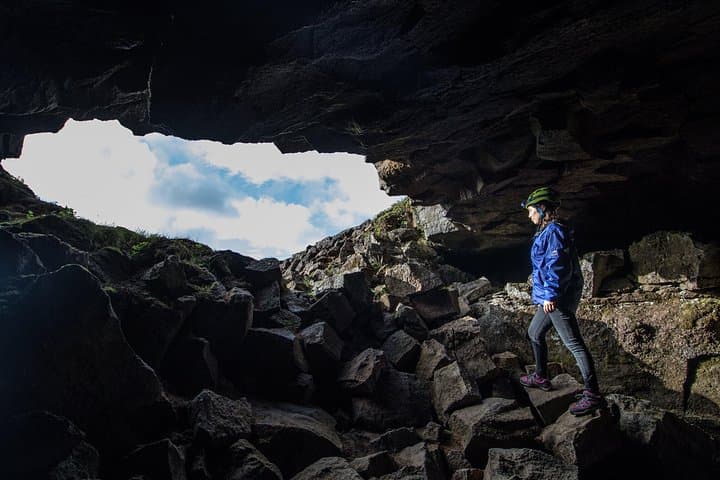
You squeeze past a rim of cooled lava and the daylight slinks away—inside, the cave takes on its own weather. The air cools, the walls close in, and the soft crunch of volcanic glass underfoot marks every step as you move through Leiðarendi’s circular lava tube.
You squeeze past a rim of cooled lava and the daylight slinks away—inside, the cave takes on its own weather. The air cools, the walls close in, and the soft crunch of volcanic glass underfoot marks every step as you move through Leiðarendi’s circular lava tube.
Leiðarendi formed when surface lava crusted over during an eruption and molten flow continued beneath, leaving a hollow conduit when the flow ceased. The result is a 900‑meter-long tunnel with ropes of pahoehoe, basalt stalactites and unexpected mineral tones that catch your light. Locals know these tubes as proof of Iceland’s recent geological youth: fields that are only thousands, not millions, of years old.
Culturally this land feels alive—shepherd tracks and sagas link to human routes across the lava, and fishing villages on the coast speak to a history of living at the edge of fire and sea. Inside the cave, geology is the guide; outside, the Reykjanes lava scenery stretches like a raw, wind-scraped page.
Practically, the tour is 3–3.5 hours with a small-group transfer from Reykjavík. Paths are uneven and at times require low crawling; there are easier bypass lines to the main chamber. Wear sturdy hiking boots, a hard-wearing jacket and bring a headlamp (guides usually provide helmets and lights). Hydrate and layer for wind and chill—the cave stays cool year-round. Expect close quarters, low ceilings in spots, and an intimate look at volcanic architecture you won’t see from the road. For travelers aiming to pair the trip with coastal views or hot springs, the Reykjanes Peninsula makes an efficient half-day extension to explore a landscape still shaping itself.
