THE ADVENTURE COLLECTIVE® · Independent discovery and booking for outdoor travel

Drive the Middle Atlas, watch cedar forests give way to the rolling Erg Chebbi dunes, and sleep under the Sahara sky. This private 2-day loop from Fes combines cultural stops, a camel trek, and an overnight Berber camp.
Drive the Middle Atlas, watch cedar forests give way to the rolling Erg Chebbi dunes, and sleep under the Sahara sky. This private 2-day loop from Fes combines cultural stops, a camel trek, and an overnight Berber camp.
A predawn silence hangs over the kasbahs of Fes as your private driver eases the vehicle out of the medina, headlights cutting a ribbon of light across the rising road.
Verified experiences and guided adventures in the surrounding area.
Operated by Morocco desert trips · Merzouga, Drâa-Tafilalet
A predawn silence hangs over the kasbahs of Fes as your private driver eases the vehicle out of the medina, headlights cutting a ribbon of light across the rising road.
You climb into the Middle Atlas, where towns like Ifrane sit at roughly 1,650 m and cedar forests host playful Barbary macaques. The route unfolds through Ziz Gorges and apple orchards around Midelt before the landscape thins, and Erg Chebbi’s golden ridges appear on the horizon.
This two-day circuit covers roughly 450–500 km one-way across varied terrain — paved avenues, mountain passes up to 2,000 m in the Middle Atlas, then descending toward the Sahara erg of rolling sand. The area bears layers of history: ancient trans-Saharan caravan routes, Berber ksur architecture and the living Gnawa musical tradition heard at camp.
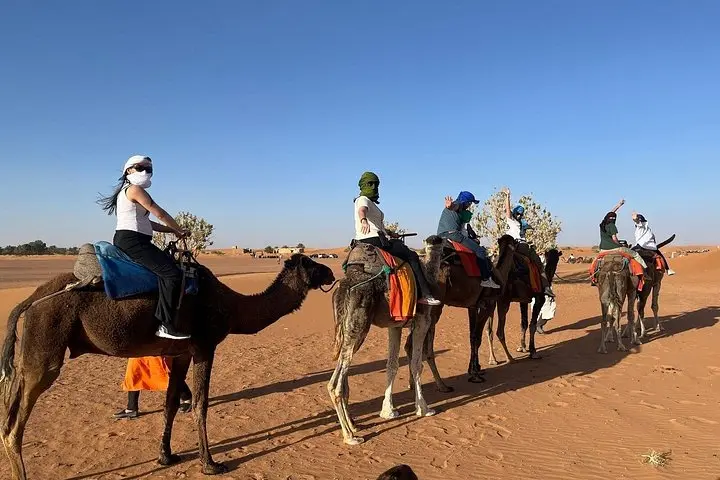
In Merzouga expect a 45–90 minute camel trek into the dunes to a traditional desert camp, a night under clear skies with local cuisine and Gnawa rhythms, and a sunrise that remakes the dunes minute by minute.
Practicalities: daily driving segments commonly take 6–8 hours with stops; bring sun protection, warm layers for nights, and at least 2–3 liters of water per person for trekking. Comfortable, closed-toe shoes and a small daypack make dunes and short village walks easier. Respect local customs, follow your guide on dune travel to avoid fragile habitats, and time your camel trek for sunrise or late afternoon to avoid peak heat.
Typical camel treks to desert camps last 45–90 minutes depending on camp location and pace; 4x4 transfers are an alternative.
Yes — the private tour includes pickup and drop-off at your riad or hotel in Fes as part of the itinerary.
Camps are traditional Berber-style with simple sleeping tents, shared sanitary facilities, and communal dining—amenities vary by camp level.
Yes — the tour is rated easy for most fitness levels; discuss mobility needs during booking to arrange appropriate pickup and camel alternatives.
Morocco desert trips operates guided outdoor trips and adventures with an emphasis on safety, stewardship, and memorable experiences.
A predawn silence hangs over the kasbahs of Fes as your private driver eases the vehicle out of the medina, headlights cutting a ribbon of light across the rising road.
A predawn silence hangs over the kasbahs of Fes as your private driver eases the vehicle out of the medina, headlights cutting a ribbon of light across the rising road.
You climb into the Middle Atlas, where towns like Ifrane sit at roughly 1,650 m and cedar forests host playful Barbary macaques. The route unfolds through Ziz Gorges and apple orchards around Midelt before the landscape thins, and Erg Chebbi’s golden ridges appear on the horizon.
This two-day circuit covers roughly 450–500 km one-way across varied terrain — paved avenues, mountain passes up to 2,000 m in the Middle Atlas, then descending toward the Sahara erg of rolling sand. The area bears layers of history: ancient trans-Saharan caravan routes, Berber ksur architecture and the living Gnawa musical tradition heard at camp.
In Merzouga expect a 45–90 minute camel trek into the dunes to a traditional desert camp, a night under clear skies with local cuisine and Gnawa rhythms, and a sunrise that remakes the dunes minute by minute.
Practicalities: daily driving segments commonly take 6–8 hours with stops; bring sun protection, warm layers for nights, and at least 2–3 liters of water per person for trekking. Comfortable, closed-toe shoes and a small daypack make dunes and short village walks easier. Respect local customs, follow your guide on dune travel to avoid fragile habitats, and time your camel trek for sunrise or late afternoon to avoid peak heat.