THE ADVENTURE COLLECTIVE® · Independent discovery and booking for outdoor travel

Three days from Fes to Marrakech take you across cedar forests, High Atlas passes and into the towering Erg Chebbi dunes. This budget-friendly circuit blends long scenic drives with camel treks, desert camps, and market stops—ideal for travelers who want breadth over luxury.
Three days from Fes to Marrakech take you across cedar forests, High Atlas passes and into the towering Erg Chebbi dunes. This budget-friendly circuit blends long scenic drives with camel treks, desert camps, and market stops—ideal for travelers who want breadth over luxury.
The road opens before dawn, a ribbon of asphalt unspooling from Fes through cedar-shadowed towns and up into the High Atlas, then falling away toward the flattening horizon of the Sahara. By late afternoon the dunes of Erg Chebbi rise like an orange ocean; sand moves underfoot and the wind writes new ridgelines every day.
Verified experiences and guided adventures in the surrounding area.
The road opens before dawn, a ribbon of asphalt unspooling from Fes through cedar-shadowed towns and up into the High Atlas, then falling away toward the flattening horizon of the Sahara. By late afternoon the dunes of Erg Chebbi rise like an orange ocean; sand moves underfoot and the wind writes new ridgelines every day.
This compact circuit follows centuries-old caravan tracks used by Berber traders and salt caravans. Geologically the route traverses folded Atlas ranges and alluvial plains that give way to aeolian dunes—sand shaped by persistent Harmattan and Atlantic breezes. Cultural stops include market towns where mint tea punctuates every meeting, ksour (fortified villages) built from rammed earth, and roadside stalls selling dates and argan oil.
Expect long drives—several hours between highlights—balanced by short, active windows: a late-afternoon camel trek, a dawn climb over a dune for sunrise photography, and visits to gorges and kasbahs. Dunes can reach 100–150 meters; climbers gain vertical effort on steep sand that shifts beneath each step. Temperatures swing dramatically: hot by day, cold after sunset.
Practical guidance: travel light, carry 2–3 liters of water daily, and protect eyes and skin from fine sand and sun. Choose sturdy shoes for rocky passes and a scarf for dust. Plan photo stops for golden hour and keep local currency for remote markets. Camping in desert bivouacs is basic but atmospheric—bring a warm layer, and respect fragile oases and local communities by minimizing waste and following guide directions.
Expect 6–8 hours total driving from Fes to Merzouga with stops—routes are scenic but include long stretches between towns.
Desert bivouacs are basic but include mattresses and blankets; nights can be cold, so bring warm layers.
Budget packages typically include at least one dinner in the camp and some breakfasts, but bring snacks and check specifics with your operator.
It depends on the operator; ask about transfer options and drop-off points when booking to confirm flexibility.
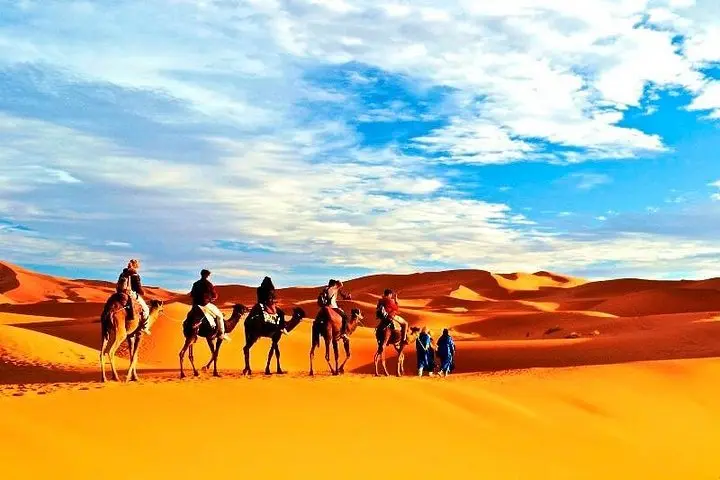
The road opens before dawn, a ribbon of asphalt unspooling from Fes through cedar-shadowed towns and up into the High Atlas, then falling away toward the flattening horizon of the Sahara. By late afternoon the dunes of Erg Chebbi rise like an orange ocean; sand moves underfoot and the wind writes new ridgelines every day.
The road opens before dawn, a ribbon of asphalt unspooling from Fes through cedar-shadowed towns and up into the High Atlas, then falling away toward the flattening horizon of the Sahara. By late afternoon the dunes of Erg Chebbi rise like an orange ocean; sand moves underfoot and the wind writes new ridgelines every day.
This compact circuit follows centuries-old caravan tracks used by Berber traders and salt caravans. Geologically the route traverses folded Atlas ranges and alluvial plains that give way to aeolian dunes—sand shaped by persistent Harmattan and Atlantic breezes. Cultural stops include market towns where mint tea punctuates every meeting, ksour (fortified villages) built from rammed earth, and roadside stalls selling dates and argan oil.
Expect long drives—several hours between highlights—balanced by short, active windows: a late-afternoon camel trek, a dawn climb over a dune for sunrise photography, and visits to gorges and kasbahs. Dunes can reach 100–150 meters; climbers gain vertical effort on steep sand that shifts beneath each step. Temperatures swing dramatically: hot by day, cold after sunset.
Practical guidance: travel light, carry 2–3 liters of water daily, and protect eyes and skin from fine sand and sun. Choose sturdy shoes for rocky passes and a scarf for dust. Plan photo stops for golden hour and keep local currency for remote markets. Camping in desert bivouacs is basic but atmospheric—bring a warm layer, and respect fragile oases and local communities by minimizing waste and following guide directions.