THE ADVENTURE COLLECTIVE® · Independent discovery and booking for outdoor travel

Walk white travertines, enter Roman libraries and float over fairy chimneys—this five-day route from Istanbul threads Pamukkale, Ephesus and Cappadocia into a compact, history-forward adventure. Read on for practical tips and what to expect each day.
Walk white travertines, enter Roman libraries and float over fairy chimneys—this five-day route from Istanbul threads Pamukkale, Ephesus and Cappadocia into a compact, history-forward adventure. Read on for practical tips and what to expect each day.
A pale, early light spills across a field of limestone, and the white terraces of Pamukkale catch the dawn like folded parchment. Travelers step from the coach and feel the warm mist—thermal water seeping down terraces carved over millennia—while a guide points out the columns of Hierapolis rising behind them, the theater’s stones still holding a Roman curve. This is the first act of a five-day loop that starts and ends in Istanbul but lives in the landscape of Anatolia: hot springs, marble libraries, rock-cut churches and the otherwordly chimneys of Cappadocia.
Verified experiences and guided adventures in the surrounding area.
Operated by Turkey Experiences · Kuşadası, Aydın
A pale, early light spills across a field of limestone, and the white terraces of Pamukkale catch the dawn like folded parchment. Travelers step from the coach and feel the warm mist—thermal water seeping down terraces carved over millennia—while a guide points out the columns of Hierapolis rising behind them, the theater’s stones still holding a Roman curve. This is the first act of a five-day loop that starts and ends in Istanbul but lives in the landscape of Anatolia: hot springs, marble libraries, rock-cut churches and the otherwordly chimneys of Cappadocia.
The route stitches together layers of history. Hierapolis, founded in the Hellenistic era and rebuilt by Romans, sits above travertine terraces formed by calcium-rich springs; Ephesus, once a major Mediterranean port, shows urban planning at scale—streets, latrines and the Celsus Library facade that still reads as a civic manifesto. Miletus and Priene tell the story of Ionian city-states and shifting coastlines as the Maeander River pushed the shoreline outward. In central Anatolia, volcanic tuffs eroded into the fairy chimneys of Cappadocia, where Byzantine monks carved chapels and frescoes into soft rock.
Geology here is an active character: thermal waters that deposit travertine; the red silt of the Kızılırmak that makes Avanos pottery clay; the tuff peaks that balloon pilots skirt at sunrise. Cultural threads are close at hand—pottery co-ops in Avanos, carpet weavers demonstrating knot counts, and the village of Doğanbey where Greek-Turkish history is visible in doorways and abandoned chapels.
Practicality guides the trip. Expect a moderate level of walking—Ephesus covers roughly 2–3 km on uneven stone streets; Hierapolis involves short elevation changes on terrace steps; Cappadocia trails include dusty, rocky singletrack with minimal sustained climbs. The hot air balloon ascends to roughly 700–1,000 meters above the valley floor; the flight window is dawn and weather-dependent.
Timing matters: visit Pamukkale early to avoid crowds and protect the crust of travertine; bring footwear that can be removed at certain sites (some terraces require barefoot entry in designated areas). Hydration and sun protection are essential—Aydın province can be hot and dry by midday. Finally, travel with respect: many sites are UNESCO-listed, so stay on marked paths, don’t remove artifacts, and support local artisans with purchases that sustain traditional crafts.
This itinerary moves fast but deliberately: thermal pools and Roman ruins, village architecture and volcanic valleys, sunrise balloons and hands-on workshops. For a traveler who wants history with movement—and a few moments to stand where emperors, prophets and potters once stood—this five-day loop is an efficient, sensory-rich primer on western and central Turkey.
The hot air balloon is included for most packages except the Flexible and Standard options—confirm at booking and expect early-morning departure and weather contingency.
You can walk on specific travertine terraces and bathe in designated thermal pools; the archaeological Antique Pool (Cleopatra’s Pool) usually requires an extra fee.
This tour includes guided visits and some admissions; verify specific museum or site entrance fees at booking—certain optional visits may be extra.
The itinerary involves uneven surfaces and stairs and is not recommended for travelers with serious mobility or spinal conditions; infants must sit on laps for transport.
Guides typically speak English; confirm language availability in advance for other languages or private guide requests.
Tipping is customary in Turkey—consider modest tips for guides and drivers at the end of each day (small groups: roughly 5–10% of daily tour cost is a local guideline).
Turkey Experiences operates guided outdoor trips and adventures with an emphasis on safety, stewardship, and memorable experiences.

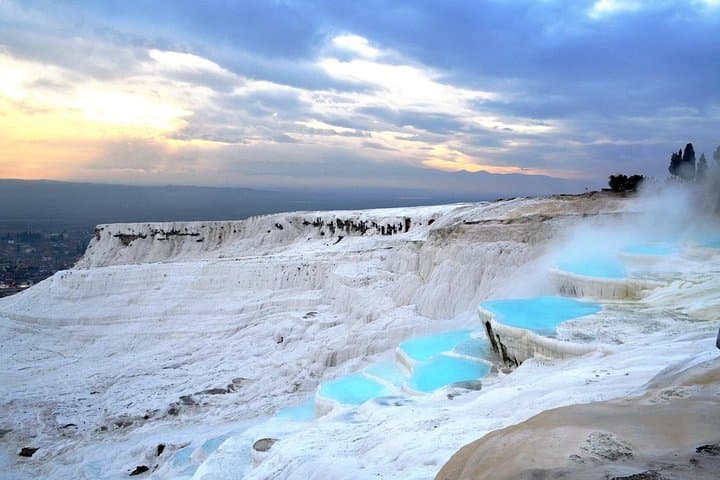
A pale, early light spills across a field of limestone, and the white terraces of Pamukkale catch the dawn like folded parchment. Travelers step from the coach and feel the warm mist—thermal water seeping down terraces carved over millennia—while a guide points out the columns of Hierapolis rising behind them, the theater’s stones still holding a Roman curve. This is the first act of a five-day loop that starts and ends in Istanbul but lives in the landscape of Anatolia: hot springs, marble libraries, rock-cut churches and the otherwordly chimneys of Cappadocia.
A pale, early light spills across a field of limestone, and the white terraces of Pamukkale catch the dawn like folded parchment. Travelers step from the coach and feel the warm mist—thermal water seeping down terraces carved over millennia—while a guide points out the columns of Hierapolis rising behind them, the theater’s stones still holding a Roman curve. This is the first act of a five-day loop that starts and ends in Istanbul but lives in the landscape of Anatolia: hot springs, marble libraries, rock-cut churches and the otherwordly chimneys of Cappadocia.
The route stitches together layers of history. Hierapolis, founded in the Hellenistic era and rebuilt by Romans, sits above travertine terraces formed by calcium-rich springs; Ephesus, once a major Mediterranean port, shows urban planning at scale—streets, latrines and the Celsus Library facade that still reads as a civic manifesto. Miletus and Priene tell the story of Ionian city-states and shifting coastlines as the Maeander River pushed the shoreline outward. In central Anatolia, volcanic tuffs eroded into the fairy chimneys of Cappadocia, where Byzantine monks carved chapels and frescoes into soft rock.
Geology here is an active character: thermal waters that deposit travertine; the red silt of the Kızılırmak that makes Avanos pottery clay; the tuff peaks that balloon pilots skirt at sunrise. Cultural threads are close at hand—pottery co-ops in Avanos, carpet weavers demonstrating knot counts, and the village of Doğanbey where Greek-Turkish history is visible in doorways and abandoned chapels.
Practicality guides the trip. Expect a moderate level of walking—Ephesus covers roughly 2–3 km on uneven stone streets; Hierapolis involves short elevation changes on terrace steps; Cappadocia trails include dusty, rocky singletrack with minimal sustained climbs. The hot air balloon ascends to roughly 700–1,000 meters above the valley floor; the flight window is dawn and weather-dependent.
Timing matters: visit Pamukkale early to avoid crowds and protect the crust of travertine; bring footwear that can be removed at certain sites (some terraces require barefoot entry in designated areas). Hydration and sun protection are essential—Aydın province can be hot and dry by midday. Finally, travel with respect: many sites are UNESCO-listed, so stay on marked paths, don’t remove artifacts, and support local artisans with purchases that sustain traditional crafts.
This itinerary moves fast but deliberately: thermal pools and Roman ruins, village architecture and volcanic valleys, sunrise balloons and hands-on workshops. For a traveler who wants history with movement—and a few moments to stand where emperors, prophets and potters once stood—this five-day loop is an efficient, sensory-rich primer on western and central Turkey.