THE ADVENTURE COLLECTIVE® · Independent discovery and booking for outdoor travel

An eight-hour day cruise that pairs a steep, short hike on Bartolomé with snorkeling and lava-field exploration at Sullivan Bay. Perfect for travelers who want dramatic views, hands-on geology, and close wildlife encounters in a single day.
An eight-hour day cruise that pairs a steep, short hike on Bartolomé with snorkeling and lava-field exploration at Sullivan Bay. Perfect for travelers who want dramatic views, hands-on geology, and close wildlife encounters in a single day.
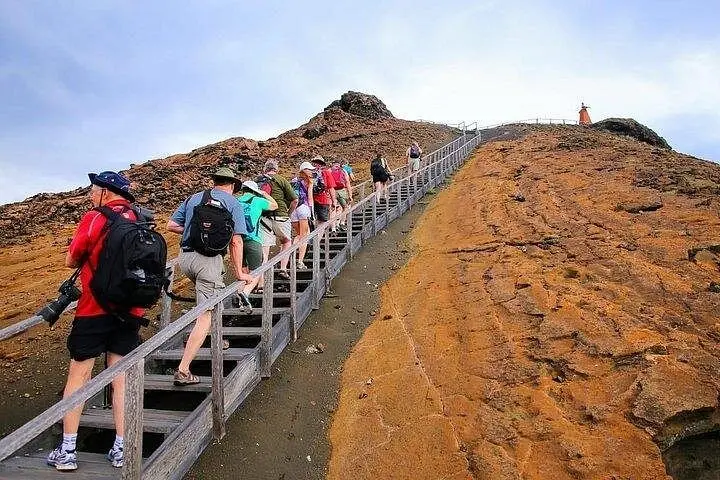
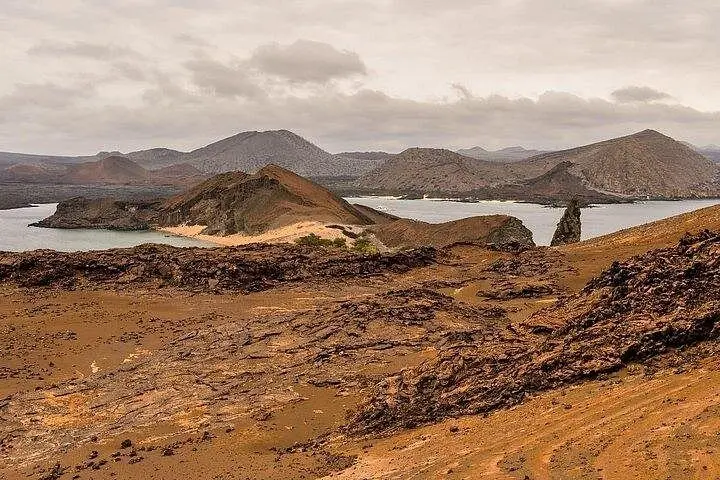
You step off the skiff onto a sliver of volcanic sand and the world rearranges its priorities: wind, salt, and a sharp black crust of lava that looks like it pushed up from the planet’s guts yesterday. On Bartolomé Island the trail climbs quickly—stairs cut into cinders and pumice—until the spit of land with Pinnacle Rock drops into view, a jagged lighthouse of hardened lava that dares the sea to move it.
Verified experiences and guided adventures in the surrounding area.
Operated by Perfect Destiny · Puerto Ayora, Galápagos
You step off the skiff onto a sliver of volcanic sand and the world rearranges its priorities: wind, salt, and a sharp black crust of lava that looks like it pushed up from the planet’s guts yesterday. On Bartolomé Island the trail climbs quickly—stairs cut into cinders and pumice—until the spit of land with Pinnacle Rock drops into view, a jagged lighthouse of hardened lava that dares the sea to move it.
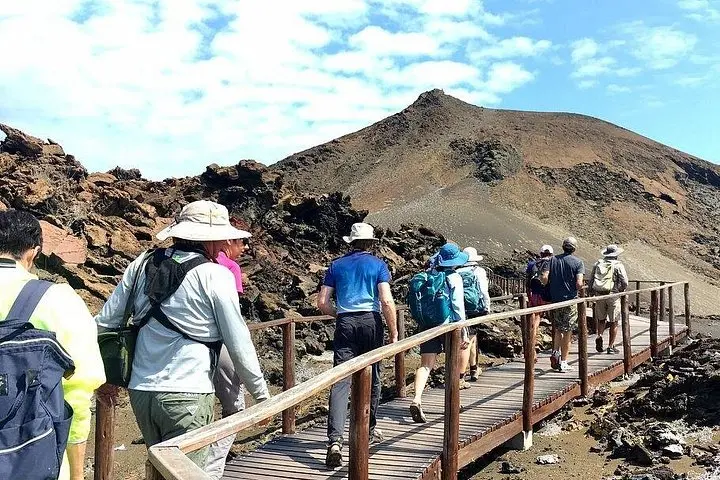
This full-day tour begins before most of Puerto Ayora stirs. A pre-dawn transfer crosses the Itabaca Channel and the yacht works its way northwest toward Bartolomé—two to three hours of ocean that the captain negotiates with a practiced eye on currents. At Bartolomé the main act is a short but steep hike to the summit viewpoint (roughly 360 steps; about 100–120 m elevation gain). From there the archipelago lays out: pitted lava fields, coral benches, and the frothy Pacific on two horizons.
Geology explains the scene. Bartolomé is one of the younger formations in the Galápagos, shaped by submarine eruptions and relentless surf that sculpt Pinnacle Rock. Sullivan Bay, on Santiago’s southeast flank, reads like a field notebook for recent volcanism—fresh pahoehoe lobes and ropy flows that have cooled into gray, ribbed plateaus.
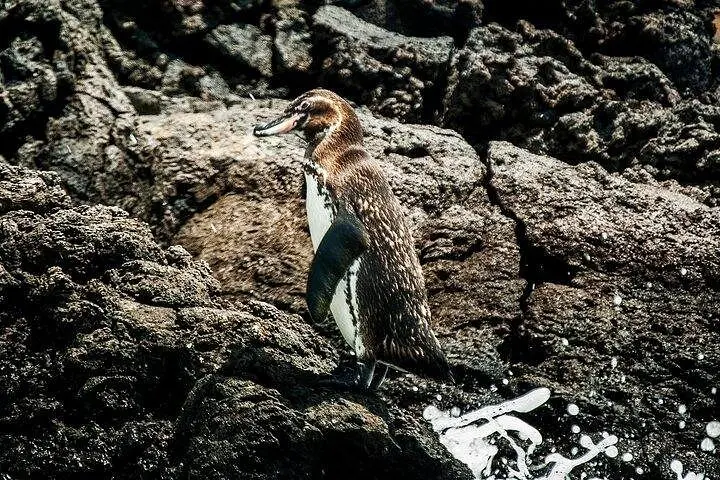
Wildlife is unflappable. Lava lizards skitter across the rocks like living punctuation marks; marine iguanas bask, black and bulbous, and sea lions lounge with the casual ownership of an island that has no predators. The human side of the story is short and careful: the Galápagos National Park regulates access, routes and behavior to protect these endemic species and fragile soils.
Practically, the day is a balance of motion and pauses. Expect a 2–3 hour boat ride each way in variable seas, an hour-long summit visit with steep steps, and a guided 45-minute snorkel at Sullivan Bay after lunch onboard. Bring a wetsuit or rent one locally: surface temps can dip and the upwelling keeps water brisk. Sun protection is non-negotiable—UV here is fierce—and shoes should handle loose volcanic rock.
Guides on these trips are part naturalist, part logistician: they time landings around swell, set snorkeling circuits where marine life congregates, and keep group sizes manageable. For photographers, the payoff is panoramic and immediate; for anyone who likes to be in motion, the hike is rewarding without being technical. The trip is suitable for most fitness levels but expect stairs, sun, and salt.
At day’s end the yacht returns to the Itabaca Channel. You come back with sand in your shoes, a throat full of sea air, and a clearer understanding of what the Galápagos feels like when it’s still shaping itself.
Expect 2–3 hours each way depending on currents and sea conditions; the operator times departures to minimize rough stretches.
No—wetsuits are not included. You can rent them in Puerto Ayora; bring one if you get cold in 20–24°C water.
The trail is steep with about 360 steps and an elevation gain near 100–120 m, but non-technical—suitable for most people in reasonable health.
Common sightings include marine iguanas, lava lizards, sea lions, and a variety of seabirds; snorkeling may reveal reef fish and sea turtles.
Yes—lunch is served on the yacht and vessels typically have restroom facilities for guests.
Yes, but children must be accompanied by an adult and be comfortable with boat travel and supervised snorkeling.
Perfect Destiny operates guided outdoor trips and adventures with an emphasis on safety, stewardship, and memorable experiences.
You step off the skiff onto a sliver of volcanic sand and the world rearranges its priorities: wind, salt, and a sharp black crust of lava that looks like it pushed up from the planet’s guts yesterday. On Bartolomé Island the trail climbs quickly—stairs cut into cinders and pumice—until the spit of land with Pinnacle Rock drops into view, a jagged lighthouse of hardened lava that dares the sea to move it.
You step off the skiff onto a sliver of volcanic sand and the world rearranges its priorities: wind, salt, and a sharp black crust of lava that looks like it pushed up from the planet’s guts yesterday. On Bartolomé Island the trail climbs quickly—stairs cut into cinders and pumice—until the spit of land with Pinnacle Rock drops into view, a jagged lighthouse of hardened lava that dares the sea to move it.
This full-day tour begins before most of Puerto Ayora stirs. A pre-dawn transfer crosses the Itabaca Channel and the yacht works its way northwest toward Bartolomé—two to three hours of ocean that the captain negotiates with a practiced eye on currents. At Bartolomé the main act is a short but steep hike to the summit viewpoint (roughly 360 steps; about 100–120 m elevation gain). From there the archipelago lays out: pitted lava fields, coral benches, and the frothy Pacific on two horizons.
Geology explains the scene. Bartolomé is one of the younger formations in the Galápagos, shaped by submarine eruptions and relentless surf that sculpt Pinnacle Rock. Sullivan Bay, on Santiago’s southeast flank, reads like a field notebook for recent volcanism—fresh pahoehoe lobes and ropy flows that have cooled into gray, ribbed plateaus.
Wildlife is unflappable. Lava lizards skitter across the rocks like living punctuation marks; marine iguanas bask, black and bulbous, and sea lions lounge with the casual ownership of an island that has no predators. The human side of the story is short and careful: the Galápagos National Park regulates access, routes and behavior to protect these endemic species and fragile soils.
Practically, the day is a balance of motion and pauses. Expect a 2–3 hour boat ride each way in variable seas, an hour-long summit visit with steep steps, and a guided 45-minute snorkel at Sullivan Bay after lunch onboard. Bring a wetsuit or rent one locally: surface temps can dip and the upwelling keeps water brisk. Sun protection is non-negotiable—UV here is fierce—and shoes should handle loose volcanic rock.
Guides on these trips are part naturalist, part logistician: they time landings around swell, set snorkeling circuits where marine life congregates, and keep group sizes manageable. For photographers, the payoff is panoramic and immediate; for anyone who likes to be in motion, the hike is rewarding without being technical. The trip is suitable for most fitness levels but expect stairs, sun, and salt.
At day’s end the yacht returns to the Itabaca Channel. You come back with sand in your shoes, a throat full of sea air, and a clearer understanding of what the Galápagos feels like when it’s still shaping itself.