THE ADVENTURE COLLECTIVE® · Independent discovery and booking for outdoor travel

Spend a full day discovering Egypt’s earliest monumental architecture: Djoser’s Step Pyramid at Saqqara, ancient Memphis, Dahshur’s bent and red pyramids, then the classic Giza plateau. This practical guide covers what to expect, how to prepare, and key on‑site tips.
Spend a full day discovering Egypt’s earliest monumental architecture: Djoser’s Step Pyramid at Saqqara, ancient Memphis, Dahshur’s bent and red pyramids, then the classic Giza plateau. This practical guide covers what to expect, how to prepare, and key on‑site tips.
A low sun spills across the desert as the driver eases the air‑conditioned van onto the dirt approach to Saqqara. Sand and limestone press close; stone stairs and weathered reliefs wait like pages turned slow. The morning light reveals the stepped silhouette of Djoser’s tomb — the world’s first monumental stone pyramid — and guides the group through narrow corridors where carved symbols still speak of gods and kings.
Verified experiences and guided adventures in the surrounding area.
Operated by gyneno Travel · Saqqara, Giza Governorate
A low sun spills across the desert as the driver eases the air‑conditioned van onto the dirt approach to Saqqara. Sand and limestone press close; stone stairs and weathered reliefs wait like pages turned slow. The morning light reveals the stepped silhouette of Djoser’s tomb — the world’s first monumental stone pyramid — and guides the group through narrow corridors where carved symbols still speak of gods and kings.
This full‑day loop threads together Egypt’s early capital at Memphis, the royal cemeteries at Saqqara and Dahshur, and the classic Giza plateau. Geology here is readable: soft Nile silt and local limestone that ancient builders quarried, and granite blocks transported upriver from Aswan. Culturally, the route charts the evolution from mastaba tombs to the smooth‑sided Great Pyramid; guides interpret hieroglyphs, funerary practices, and the politics that shaped pharaonic power.
Expect a balanced mix of outdoor walking, short climbs into shallow chambered tombs, and time beside massive, sun‑baked blocks. Practicalities matter: start early to avoid midday heat, carry a refillable water bottle, and wear sturdy shoes for uneven stone and loose sand. Admission is usually paid on site; a knowledgeable guide speeds lines and photographs while keeping the group moving.
Plan for 6–7 hours, moderate exertion, and dusty conditions — but also for remarkable close‑range views of monuments that changed how civilizations built memory into stone.
No — the tour description notes admission is not included; expect to pay on site for each archaeological area visited.
Specialized infant seats are available and children can join, but sites have uneven ground and short, steep passages that require supervision.
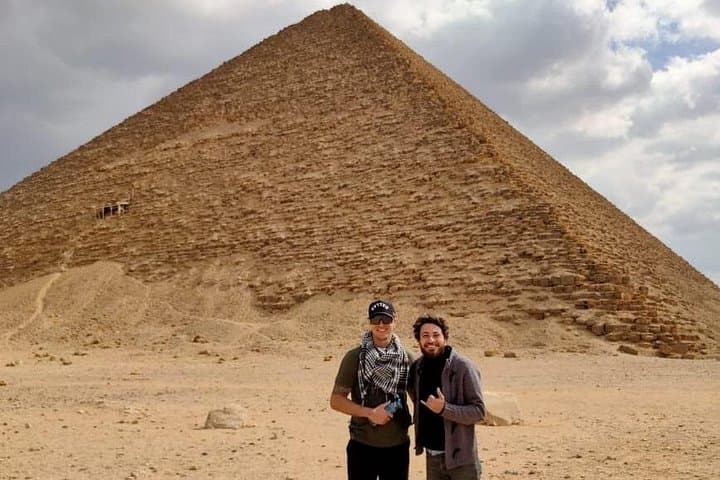
At Dahshur you may enter the Red Pyramid where access is permitted, but availability can vary and may involve tight, low passages.
Yes — private pickup in an air‑conditioned vehicle is typically provided; confirm your pickup point at booking.
gyneno Travel operates guided outdoor trips and adventures with an emphasis on safety, stewardship, and memorable experiences.


A low sun spills across the desert as the driver eases the air‑conditioned van onto the dirt approach to Saqqara. Sand and limestone press close; stone stairs and weathered reliefs wait like pages turned slow. The morning light reveals the stepped silhouette of Djoser’s tomb — the world’s first monumental stone pyramid — and guides the group through narrow corridors where carved symbols still speak of gods and kings.
A low sun spills across the desert as the driver eases the air‑conditioned van onto the dirt approach to Saqqara. Sand and limestone press close; stone stairs and weathered reliefs wait like pages turned slow. The morning light reveals the stepped silhouette of Djoser’s tomb — the world’s first monumental stone pyramid — and guides the group through narrow corridors where carved symbols still speak of gods and kings.
This full‑day loop threads together Egypt’s early capital at Memphis, the royal cemeteries at Saqqara and Dahshur, and the classic Giza plateau. Geology here is readable: soft Nile silt and local limestone that ancient builders quarried, and granite blocks transported upriver from Aswan. Culturally, the route charts the evolution from mastaba tombs to the smooth‑sided Great Pyramid; guides interpret hieroglyphs, funerary practices, and the politics that shaped pharaonic power.
Expect a balanced mix of outdoor walking, short climbs into shallow chambered tombs, and time beside massive, sun‑baked blocks. Practicalities matter: start early to avoid midday heat, carry a refillable water bottle, and wear sturdy shoes for uneven stone and loose sand. Admission is usually paid on site; a knowledgeable guide speeds lines and photographs while keeping the group moving.
Plan for 6–7 hours, moderate exertion, and dusty conditions — but also for remarkable close‑range views of monuments that changed how civilizations built memory into stone.