THE ADVENTURE COLLECTIVE® · Independent discovery and booking for outdoor travel

A full-day escape from Hanoi into the limestone heart of Ninh Binh: boat through low caves, cycle village lanes and climb 500 steps to Mua Cave for a sweeping view of Tam Coc’s rice fields. Practical, scenic and accessible for most travelers.
A full-day escape from Hanoi into the limestone heart of Ninh Binh: boat through low caves, cycle village lanes and climb 500 steps to Mua Cave for a sweeping view of Tam Coc’s rice fields. Practical, scenic and accessible for most travelers.
The bus eases out of Hanoi’s Old Quarter and the city noise thins into highway hum; after three hours you arrive where limestone towers jab out of rice flats and the river dares you to slow down. A local rower will guide the wooden boat through low caves and along mirror-still water, while karst cliffs lean close enough to feel their scale.
Verified experiences and guided adventures in the surrounding area.
Operated by Go Asia Travel · Tam Coc, Ninh Binh
The bus eases out of Hanoi’s Old Quarter and the city noise thins into highway hum; after three hours you arrive where limestone towers jab out of rice flats and the river dares you to slow down. A local rower will guide the wooden boat through low caves and along mirror-still water, while karst cliffs lean close enough to feel their scale.
This region was Vietnam’s first dynastic capital—Hoa Lu’s 10th–11th century temples are compact reminders of an early state centered on the Red River plain. Geologically the valley is classic tropical karst: soluble limestone sculpted into caves, cliffs and isolated peaks that channel rivers and frame the fields. The culture here is rural and tactile—rowers, farmers and temple caretakers shape a slow rhythm that contrasts with Hanoi’s rush.
Practical navigation of the day is straightforward: options let you choose Tam Coc or Trang An for boating, a short cycling loop through village lanes, and a steep 500-step climb to the Mua Cave viewpoint for a panoramic sweep of Tam Coc valley. Expect uneven steps, boat seating low to the water, and stretches in the sun.
Bring layered clothing, sun protection, and a daypack with water and snacks; carry small cash for optional entrance fees or coffee. Timing matters—arrive at the viewpoint before late afternoon for the best light, and allow flexibility during hotel pickups. The trip balances easy cultural sightseeing with short bursts of exertion and long, quiet moments on the river—precise, scenic, and accessible to most travelers.
Yes—small cash (VND) is useful for optional entrance fees, tips for rowers, or local snacks; major cards are not widely accepted in villages.
Tam Coc offers tighter cave passages and a classic rice-field panorama; Trang An routes are longer and include larger cave systems and more varied historical sites—both are scenic.
The climb is steep with roughly 500 uneven steps—it's short but intense; take breaks, wear good shoes, and descend carefully.
Yes—many parts are accessible to families and older travelers, though the Mua Cave climb may be skipped if mobility is limited; boats are rowed by locals and can be stable but sit low.
Go Asia Travel operates guided outdoor trips and adventures with an emphasis on safety, stewardship, and memorable experiences.



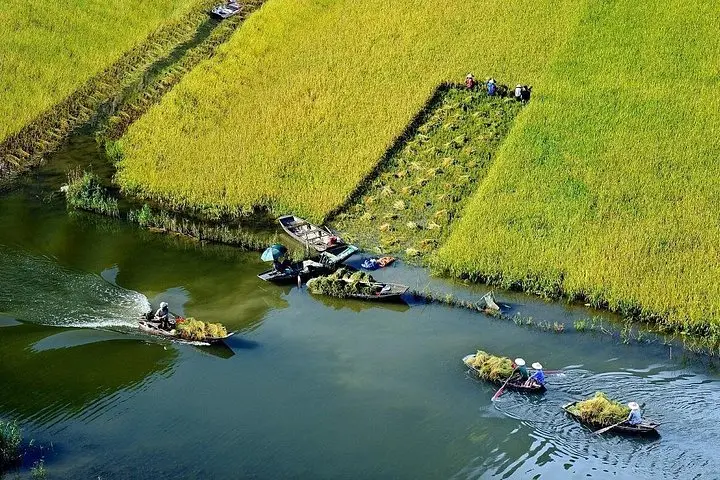
The bus eases out of Hanoi’s Old Quarter and the city noise thins into highway hum; after three hours you arrive where limestone towers jab out of rice flats and the river dares you to slow down. A local rower will guide the wooden boat through low caves and along mirror-still water, while karst cliffs lean close enough to feel their scale.
The bus eases out of Hanoi’s Old Quarter and the city noise thins into highway hum; after three hours you arrive where limestone towers jab out of rice flats and the river dares you to slow down. A local rower will guide the wooden boat through low caves and along mirror-still water, while karst cliffs lean close enough to feel their scale.
This region was Vietnam’s first dynastic capital—Hoa Lu’s 10th–11th century temples are compact reminders of an early state centered on the Red River plain. Geologically the valley is classic tropical karst: soluble limestone sculpted into caves, cliffs and isolated peaks that channel rivers and frame the fields. The culture here is rural and tactile—rowers, farmers and temple caretakers shape a slow rhythm that contrasts with Hanoi’s rush.
Practical navigation of the day is straightforward: options let you choose Tam Coc or Trang An for boating, a short cycling loop through village lanes, and a steep 500-step climb to the Mua Cave viewpoint for a panoramic sweep of Tam Coc valley. Expect uneven steps, boat seating low to the water, and stretches in the sun.
Bring layered clothing, sun protection, and a daypack with water and snacks; carry small cash for optional entrance fees or coffee. Timing matters—arrive at the viewpoint before late afternoon for the best light, and allow flexibility during hotel pickups. The trip balances easy cultural sightseeing with short bursts of exertion and long, quiet moments on the river—precise, scenic, and accessible to most travelers.