THE ADVENTURE COLLECTIVE® · Independent discovery and booking for outdoor travel

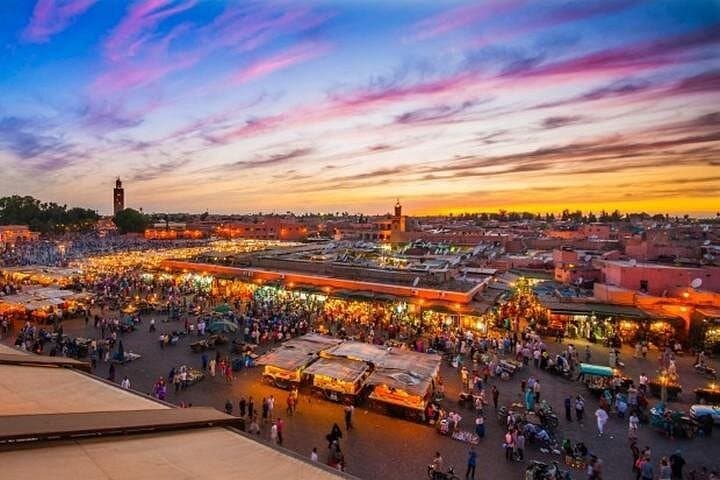
Spend a full day with a private guide exploring Marrakech’s medina, from the Koutoubia and Bahia Palace to the bustling Djemaa El Fnaa. This immersive tour blends history, culture, and practical city navigation for a single-day deep dive.
Spend a full day with a private guide exploring Marrakech’s medina, from the Koutoubia and Bahia Palace to the bustling Djemaa El Fnaa. This immersive tour blends history, culture, and practical city navigation for a single-day deep dive.
You step from a narrow riad courtyard into a burst of sun and sound — spice piles, vendors calling, and the minaret of the Koutoubia keeping a steady silhouette against a bright sky. A private guide steers you through alleyways where leather is dyed and copper sings under hammer blows; the city moves like a living map, full of quick turns and sudden views.
Verified experiences and guided adventures in the surrounding area.
Operated by Go Travel Morocco · Marrakech, Marrakech-Safi
You step from a narrow riad courtyard into a burst of sun and sound — spice piles, vendors calling, and the minaret of the Koutoubia keeping a steady silhouette against a bright sky. A private guide steers you through alleyways where leather is dyed and copper sings under hammer blows; the city moves like a living map, full of quick turns and sudden views.
Marrakech began as a strategic desert outpost in the 11th century under the Almoravids and grew into a cultural crossroads. The medina’s red-ochre walls are literal geology and history: quarried sandstone warmed by centuries of sunlight. Bahia Palace and Majorelle Garden show different faces of the city — ornate Saadian-era architecture and a 20th-century garden shaped by global collectors. Djemaa El Fnaa, the square, is both marketplace and performance stage, an evolving cultural practice where food, music, and storytelling converge.
On a practical level, expect 10–12 hours of walking with intermittent rests: narrow, uneven cobbles, occasional staircases, and shaded souk passages. Your guide handles bargaining and directions; you handle water, sun protection, and respect for local dress norms. Plan to move at the city’s tempo — slower in the heat, quick between sites.
Timing matters: mornings for cooler tombs and palaces, late afternoon for golden light in the gardens, and evening for the square’s transformation. Bring cash in small bills, comfortable shoes, and a light scarf for mosque visits or dusty lanes. With thoughtful pacing this private day turns a chaotic city into an accessible, richly textured adventure.
Most private tour packages do not include entrance fees by default—confirm with the operator and carry cash or card for tickets.
Yes; a professional private guide typically advises on local prices and can help negotiate at markets or point you to fixed-price shops.
Children are allowed but must be accompanied by an adult; consider shorter legs of the itinerary for younger kids due to long walking segments.
Many licensed guides speak French, English, and often Spanish or Italian; request language preferences at booking to ensure a match.
Go Travel Morocco operates guided outdoor trips and adventures with an emphasis on safety, stewardship, and memorable experiences.


You step from a narrow riad courtyard into a burst of sun and sound — spice piles, vendors calling, and the minaret of the Koutoubia keeping a steady silhouette against a bright sky. A private guide steers you through alleyways where leather is dyed and copper sings under hammer blows; the city moves like a living map, full of quick turns and sudden views.
You step from a narrow riad courtyard into a burst of sun and sound — spice piles, vendors calling, and the minaret of the Koutoubia keeping a steady silhouette against a bright sky. A private guide steers you through alleyways where leather is dyed and copper sings under hammer blows; the city moves like a living map, full of quick turns and sudden views.
Marrakech began as a strategic desert outpost in the 11th century under the Almoravids and grew into a cultural crossroads. The medina’s red-ochre walls are literal geology and history: quarried sandstone warmed by centuries of sunlight. Bahia Palace and Majorelle Garden show different faces of the city — ornate Saadian-era architecture and a 20th-century garden shaped by global collectors. Djemaa El Fnaa, the square, is both marketplace and performance stage, an evolving cultural practice where food, music, and storytelling converge.
On a practical level, expect 10–12 hours of walking with intermittent rests: narrow, uneven cobbles, occasional staircases, and shaded souk passages. Your guide handles bargaining and directions; you handle water, sun protection, and respect for local dress norms. Plan to move at the city’s tempo — slower in the heat, quick between sites.
Timing matters: mornings for cooler tombs and palaces, late afternoon for golden light in the gardens, and evening for the square’s transformation. Bring cash in small bills, comfortable shoes, and a light scarf for mosque visits or dusty lanes. With thoughtful pacing this private day turns a chaotic city into an accessible, richly textured adventure.