THE ADVENTURE COLLECTIVE® · Independent discovery and booking for outdoor travel

Spend a full day moving through Cappadocia’s sculpted valleys and cultural hubs—Pasabag’s fairy chimneys, Avanos pottery lanes, Zelve’s cave dwellings—on a small-group tour that pairs geology, craft and concise local history.
Spend a full day moving through Cappadocia’s sculpted valleys and cultural hubs—Pasabag’s fairy chimneys, Avanos pottery lanes, Zelve’s cave dwellings—on a small-group tour that pairs geology, craft and concise local history.
You step out of the minivan into a wind that seems to have its own agenda—one that nudges dust along the carved faces of rock and cools the first sips of your morning coffee. Around you, mushroom-shaped fairy chimneys crowd the horizon like an abandoned village of stone sentries. The guide folds a map and points to the route: first valleys, then pottery town, then monasteries carved into the soft volcanic tuff. For the next eight hours you move through landscapes shaped by fire and human hands.
Verified experiences and guided adventures in the surrounding area.
Operated by Turquesa Tours · Göreme, Nevşehir Province
You step out of the minivan into a wind that seems to have its own agenda—one that nudges dust along the carved faces of rock and cools the first sips of your morning coffee. Around you, mushroom-shaped fairy chimneys crowd the horizon like an abandoned village of stone sentries. The guide folds a map and points to the route: first valleys, then pottery town, then monasteries carved into the soft volcanic tuff. For the next eight hours you move through landscapes shaped by fire and human hands.
Cappadocia’s story starts millions of years ago when lava from Erciyes and Hasan volcanoes blanketed central Anatolia. The ash compacted into tuff, and millennia of wind and water sculpted the unusual cones and pillars that now host cave dwellings, churches, and hermit cells. Byzantine monks hollowed out sanctuaries here, while later Ottoman-era villages clustered along the Kızılırmak River—Avanos—where red clay pottery has been thrown on wheels for centuries.
The itinerary is compact but varied. Short walks (typically 0.5–2 km) through Pasabag’s clustered chimneys give way to the open riverfront lanes of Avanos, where a workshop demonstration explains how local clay becomes a red-brown pot. Zelve’s multi-tiered caves invite exploration: expect uneven stone steps, carved interiors, and photo angles that reveal both human scale and geology at once. You stop at a panoramic overlook for a sweep of Göreme’s chimneys and a chance to watch light shift across the valleys.
Practicalities are straightforward. This is a small-group tour (up to ~15 travelers) with hotel pickup and an included lunch, making logistics simple. Wear sturdy shoes—the paths are rocky and dusty—and bring at least 1.5–2 liters of water. Sun protection is non-negotiable in summer; in shoulder seasons bring a light layer for cool mornings and evenings. While a portion of the route is accessible, some cave interiors and viewpoint approaches have steps and uneven surfaces, so moderate fitness is required.
The tour balances cultural touchpoints—pottery, carpet weaving demonstrations and guide commentary—with the tactile joy of walking in a landscape that still reshapes itself. Photographers will want to time their day for soft light at the panorama stop, but every corner offers a frame: a monk cell cut into rose-colored stone, a potter’s hands spinning a vessel, the blue of sky against cream tuff.
For a first-time Cappadocia visit, this full-day North tour is efficient and immersive: it delivers geology, craft, and history in a single loop, while leaving you with a clear sense of the region’s scale and how people have carved a life out of volcanic rock.
Yes—hotel pickup and drop-off are included; the guide will meet you at your hotel reception roughly 15 minutes before departure.
Admission to specific sites listed in the itinerary (like Zelve and Pasabag) is typically included; your booking confirmation lists included admissions.
Expect multiple short walks of 0.5–2 km on uneven terrain with some short climbs and stairs into cave areas—moderate mobility required.
Strollers may be used for flat areas, but many sites have steps and rough ground; infants must sit on laps if traveling on this tour.
This tour is not recommended for travelers with poor cardiovascular health due to uneven terrain and the day’s length.
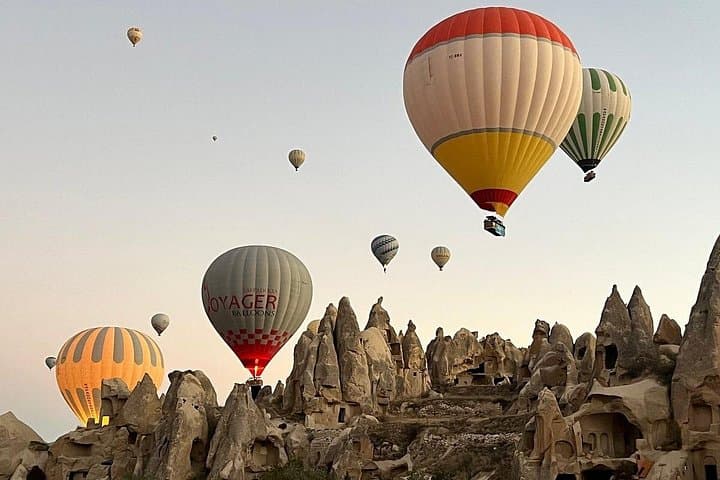
Balloon flights typically launch at sunrise and may be visible from viewpoints, but balloon rides are separate and not part of this full-day tour.
Turquesa Tours operates guided outdoor trips and adventures with an emphasis on safety, stewardship, and memorable experiences.


You step out of the minivan into a wind that seems to have its own agenda—one that nudges dust along the carved faces of rock and cools the first sips of your morning coffee. Around you, mushroom-shaped fairy chimneys crowd the horizon like an abandoned village of stone sentries. The guide folds a map and points to the route: first valleys, then pottery town, then monasteries carved into the soft volcanic tuff. For the next eight hours you move through landscapes shaped by fire and human hands.
You step out of the minivan into a wind that seems to have its own agenda—one that nudges dust along the carved faces of rock and cools the first sips of your morning coffee. Around you, mushroom-shaped fairy chimneys crowd the horizon like an abandoned village of stone sentries. The guide folds a map and points to the route: first valleys, then pottery town, then monasteries carved into the soft volcanic tuff. For the next eight hours you move through landscapes shaped by fire and human hands.
Cappadocia’s story starts millions of years ago when lava from Erciyes and Hasan volcanoes blanketed central Anatolia. The ash compacted into tuff, and millennia of wind and water sculpted the unusual cones and pillars that now host cave dwellings, churches, and hermit cells. Byzantine monks hollowed out sanctuaries here, while later Ottoman-era villages clustered along the Kızılırmak River—Avanos—where red clay pottery has been thrown on wheels for centuries.
The itinerary is compact but varied. Short walks (typically 0.5–2 km) through Pasabag’s clustered chimneys give way to the open riverfront lanes of Avanos, where a workshop demonstration explains how local clay becomes a red-brown pot. Zelve’s multi-tiered caves invite exploration: expect uneven stone steps, carved interiors, and photo angles that reveal both human scale and geology at once. You stop at a panoramic overlook for a sweep of Göreme’s chimneys and a chance to watch light shift across the valleys.
Practicalities are straightforward. This is a small-group tour (up to ~15 travelers) with hotel pickup and an included lunch, making logistics simple. Wear sturdy shoes—the paths are rocky and dusty—and bring at least 1.5–2 liters of water. Sun protection is non-negotiable in summer; in shoulder seasons bring a light layer for cool mornings and evenings. While a portion of the route is accessible, some cave interiors and viewpoint approaches have steps and uneven surfaces, so moderate fitness is required.
The tour balances cultural touchpoints—pottery, carpet weaving demonstrations and guide commentary—with the tactile joy of walking in a landscape that still reshapes itself. Photographers will want to time their day for soft light at the panorama stop, but every corner offers a frame: a monk cell cut into rose-colored stone, a potter’s hands spinning a vessel, the blue of sky against cream tuff.
For a first-time Cappadocia visit, this full-day North tour is efficient and immersive: it delivers geology, craft, and history in a single loop, while leaving you with a clear sense of the region’s scale and how people have carved a life out of volcanic rock.