THE ADVENTURE COLLECTIVE® · Independent discovery and booking for outdoor travel

Spend a long, rewarding day crossing Cambodia’s northern plains to visit Preah Vihear’s cliff-top galleries, Koh Ker’s pyramid complex, and the jungle-engulfed Beng Mealea. Expect long drives, uneven paths, and richly atmospheric ruins away from the main Angkor crowds.
Spend a long, rewarding day crossing Cambodia’s northern plains to visit Preah Vihear’s cliff-top galleries, Koh Ker’s pyramid complex, and the jungle-engulfed Beng Mealea. Expect long drives, uneven paths, and richly atmospheric ruins away from the main Angkor crowds.
The day begins before dawn in Siem Reap, the road unspooling north through rice paddies and roadside villages as your driver collects you for a 12-hour circuit of Cambodia’s quieter Angkor-era sites. By midmorning you’re at Preah Vihear, a cliff-top Hindu complex where stone terraces peer over the Thailand border and wind pushes through ruined galleries like a questioning hand.
Verified experiences and guided adventures in the surrounding area.
Operated by Asean Angkor Guide · Siem Reap, Siem Reap Province
The day begins before dawn in Siem Reap, the road unspooling north through rice paddies and roadside villages as your driver collects you for a 12-hour circuit of Cambodia’s quieter Angkor-era sites. By midmorning you’re at Preah Vihear, a cliff-top Hindu complex where stone terraces peer over the Thailand border and wind pushes through ruined galleries like a questioning hand.
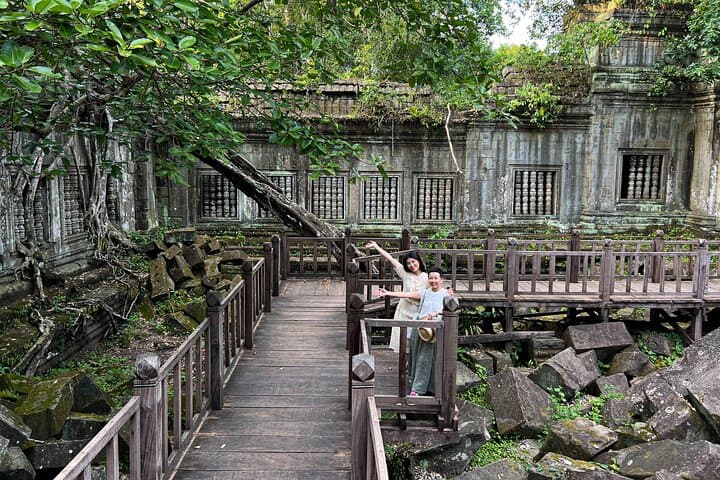
These sites trace the sweep of the Khmer Empire: Preah Vihear’s 11th–12th century construction clings to limestone escarpments; Koh Ker’s Prasat Thom is a rare pyramid form built during a short-lived 10th-century capital; Beng Mealea is a 12th-century monastery swallowed by forest, roots and vines threading through collapsed towers.
Geology and climate shaped everything here—sandstone blocks quarried and raised into axial temples, later softened by tropical growth and monsoon rains. Local culture remains present: roadside stalls serving rice and grilled fish, and communities that still maintain traditional craft skills.
Practical guidance: start very early, bring cash for site fees and lunches, and expect uneven stone, tree roots and damp moss at Beng Mealea. Footing is often steep and slippery; a short truck ride reduces the climb at Preah Vihear but walking on narrow ramps is required. Hydrate aggressively in the heat, pack insect repellent, and dress modestly—shoulders and knees covered—out of respect at religious sites. Timing matters: visit Preah Vihear in the morning light, and reserve late afternoon for Beng Mealea when shadows make the architecture most dramatic.
This operator typically does not include archaeological site entrance fees—confirm at booking and bring local currency to pay on arrival.
Expect long transfers: roughly 2–3 hours each way to northern temples and additional drives between sites; the full itinerary runs about 12 hours from hotel pickup to return.
Most walking is moderate—stone staircases, uneven paths and short uphill sections; vehicle transfers and an optional truck ride to Preah Vihear’s summit reduce strenuous walking.
Dry, cooler months (November–February) offer more comfortable walking and clearer views; avoid the peak rainy season if you want drier footing at jungle temples.
Asean Angkor Guide operates guided outdoor trips and adventures with an emphasis on safety, stewardship, and memorable experiences.


The day begins before dawn in Siem Reap, the road unspooling north through rice paddies and roadside villages as your driver collects you for a 12-hour circuit of Cambodia’s quieter Angkor-era sites. By midmorning you’re at Preah Vihear, a cliff-top Hindu complex where stone terraces peer over the Thailand border and wind pushes through ruined galleries like a questioning hand.
The day begins before dawn in Siem Reap, the road unspooling north through rice paddies and roadside villages as your driver collects you for a 12-hour circuit of Cambodia’s quieter Angkor-era sites. By midmorning you’re at Preah Vihear, a cliff-top Hindu complex where stone terraces peer over the Thailand border and wind pushes through ruined galleries like a questioning hand.
These sites trace the sweep of the Khmer Empire: Preah Vihear’s 11th–12th century construction clings to limestone escarpments; Koh Ker’s Prasat Thom is a rare pyramid form built during a short-lived 10th-century capital; Beng Mealea is a 12th-century monastery swallowed by forest, roots and vines threading through collapsed towers.
Geology and climate shaped everything here—sandstone blocks quarried and raised into axial temples, later softened by tropical growth and monsoon rains. Local culture remains present: roadside stalls serving rice and grilled fish, and communities that still maintain traditional craft skills.
Practical guidance: start very early, bring cash for site fees and lunches, and expect uneven stone, tree roots and damp moss at Beng Mealea. Footing is often steep and slippery; a short truck ride reduces the climb at Preah Vihear but walking on narrow ramps is required. Hydrate aggressively in the heat, pack insect repellent, and dress modestly—shoulders and knees covered—out of respect at religious sites. Timing matters: visit Preah Vihear in the morning light, and reserve late afternoon for Beng Mealea when shadows make the architecture most dramatic.