THE ADVENTURE COLLECTIVE® · Independent discovery and booking for outdoor travel

Spend a full day breaking trail in the Catalan Pyrenees: guided snowshoeing across alpine slopes with hands-on snow-shelter building and wildlife tracking. Ideal for winter hikers who want practical mountain safety skills plus panoramic high-country travel.
Spend a full day breaking trail in the Catalan Pyrenees: guided snowshoeing across alpine slopes with hands-on snow-shelter building and wildlife tracking. Ideal for winter hikers who want practical mountain safety skills plus panoramic high-country travel.
A crisp wind edges across the high ridges as you step off the narrow track and sink into fresh snow. The valley opens up: white slopes, scarred rock outcrops, and a scatter of animal tracks that pull you forward. Your guide points to a distant ridge where the sun skims a cornice; the mountains feel alive and watchful.
Verified experiences and guided adventures in the surrounding area.
A crisp wind edges across the high ridges as you step off the narrow track and sink into fresh snow. The valley opens up: white slopes, scarred rock outcrops, and a scatter of animal tracks that pull you forward. Your guide points to a distant ridge where the sun skims a cornice; the mountains feel alive and watchful.
The Catalan Pyrenees are an upland frontier carved by the Alpine orogeny and sculpted by glaciers; trails here follow old pastoral routes used for seasonal sheep migration and small hamlets where Catalan mountain culture still holds. Geological bands of limestone and shale create sudden cliffs that break wide basins, while Romanesque sanctuaries and shepherd stone huts mark human persistence at altitude.
On this full-day winter outing expect sustained, steady snowshoeing at roughly 1,500–2,200 m elevation with moderate climbs and packed-snow descents. The instructional portion teaches practical snow-shelter construction—digging a trench, shaping a roof, and using an avalanche probe and shovel—skills grounded in simple physics and local safety practice. You will follow animal tracks, scan for isards (Pyrenean chamois) and marmots, and learn how weather shifts the snowpack.
Practical tips: dress in layered synthetics, bring gaiters and insulated boots, and carry extra water—cold air dries you out faster than you think. Start early to take advantage of firmer morning snow and allow time for instruction, breaks, and a relaxed return before afternoon melt or wind increases. Guides usually provide group gear for shelter practice but confirm in advance if you need personal avalanche kit.
No—this trip is suitable for beginners with a reasonable fitness level; guides cover technique and will set a pace appropriate for the group.
Guides commonly carry group avalanche equipment for demonstration and safety; check with the operator if you need personal beacon or probe for your role in group procedures.
Expect sub-freezing temperatures at elevation; dress in breathable base layers, insulating mid-layers, a windproof/waterproof shell, and warm gloves and hat.
Routes are day-trip accessible from nearby mountain towns, but weather can slow access—guides carry communication gear and have evacuation plans coordinated with local services.
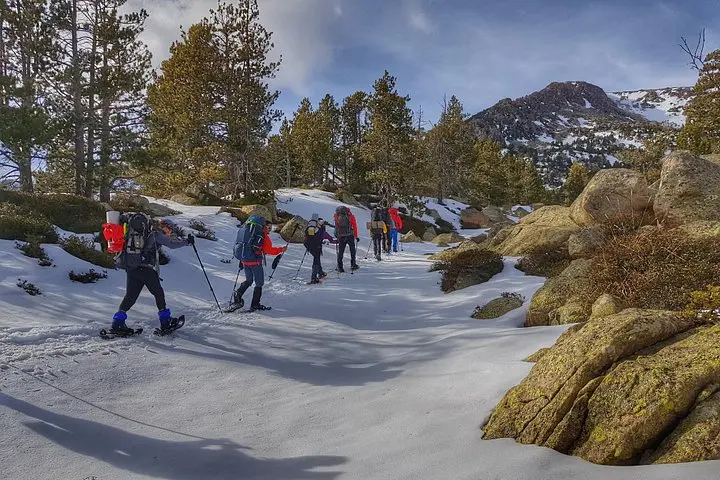
A crisp wind edges across the high ridges as you step off the narrow track and sink into fresh snow. The valley opens up: white slopes, scarred rock outcrops, and a scatter of animal tracks that pull you forward. Your guide points to a distant ridge where the sun skims a cornice; the mountains feel alive and watchful.
A crisp wind edges across the high ridges as you step off the narrow track and sink into fresh snow. The valley opens up: white slopes, scarred rock outcrops, and a scatter of animal tracks that pull you forward. Your guide points to a distant ridge where the sun skims a cornice; the mountains feel alive and watchful.
The Catalan Pyrenees are an upland frontier carved by the Alpine orogeny and sculpted by glaciers; trails here follow old pastoral routes used for seasonal sheep migration and small hamlets where Catalan mountain culture still holds. Geological bands of limestone and shale create sudden cliffs that break wide basins, while Romanesque sanctuaries and shepherd stone huts mark human persistence at altitude.
On this full-day winter outing expect sustained, steady snowshoeing at roughly 1,500–2,200 m elevation with moderate climbs and packed-snow descents. The instructional portion teaches practical snow-shelter construction—digging a trench, shaping a roof, and using an avalanche probe and shovel—skills grounded in simple physics and local safety practice. You will follow animal tracks, scan for isards (Pyrenean chamois) and marmots, and learn how weather shifts the snowpack.
Practical tips: dress in layered synthetics, bring gaiters and insulated boots, and carry extra water—cold air dries you out faster than you think. Start early to take advantage of firmer morning snow and allow time for instruction, breaks, and a relaxed return before afternoon melt or wind increases. Guides usually provide group gear for shelter practice but confirm in advance if you need personal avalanche kit.