THE ADVENTURE COLLECTIVE® · Independent discovery and booking for outdoor travel

A classic Annapurna foothills loop that trades terraced fields for rhododendron forests and sunrise above Annapurna and Dhaulagiri. This 6-night, 7-day trek links Pokhara with Ghorepani and Ghandruk and is suited to hikers with moderate fitness.
A classic Annapurna foothills loop that trades terraced fields for rhododendron forests and sunrise above Annapurna and Dhaulagiri. This 6-night, 7-day trek links Pokhara with Ghorepani and Ghandruk and is suited to hikers with moderate fitness.
A cool alpine wind pushes through rhododendron branches as you climb the stone steps out of Ulleri, breath clouding with each pulse of effort. Dawn on Poon Hill breaks across a rim of jagged white—Annapurna I and Dhaulagiri step into light while the valley below still holds night. This six-night, seven-day loop links Pokhara to Ghorepani and Ghandruk, trading lowland rice terraces for steep village stairways and wide Himalayan views.
Verified experiences and guided adventures in the surrounding area.
Operated by Himalayan Trekking Path (P). Ltd. · Pokhara, Gandaki Province
A cool alpine wind pushes through rhododendron branches as you climb the stone steps out of Ulleri, breath clouding with each pulse of effort. Dawn on Poon Hill breaks across a rim of jagged white—Annapurna I and Dhaulagiri step into light while the valley below still holds night. This six-night, seven-day loop links Pokhara to Ghorepani and Ghandruk, trading lowland rice terraces for steep village stairways and wide Himalayan views.
The trail follows centuries-old mule tracks threaded with Magar and Gurung settlements; these communities shaped the route as much as the mountains did. Geologically the Annapurna foothills are young, folded ranges of metamorphic rock, their steep faces and deep ravines formed by active uplift and monsoon-fed erosion. Culturally, Ghandruk is a living Gurung village with traditional homes, dress and a small cultural museum that explains local military service and agricultural cycles.
Practically, the itinerary keeps daily walking to 4–7 hours, topping out at Poon Hill (~3,210 m) and sleeping at teahouses in Ghorepani (2,874 m) and Ghandruk (1,860 m). Expect rocky, often stepped trails, occasional muddy patches after rain, and large elevation changes in short distances. Conditions change fast—sunny mornings can turn cold and windy by midday—so layer and time your summit for sunrise.
This trek is accessible to fit newcomers with steady footing and moderate fitness, but acclimatization and pace matter. Carry water, respect teahouse schedules, tip local guides, and leave no trace—these trails are livelihoods as well as routes to views.
Yes—trekkers must carry an Annapurna Conservation Area Permit (ACAP) and TIMS card; guides or operators typically arrange these before departure.
The route peaks near 3,210 m; while major altitude illness is uncommon, go slow, hydrate, and be prepared to descend if symptoms appear.
Simple shared rooms with mattress and blanket, shared toilets; hot showers are available in larger villages for a fee.
Peak seasons are spring (Mar–May) and fall (Sep–Nov) for stable weather and clear mountain views.
Himalayan Trekking Path (P). Ltd. operates guided outdoor trips and adventures with an emphasis on safety, stewardship, and memorable experiences.
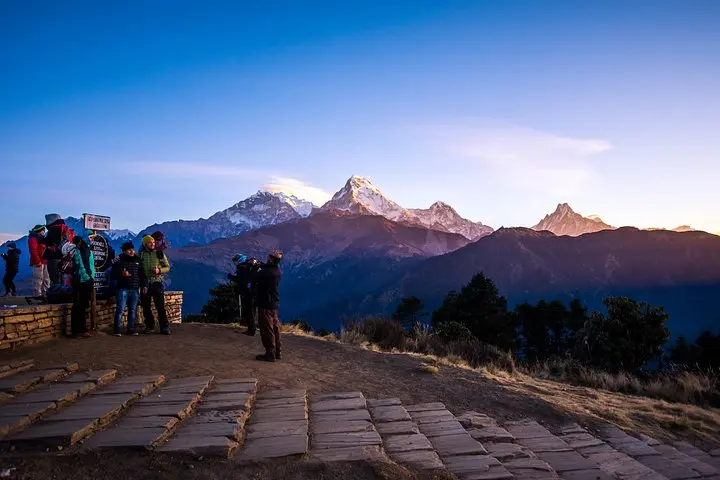
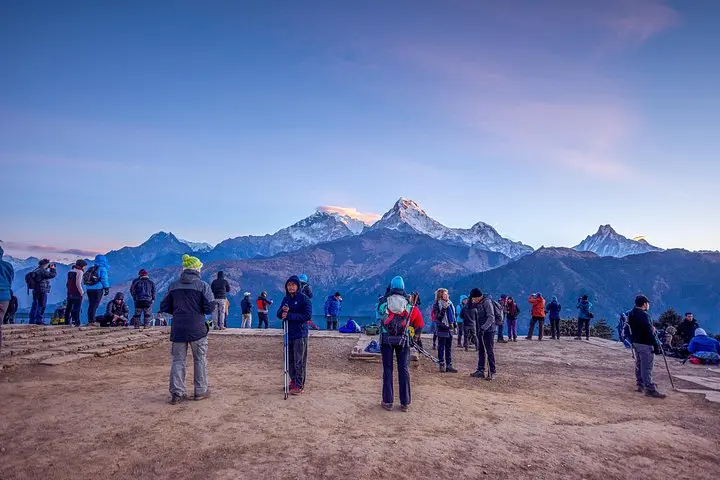
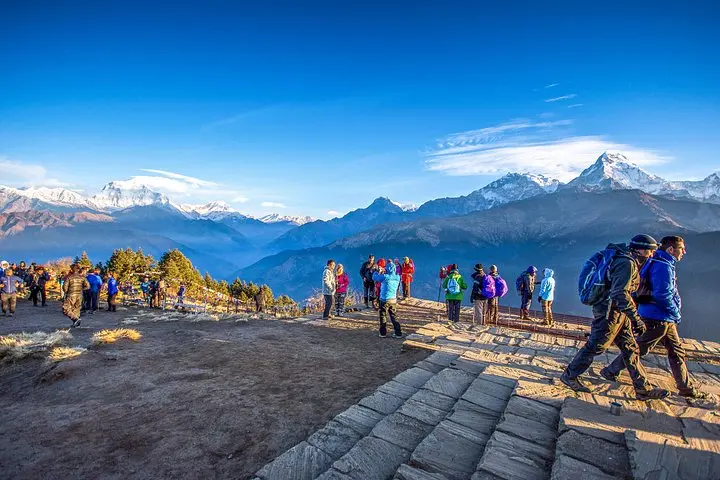
A cool alpine wind pushes through rhododendron branches as you climb the stone steps out of Ulleri, breath clouding with each pulse of effort. Dawn on Poon Hill breaks across a rim of jagged white—Annapurna I and Dhaulagiri step into light while the valley below still holds night. This six-night, seven-day loop links Pokhara to Ghorepani and Ghandruk, trading lowland rice terraces for steep village stairways and wide Himalayan views.
A cool alpine wind pushes through rhododendron branches as you climb the stone steps out of Ulleri, breath clouding with each pulse of effort. Dawn on Poon Hill breaks across a rim of jagged white—Annapurna I and Dhaulagiri step into light while the valley below still holds night. This six-night, seven-day loop links Pokhara to Ghorepani and Ghandruk, trading lowland rice terraces for steep village stairways and wide Himalayan views.
The trail follows centuries-old mule tracks threaded with Magar and Gurung settlements; these communities shaped the route as much as the mountains did. Geologically the Annapurna foothills are young, folded ranges of metamorphic rock, their steep faces and deep ravines formed by active uplift and monsoon-fed erosion. Culturally, Ghandruk is a living Gurung village with traditional homes, dress and a small cultural museum that explains local military service and agricultural cycles.
Practically, the itinerary keeps daily walking to 4–7 hours, topping out at Poon Hill (~3,210 m) and sleeping at teahouses in Ghorepani (2,874 m) and Ghandruk (1,860 m). Expect rocky, often stepped trails, occasional muddy patches after rain, and large elevation changes in short distances. Conditions change fast—sunny mornings can turn cold and windy by midday—so layer and time your summit for sunrise.
This trek is accessible to fit newcomers with steady footing and moderate fitness, but acclimatization and pace matter. Carry water, respect teahouse schedules, tip local guides, and leave no trace—these trails are livelihoods as well as routes to views.