THE ADVENTURE COLLECTIVE® · Independent discovery and booking for outdoor travel

Step out from Jackson Square into New Orleans after dark with the Ghostly Gallivant Tour—Saints and Sinners edition. Sixty-five to seventy-five minutes of history, folklore and atmospheric walks through the French Quarter, led by guides who balance archival fact with hair-raising lore.
Step out from Jackson Square into New Orleans after dark with the Ghostly Gallivant Tour—Saints and Sinners edition. Sixty-five to seventy-five minutes of history, folklore and atmospheric walks through the French Quarter, led by guides who balance archival fact with hair-raising lore.
Walk past the ironwork balconies and gaslamps as the afternoon slips into dusk and the city exhales—this is New Orleans after hours. The Ghostly Gallivant Tour: Saints and Sinners begins at the Cabildo, that low-slung stone building facing Jackson Square, and in seventy-five minutes it threads through the French Quarter’s narrow alleys and storied plazas. Guides move like conductors, cuing the city’s ghosts with an even voice and a map of notorious names: river pilots, voodoo queens, unscrupulous politicians and the unlucky who called this quarter home.
Verified experiences and guided adventures in the surrounding area.
Operated by Friends of the Cabildo · New Orleans, Louisiana
Walk past the ironwork balconies and gaslamps as the afternoon slips into dusk and the city exhales—this is New Orleans after hours. The Ghostly Gallivant Tour: Saints and Sinners begins at the Cabildo, that low-slung stone building facing Jackson Square, and in seventy-five minutes it threads through the French Quarter’s narrow alleys and storied plazas. Guides move like conductors, cuing the city’s ghosts with an even voice and a map of notorious names: river pilots, voodoo queens, unscrupulous politicians and the unlucky who called this quarter home.
The route reads like a compact social history. You’ll hear how the Cabildo served as the locus of civil authority during the Louisiana Purchase era, and why its rooms still feel like the city’s ledger—debts paid and fortunes lost. The French Quarter’s geology is simple: a low ridge of naturally higher ground along the river where settlers built to avoid swampy environs. That choice shaped commerce and class, and the narrow streets magnified drama. Cultural layers accumulate here visibly: Creole townhouses with wrought-iron galleries, Spanish repairs after fires, and shop signs in both English and French—an architectural record of conquest, commerce and Carnival.
Guides balance folklore and fact. Expect primary documents—court cases, ship manifests, burial records—woven with oral lore about saints who saved neighborhoods and sinners whose names linger on plaques and in whispered stories. The experience is civic theater rather than cheap shock: lights, lanterns and the city’s ambient sounds—the river, a distant call of a bar piano—become players. Nature is present in small ways; humidity presses against your jacket and the Mississippi often seems to be pushing the night forward.
Practical notes: the tour meets at the Cabildo on specified October evenings with departures every 20 minutes between 5:00 and 8:00 PM. It’s wheelchair and stroller accessible and suitable for most fitness levels, but the route is urban walking—expect pavement, cobbles and brief standing. Wear steady shoes and bring a charged phone for maps and photos. The tour includes bottled water and light refreshments; obey posted signs and private-property boundaries. Tickets are mobile-only and final sale, so confirm dates and times before you arrive.
For travelers: pair the walk with a late dinner in the Quarter or a jazz set on Frenchmen Street to compare the city’s living cultures with its spectral past. Whether you’re here for history, architecture or a brush with the uncanny, the Ghostly Gallivant Tour holds the Quarter to account—revealing who was celebrated, who was erased, and why the city still tells both stories when the lights go down.
The tour runs approximately 75 minutes, with departures every 20 minutes between 5:00 PM and 8:00 PM on listed dates.
Meet at The Cabildo on Jackson Square—guides will assemble groups near the main entrance facing the square.
Yes; the tour is family-friendly though some stories can be intense—use discretion for young children.
Yes. The itinerary and surfaces are wheelchair accessible, but contact operators in advance to confirm accommodations.
All sales are final; no refunds. Tours may be canceled for severe weather—check communications from the operator before arrival.
Light refreshments, bottled water and soda are included during the experience.
Friends of the Cabildo operates guided outdoor trips and adventures with an emphasis on safety, stewardship, and memorable experiences.


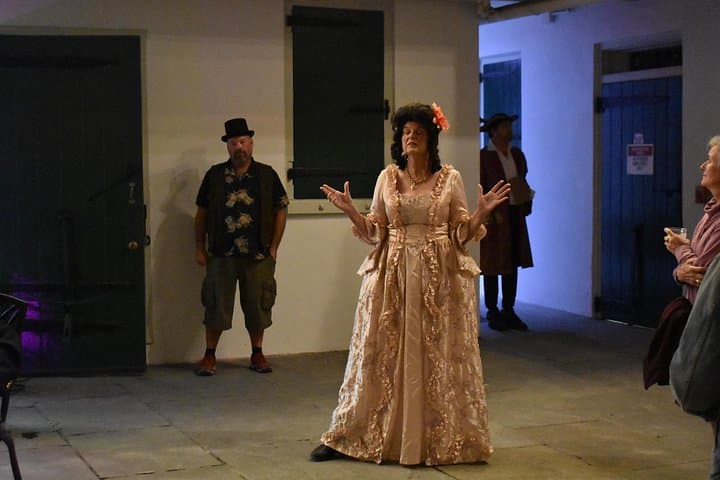
Walk past the ironwork balconies and gaslamps as the afternoon slips into dusk and the city exhales—this is New Orleans after hours. The Ghostly Gallivant Tour: Saints and Sinners begins at the Cabildo, that low-slung stone building facing Jackson Square, and in seventy-five minutes it threads through the French Quarter’s narrow alleys and storied plazas. Guides move like conductors, cuing the city’s ghosts with an even voice and a map of notorious names: river pilots, voodoo queens, unscrupulous politicians and the unlucky who called this quarter home.
Walk past the ironwork balconies and gaslamps as the afternoon slips into dusk and the city exhales—this is New Orleans after hours. The Ghostly Gallivant Tour: Saints and Sinners begins at the Cabildo, that low-slung stone building facing Jackson Square, and in seventy-five minutes it threads through the French Quarter’s narrow alleys and storied plazas. Guides move like conductors, cuing the city’s ghosts with an even voice and a map of notorious names: river pilots, voodoo queens, unscrupulous politicians and the unlucky who called this quarter home.
The route reads like a compact social history. You’ll hear how the Cabildo served as the locus of civil authority during the Louisiana Purchase era, and why its rooms still feel like the city’s ledger—debts paid and fortunes lost. The French Quarter’s geology is simple: a low ridge of naturally higher ground along the river where settlers built to avoid swampy environs. That choice shaped commerce and class, and the narrow streets magnified drama. Cultural layers accumulate here visibly: Creole townhouses with wrought-iron galleries, Spanish repairs after fires, and shop signs in both English and French—an architectural record of conquest, commerce and Carnival.
Guides balance folklore and fact. Expect primary documents—court cases, ship manifests, burial records—woven with oral lore about saints who saved neighborhoods and sinners whose names linger on plaques and in whispered stories. The experience is civic theater rather than cheap shock: lights, lanterns and the city’s ambient sounds—the river, a distant call of a bar piano—become players. Nature is present in small ways; humidity presses against your jacket and the Mississippi often seems to be pushing the night forward.
Practical notes: the tour meets at the Cabildo on specified October evenings with departures every 20 minutes between 5:00 and 8:00 PM. It’s wheelchair and stroller accessible and suitable for most fitness levels, but the route is urban walking—expect pavement, cobbles and brief standing. Wear steady shoes and bring a charged phone for maps and photos. The tour includes bottled water and light refreshments; obey posted signs and private-property boundaries. Tickets are mobile-only and final sale, so confirm dates and times before you arrive.
For travelers: pair the walk with a late dinner in the Quarter or a jazz set on Frenchmen Street to compare the city’s living cultures with its spectral past. Whether you’re here for history, architecture or a brush with the uncanny, the Ghostly Gallivant Tour holds the Quarter to account—revealing who was celebrated, who was erased, and why the city still tells both stories when the lights go down.