THE ADVENTURE COLLECTIVE® · Independent discovery and booking for outdoor travel

Spend a full day exploring Egypt’s monumental necropolises — Giza’s pyramids and Sphinx, Saqqara’s Step Pyramid, the open-air ruins of Memphis, and Dahshur’s Red and Bent Pyramids. This guided tour blends on-site history with practical logistics, camel rides, and hotel pickup.
Spend a full day exploring Egypt’s monumental necropolises — Giza’s pyramids and Sphinx, Saqqara’s Step Pyramid, the open-air ruins of Memphis, and Dahshur’s Red and Bent Pyramids. This guided tour blends on-site history with practical logistics, camel rides, and hotel pickup.
You step off the Cairo curb and the city’s noise thins to wind and stone — the Giza Plateau opens like a page of living history, the Great Pyramid rising as a steady, human-made cliff. Camels stand, patient as time; local guides move between tourists and antiquities with practiced ease.
Verified experiences and guided adventures in the surrounding area.
You step off the Cairo curb and the city’s noise thins to wind and stone — the Giza Plateau opens like a page of living history, the Great Pyramid rising as a steady, human-made cliff. Camels stand, patient as time; local guides move between tourists and antiquities with practiced ease.
This full-day route threads four epochs of ancient Egypt: Giza’s Old Kingdom giants, Saqqara’s Step Pyramid — Imhotep’s milestone in monumental architecture — the open-air remnants of Memphis, once the nation’s capital, and Dahshur’s experimental Bent and Red Pyramids where builders tested angles and engineering. Geologically, you’ll notice pale limestone quarried for centuries and the plateau’s sharp contrast to the Nile floodplain below.
Culturally the sites retain village rhythms: bedouin camel handlers, vendors selling papyrus prints, and guards guiding respectful photography. Conservation work is visible — scaffolding and fenced chambers — a reminder of fragile surfaces and ongoing restoration.
Practically: this is a long, mostly flat day with uneven stone steps, sandy paths and short climbs into tomb thresholds. Expect about nine hours with hotel pickup, admissions and lunch included. Bring sun protection, sturdy shoes, and a full water bottle; if you plan to enter inner chambers, check size and mobility restrictions ahead of time. Camel rides are brief and managed by handlers; they’re scenic but jostling.
Timing matters — early light softens the limestone and reduces heat. Move with patience, and you’ll leave with an informed view of how ancient builders shaped a landscape that continues to direct the gaze of the world.
Not always—access to inner chambers is limited, subject to additional fees and time; confirm with the operator before booking.
Short, guided camel rides are common but can be jostling; discuss mobility or back issues with your guide and opt out if unsure.
Yes—the itinerary covers Giza, Saqqara, Memphis and Dahshur, but time at each site is limited; expect highlights rather than deep dives.
Photography rules vary by site and room—flash and tripods are often restricted to protect pigments; follow posted signs and staff instructions.
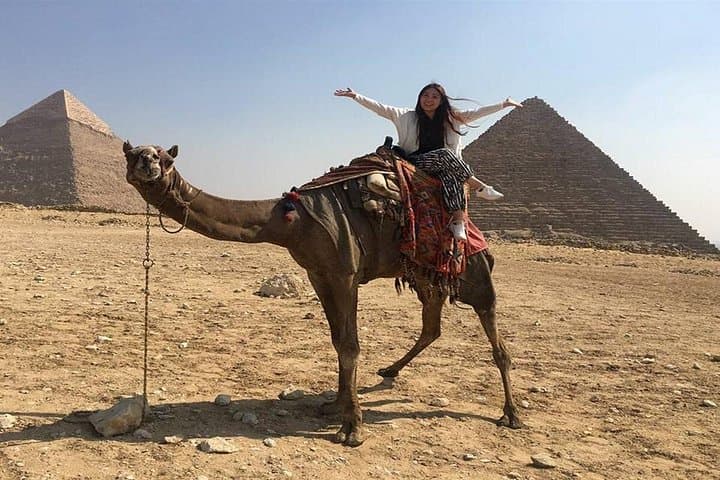
You step off the Cairo curb and the city’s noise thins to wind and stone — the Giza Plateau opens like a page of living history, the Great Pyramid rising as a steady, human-made cliff. Camels stand, patient as time; local guides move between tourists and antiquities with practiced ease.
You step off the Cairo curb and the city’s noise thins to wind and stone — the Giza Plateau opens like a page of living history, the Great Pyramid rising as a steady, human-made cliff. Camels stand, patient as time; local guides move between tourists and antiquities with practiced ease.
This full-day route threads four epochs of ancient Egypt: Giza’s Old Kingdom giants, Saqqara’s Step Pyramid — Imhotep’s milestone in monumental architecture — the open-air remnants of Memphis, once the nation’s capital, and Dahshur’s experimental Bent and Red Pyramids where builders tested angles and engineering. Geologically, you’ll notice pale limestone quarried for centuries and the plateau’s sharp contrast to the Nile floodplain below.
Culturally the sites retain village rhythms: bedouin camel handlers, vendors selling papyrus prints, and guards guiding respectful photography. Conservation work is visible — scaffolding and fenced chambers — a reminder of fragile surfaces and ongoing restoration.
Practically: this is a long, mostly flat day with uneven stone steps, sandy paths and short climbs into tomb thresholds. Expect about nine hours with hotel pickup, admissions and lunch included. Bring sun protection, sturdy shoes, and a full water bottle; if you plan to enter inner chambers, check size and mobility restrictions ahead of time. Camel rides are brief and managed by handlers; they’re scenic but jostling.
Timing matters — early light softens the limestone and reduces heat. Move with patience, and you’ll leave with an informed view of how ancient builders shaped a landscape that continues to direct the gaze of the world.