THE ADVENTURE COLLECTIVE® · Independent discovery and booking for outdoor travel

A seven‑hour private drive from Baku takes you to Gobustan's ancient petroglyphs, active mud volcanoes, the Ateshgah Fire Temple and Yanar Dag’s perpetual flame—an elemental day trip that pairs geology with centuries of culture.
A seven‑hour private drive from Baku takes you to Gobustan's ancient petroglyphs, active mud volcanoes, the Ateshgah Fire Temple and Yanar Dag’s perpetual flame—an elemental day trip that pairs geology with centuries of culture.
You pull away from Baku just after sunrise, the city shrinking into a ribbon of glass and concrete while the Absheron peninsula opens into scrub, salt flats and the low, wind-polished hills of Gobustan. The road hums under an air-conditioned car and a guide's voice sketches what you'll see—stone panels that have watched humans for millennia, mud domes bubbling like a slow earth heartbeat, and a slope of flame that refuses to be extinguished.
Verified experiences and guided adventures in the surrounding area.
Operated by Eagle Travel · Baku, Absheron District
You pull away from Baku just after sunrise, the city shrinking into a ribbon of glass and concrete while the Absheron peninsula opens into scrub, salt flats and the low, wind-polished hills of Gobustan. The road hums under an air-conditioned car and a guide's voice sketches what you'll see—stone panels that have watched humans for millennia, mud domes bubbling like a slow earth heartbeat, and a slope of flame that refuses to be extinguished.
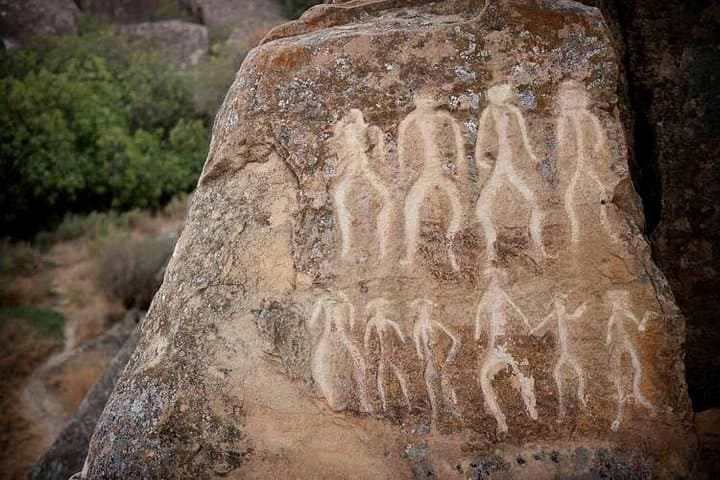
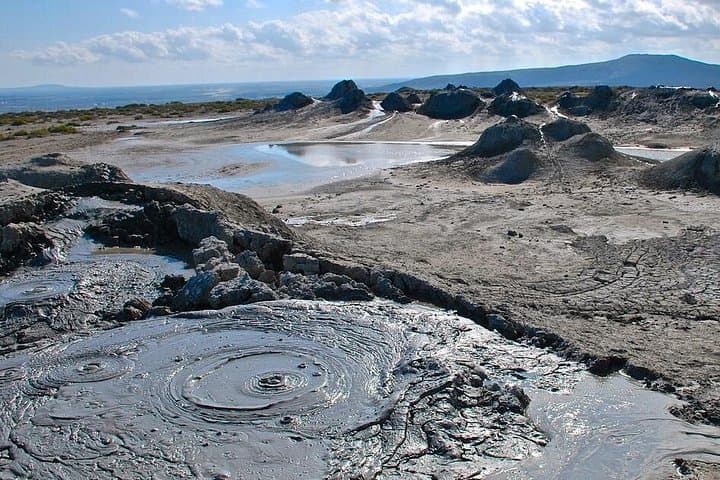
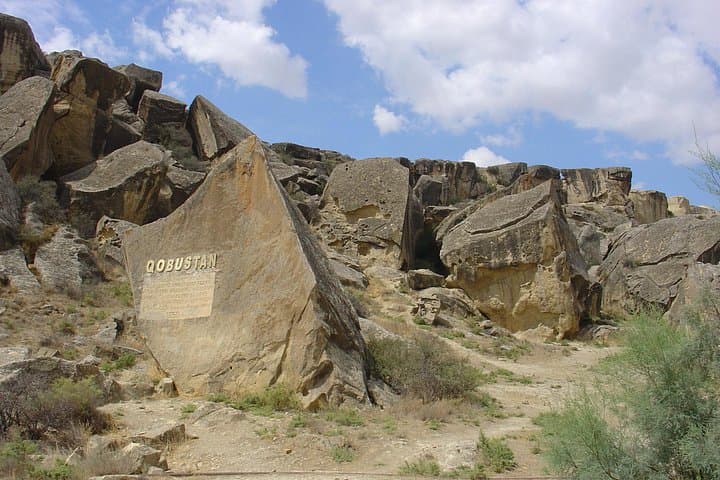
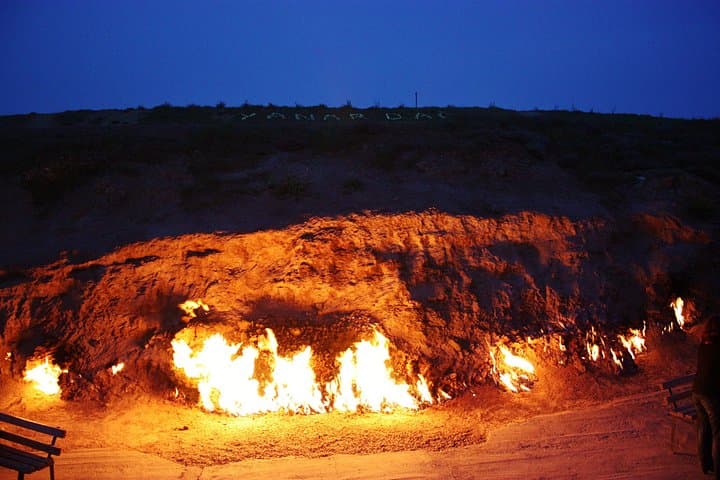
Gobustan's rock art is the backbone of this route. The petroglyphs here record fishing scenes, hunting parties and strangely geometrical signs dating back at least 5,000 years; panels were repeatedly reworked, so the surface reads like a field journal of changing lives. Geology arrives on schedule: Azerbaijan's subterranean hydrocarbons force gas and mud to the surface, creating the bubbling fields you'll approach at the mud volcanoes and feeding the ever-burning Yanar Dag. The Ateshgah Fire Temple on Absheron gives the landscape a cultural undertow—an 18th–19th century pilgrimage site reflecting Zoroastrian and Hindu practices tied to this region's sacred fires.
The tour blends culture and geology with straightforward logistics. Expect roughly seven hours door-to-door from central Baku, with 45–75 minutes of driving between major stops depending on traffic. Terrain is easy driving, followed by short on-foot segments: a 1–2 km loop at Gobustan over uneven, rocky ground with small climbs to viewing ledges; 200–500m walks at most mud volcano sites across soft, sometimes muddy surfaces; and a stepped approach to the Yanar Dag viewpoint and Ateshgah courtyard. Elevation remains low—near sea level—so acclimatization isn't a factor, but sun and wind are.
Practical notes: bring sturdy walking shoes with good traction and a sun hat; carry at least 1–1.5 liters of water per person for the day. Museum and temple fees are typically included for the private option but carry some cash for small purchases. Dress respectfully for the Fire Temple—shoulders covered and no offensive shirt slogans. Mobility: vehicles are comfortable and accessible, but petroglyph panels and mud volcano bases require negotiating uneven ground; plan accordingly.
Why go? This is a compact crash course in Azerbaijan's elemental forces and ancient human responses to them: rock carvings that narrate survival, mud cones that illustrate an active planet, and a flame that anchors ritual and identity. For travelers who want a single-day synthesis of landscape, history and culture outside Baku, this private tour is efficient, vivid and surprisingly elemental.
The private tour lasts about seven hours door‑to‑door from Baku and typically includes private air‑conditioned transport, a guide, and admission fees for the private option—confirm specifics when booking.
Museum and temple fees are often included with private bookings, but check your voucher; if not, have small cash available for entry at certain sites.
Vehicles are accessible, but access to petroglyph panels and some mud volcano viewing areas involves uneven ground and steps, which can limit full wheelchair access.
There are basic restroom facilities and simple cafes near the main tourist stops, but options are limited—plan accordingly for dietary needs.
Yes—photography is welcome at most sites, but avoid flash on some museum exhibits and be respectful at the Fire Temple; tripods may be restricted in confined spaces.
Yes—this is family‑friendly, though parents should supervise children near mud volcanoes and on rocky trails; infant seats are available on request.
Eagle Travel operates guided outdoor trips and adventures with an emphasis on safety, stewardship, and memorable experiences.
You pull away from Baku just after sunrise, the city shrinking into a ribbon of glass and concrete while the Absheron peninsula opens into scrub, salt flats and the low, wind-polished hills of Gobustan. The road hums under an air-conditioned car and a guide's voice sketches what you'll see—stone panels that have watched humans for millennia, mud domes bubbling like a slow earth heartbeat, and a slope of flame that refuses to be extinguished.
You pull away from Baku just after sunrise, the city shrinking into a ribbon of glass and concrete while the Absheron peninsula opens into scrub, salt flats and the low, wind-polished hills of Gobustan. The road hums under an air-conditioned car and a guide's voice sketches what you'll see—stone panels that have watched humans for millennia, mud domes bubbling like a slow earth heartbeat, and a slope of flame that refuses to be extinguished.
Gobustan's rock art is the backbone of this route. The petroglyphs here record fishing scenes, hunting parties and strangely geometrical signs dating back at least 5,000 years; panels were repeatedly reworked, so the surface reads like a field journal of changing lives. Geology arrives on schedule: Azerbaijan's subterranean hydrocarbons force gas and mud to the surface, creating the bubbling fields you'll approach at the mud volcanoes and feeding the ever-burning Yanar Dag. The Ateshgah Fire Temple on Absheron gives the landscape a cultural undertow—an 18th–19th century pilgrimage site reflecting Zoroastrian and Hindu practices tied to this region's sacred fires.
The tour blends culture and geology with straightforward logistics. Expect roughly seven hours door-to-door from central Baku, with 45–75 minutes of driving between major stops depending on traffic. Terrain is easy driving, followed by short on-foot segments: a 1–2 km loop at Gobustan over uneven, rocky ground with small climbs to viewing ledges; 200–500m walks at most mud volcano sites across soft, sometimes muddy surfaces; and a stepped approach to the Yanar Dag viewpoint and Ateshgah courtyard. Elevation remains low—near sea level—so acclimatization isn't a factor, but sun and wind are.
Practical notes: bring sturdy walking shoes with good traction and a sun hat; carry at least 1–1.5 liters of water per person for the day. Museum and temple fees are typically included for the private option but carry some cash for small purchases. Dress respectfully for the Fire Temple—shoulders covered and no offensive shirt slogans. Mobility: vehicles are comfortable and accessible, but petroglyph panels and mud volcano bases require negotiating uneven ground; plan accordingly.
Why go? This is a compact crash course in Azerbaijan's elemental forces and ancient human responses to them: rock carvings that narrate survival, mud cones that illustrate an active planet, and a flame that anchors ritual and identity. For travelers who want a single-day synthesis of landscape, history and culture outside Baku, this private tour is efficient, vivid and surprisingly elemental.